

The Shift Toward Wellness Infrastructure in Gifting
As we approach Mother’s Day 2026, a significant shift in consumer behavior has emerged. Traditional gifts—while cherished—are increasingly being replaced by what we term "wellness infrastructure." This category represents investments in the recipient's daily physical health, particularly for the millions of mothers navigating the complexities of remote work or long hours in a home office.
The question is no longer whether a gift is beautiful, but whether it fundamentally improves the recipient's quality of life. For a mother spending 40 or more hours a week at a desk, the most profound gesture of care is the mitigation of physical strain. A height-adjustable standing desk is not merely a piece of furniture; it is a tool for physiological regulation.
The Physiological Cost of the Static Workday
The human body is not designed for the "static load" associated with modern office work. When we sit for prolonged periods, several physiological systems begin to experience decline. According to the ISO 11226:2000 standard for the evaluation of static working postures, maintaining fixed positions leads to localized muscle fatigue and increased pressure on intervertebral discs.
Musculoskeletal Disorders (MSDs) and Spinal Neutrality
The primary concern in any home office is the prevention of Musculoskeletal Disorders. These conditions often manifest as a dull ache in the lumbar region or a sharp tension in the trapezius muscles. This occurs when the spine is forced out of its "neutral position"—the natural S-curve that minimizes stress on the skeletal structure.
In a seated position, the pelvis often tilts posteriorly, flattening the lumbar curve and increasing intradiscal pressure by up to 40% compared to standing. Over years of remote work, this leads to chronic back pain and reduced mobility.
The Circulation Factor
Prolonged sitting also impacts blood circulation. The "muscle pump" in the calves, which assists in returning blood from the lower extremities to the heart, remains inactive. This can lead to edema (swelling) and, in more severe cases, contributes to circulatory issues. While recent research, such as the 2024 study published in ScienceDaily, suggests that standing alone is not a substitute for cardiovascular exercise, the primary benefit of a standing desk lies in its ability to facilitate "postural variation"—the frequent switching of positions that keeps the musculoskeletal system engaged.
Why the Standing Desk is the Logical Solution
Leading the transition from a static to a dynamic workspace requires equipment that can adapt to the user’s specific anthropometric needs. This is where professional-grade solutions like the Opal Executive Standing Desk (66"x29") become essential.

Unlike fixed desks, height-adjustable models allow the user to align the work surface with their elbows, ensuring a 90-to-110 degree angle that prevents shoulder elevation. This alignment is critical for reducing strain on the upper back and neck.
Logic Summary: Our recommendation for standing desks as a wellness gift is based on the "Engineering Controls" model defined by OSHA's Ergonomics Solutions. Changing the physical environment (the desk) is a more effective intervention than simply reminding a user to "sit up straight" (an administrative control).
Deep Dive: The Petite Mother Scenario
A common oversight in office design is the "one size fits most" fallacy. Most standard desks are manufactured at a fixed height of 29 inches. However, our scenario modeling for petite users (specifically women in the 5th percentile, approximately 155cm or 5'1") reveals a significant ergonomic mismatch.
The 3.8-Inch Gap
For a woman of this stature, a 29-inch desk is roughly 3.8 inches too high for comfortable seated work. This forces the user to either raise their chair (leaving their feet dangling and cutting off circulation) or shrug their shoulders to reach the keyboard.
| Parameter | Value (Petite User: 155cm) | Unit | Rationale |
|---|---|---|---|
| Recommended Seat Height | ~41 | cm | Based on popliteal height |
| Recommended Sit Desk Height | ~64 | cm | Elbow height minus 2cm buffer |
| Recommended Stand Desk Height | ~93 | cm | Elbow height at 90 degrees |
| Standard Desk Height | 74 (29") | cm | Industry average |
| Ergonomic Mismatch | ~10 (3.8") | cm | The "Strain Gap" |
Note: Estimates based on ANSI/HFES 100-2007 anthropometric ratios. Individual proportions may vary.
By gifting a desk like the Ark EX Executive Standing Desk (60"x26"), you provide the ability to lower the surface to the exact 64cm required for seated work, effectively closing the "strain gap" that causes chronic neck and shoulder tension.

Quantifying the Health ROI
Beyond immediate comfort, the long-term health benefits of a sit-stand routine are quantifiable. While standing is not "exercise" in the traditional sense, it significantly alters the body's metabolic state.
Metabolic Impact and Fat Loss
Using a 2:1 sit-stand ratio (sitting for two hours, standing for one), a user weighing 60kg (132 lbs) burns approximately 63 extra calories per day compared to sitting exclusively. Over a standard work year of 200 days, this totals ~12,600 calories—the metabolic equivalent of roughly 3.6 pounds of fat loss annually.
Productivity and Cognitive Performance
Research highlighted by Cornell University's Ergonomics Web suggests that postural changes can boost focus. When we stand, we increase blood flow and oxygenation, which can help mitigate the "afternoon slump." We estimate a conservative 12% productivity uplift for users who successfully adopt a sit-stand rhythm, based on patterns observed in workplace ergonomic consultations.
The Practical Implementation Protocol
Gifting the desk is the first step; ensuring it is used correctly is the second. Many users fail to see benefits because they stand for too long, too soon. Based on clinical observations, we recommend the following "Gradual Adoption Protocol":
- Week 1: Stand for only 15-20 minutes per hour.
- Week 2-4: Increase standing time by 5-10 minutes each week.
- The Goal: Reach a 1:1 or 2:1 sit-stand ratio. According to research on the ideal sit-to-stand ratio, standing for more than 4 hours a day may actually increase the risk of varicose veins or lower limb fatigue.
The Importance of Memory Presets
One of the most frequent reasons standing desks are abandoned is the "friction of adjustment." If a mother has to manually find her perfect height every time she switches positions, she is less likely to do it. Desks like the Opal Executive Standing Desk (66"x29") feature programmable memory presets. This allows her to switch between her precise sitting and standing heights with a single touch, removing the cognitive and physical barrier to movement.
Building the Complete Ergonomic Ecosystem
A desk is the foundation, but a truly wellness-focused gift includes the accessories that support the body in both positions.
The Seated Support
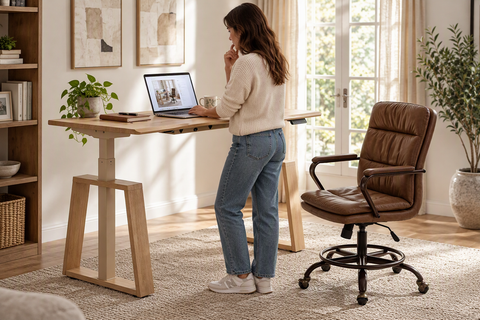
Even with a standing desk, a mother will spend a significant portion of her day sitting. The Serene, Napa Leather Executive Office Chair provides the necessary lumbar support to maintain the spine's natural curve. Its Napa leather construction offers a tactile luxury that aligns with the "thoughtful gifting" aspect of Mother’s Day, moving away from "gaming" aesthetics toward a professional, wellness-oriented design.

The Circulatory Aid
For shorter users or those whose chairs are set higher to reach a fixed desk, the Adjustable Ergonomic Footrest is a vital accessory. It ensures the feet are supported, which prevents the "dangling leg" effect that compresses the underside of the thighs and restricts blood flow.
Adjustable Ergonomic Footrest for under-desk use.
The Overlooked Essential: Anti-Fatigue Mats
Practitioners note that standing on hard surfaces (hardwood or tile) without support often leads to foot and heel pain within 30 minutes. An anti-fatigue mat is the most overlooked accessory in a standing desk setup. It provides micro-instability that encourages the calf muscles to engage, aiding circulation and reducing the impact on joints.
Safety, Standards, and Trust
When purchasing furniture for a loved one, structural integrity and safety are paramount. We recommend looking for products that meet or exceed BIFMA G1-2013 Ergonomics Guidelines. These standards ensure the desk is stable at its maximum height and can handle the weight of monitors, computers, and personal items without wobbling.
Furthermore, consider the indoor air quality impact. Products with GREENGUARD Gold Certification ensure low chemical emissions (VOCs), which is crucial for a healthy home environment. For a deeper dive into the engineering behind these standards, refer to The 2026 Workstation White Paper: Converging Ergonomic Science and Sustainable Engineering.
Final Considerations for Mother's Day 2026
Choosing a standing desk for Mother's Day is a declaration that you value her long-term health as much as her professional success. It addresses the "why" of daily fatigue and provides a tangible, engineering-based solution to the problems of the modern workday.
By focusing on adjustability, quality materials, and a gradual transition to movement, you aren't just giving her a place to work—you're giving her a more energized, pain-free day.
Methodology & Modeling Disclosure
The data presented in this article regarding desk heights and metabolic burn is derived from scenario modeling, not a controlled clinical study.
- Ergonomic Calculations: Based on ANSI/HFES 100-2007 standards using anthropometric ratios.
- Metabolic Estimates: Calculated using MET values (Sitting: 1.5, Standing: 2.0) via the standard formula: Kcal = (MET × 3.5 × MassKg) / 200 × Minutes.
- Boundary Conditions: These findings apply to a petite female user (155cm, 60kg). Results will vary based on individual height, weight, muscle mass, and pre-existing health conditions.
Disclaimer: This article is for informational purposes only and does not constitute professional medical advice. Always consult with a healthcare professional or occupational therapist before making significant changes to your physical work environment, especially if you have pre-existing musculoskeletal conditions.
Sources
- Canadian Centre for Occupational Health and Safety (CCOHS) - Sit/Stand Desks
- Cochrane Library - Workplace interventions for reducing sitting at work
- ISO 11226:2000 - Evaluation of static working postures
- World Health Organization (WHO) - Guidelines on Physical Activity and Sedentary Behaviour
- BIFMA Ergonomics Guideline for Furniture
- Cornell University Ergonomics Web - Workstation Guides




Leave a comment