

Return-to-office mandates are colliding with agile, activity-based work models that require desks to serve multiple users and postures every day. A standing desk, defined as a height-adjustable workstation that shifts between seated and standing positions via electric motor or pneumatic lift, sits at the center of this tension. Effective return-to-office workspace planning must account for how agile methodology reshaped desk requirements, what makes shared workstations functional, what movement science recommends, and how to configure multi-user presets correctly.
The Decline of the Assigned Seat: How Agile Methodology Changed What Offices Need From Furniture
Agile project methodology eliminated fixed team structures, and that organizational shift converted the personal assigned desk into an operational liability. The causal link between iterative work cycles and the demand for agile workspace furniture runs directly through how teams form, dissolve, and re-form around sprint goals.
From Permanent Desks to Activity-Based Workstations
Activity-based working (ABW) reduces assigned desks by 30 to 40 percent in most implementations, replacing owned workstations with shared, task-specific zones. Each zone must accommodate different body types, tasks, and team sizes within the same physical footprint. Agile workspace furniture operating under ABW principles cannot be sized or configured for a single occupant; it must serve a 5th-percentile user and a 95th-percentile user on the same day without physical intervention from facilities staff.
Why Agile Sprints Demand Spatial Flexibility
Agile sprints restructure team compositions every two to four weeks, meaning the people occupying a given desk cluster change constantly across the calendar. Fixed-height desks force ergonomic compromises whenever occupants rotate, because each person carries different seated and standing ergonomic requirements. Height-adjustable desks eliminate per-user reconfiguration time and reduce cumulative ergonomic risk across a rotating occupant pool by making each transition a single button press rather than a manual adjustment process.
The Furniture Gap Agile Teams Exposed
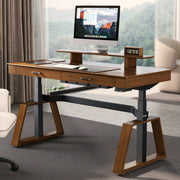
Traditional office furniture was designed for single-occupant, full-day use at one fixed height. Agile teams exposed a structural furniture gap: workstations needed to reconfigure for standing collaboration, heads-down focus work, and brief check-ins without requiring tool changes or facilities support between uses. A motorized standing desk addresses this gap directly, because its adjustable surface serves all three work modes from the same frame without adding square footage to the floor plan.
Agile methodology converted the desk from a personal asset into shared infrastructure, making height adjustability a functional requirement rather than a wellness perk. The next section examines how hot-desking programs operationalize that shift across an entire floor.

Hot-Desking in Practice: What Makes a Shared Workstation Actually Work for Multiple Users
Hot-desking office solutions succeed or fail based on how well the physical workstation accommodates rapid user turnover. These criteria determine whether a shared desk genuinely functions for multiple occupants across a single day.
- Height range of 22 to 48 inches covers the seated and standing positions of the 5th-percentile female through the 95th-percentile male, ensuring one desk fits virtually every employee without physical adjustment trade-offs.
- Motor speed of 1.5 inches per second or faster allows full height transitions in under 20 seconds, preventing bottlenecks when multiple employees cycle through the same workstation during shift changes.
- Programmable memory presets (minimum four slots) let each daily user recall their exact ergonomic position without measuring or guessing, cutting setup time to a single button press.
- Collision-detection sensors protect personal items left on the desk surface during automated height changes, a critical safety feature when desk ownership is anonymous and unpredictable.
- Cable management channels integrated into the desk frame keep power and data connections organized across user transitions, preventing the tangled-cable problem that degrades shared workstation hygiene.
- Anti-fatigue mat storage or designated mat zones adjacent to the desk complete the ergonomic setup without requiring each user to carry personal equipment to an unassigned seat.
A shared workstation that meets these criteria converts hot-desking from a cost-cutting measure into a genuinely ergonomic system. Height adjustability is the single feature that makes all other shared-desk criteria achievable.

Height-Adjustable Desks and the Spontaneous Stand-Up: Designing for Informal Collaboration
Agile ceremonies include daily stand-ups, sprint reviews, and impromptu pair-programming sessions, all of which require physical flexibility from the workspace itself. A cluster of height-adjustable desks reconfigures from individual focus workstations to a standing collaboration node in under 20 seconds per surface, eliminating the need to migrate to a dedicated meeting room for short-duration group work. This dual-purpose capability matters especially during sprint planning, when teams oscillate between solo task analysis and rapid group alignment within the same hour.
Positioning standing desk clusters near writable wall surfaces or rolling whiteboards amplifies their collaboration value without adding square footage. A developer pair-programming at standing height can annotate a whiteboard, reference a shared monitor, and return to independent coding without changing locations or furniture arrangements. The spontaneous stand-up, one of agile’s most time-efficient communication formats, works best when the furniture around it supports standing posture by default rather than requiring participants to remain in desk chairs pulled into an improvised circle.
Flexible office design principles recommend grouping height-adjustable workstations in clusters of four to six, with aisles wide enough for a standing user to turn and address colleagues without pushing back from the desk. This spatial arrangement reduces the acoustic and visual barriers that make impromptu collaboration awkward in traditional open-plan layouts. Teams that operate in these configurations report fewer scheduled meetings for topics that would previously have required a conference room booking.
Height-adjustable desk clusters compress the distance between individual focus work and group collaboration, reducing the meeting-room dependency that slows agile teams. Research on movement and cognition, covered next, explains why that posture shift also improves the quality of the collaboration itself.

What Workplace Studies Say About Movement, Posture, and Sustained Creative Output
Evidence from occupational health and cognitive science research quantifies why posture variety improves the outputs agile teams depend on. The table below maps specific research findings to practical desk-use implications.
| Research Finding | Source / Field | Practical Desk-Use Implication |
| Alternating sitting and standing every 30 to 60 minutes reduces musculoskeletal discomfort by up to 54%. | Occupational health studies, peer-reviewed ergonomics literature | Set a desk timer or use auto-reminder software to prompt posture transitions during sprint work blocks. |
| Standing posture increases cerebral blood flow, correlating with improved working memory performance in task-switching scenarios. | Cognitive neuroscience research | Schedule standing intervals during backlog grooming and sprint planning, which require high working-memory load. |
| Sedentary work blocks exceeding 90 minutes reduce afternoon productivity by measurable margins independent of total hours worked. | Workplace health research | Use programmable height presets to eliminate friction from posture changes, making transitions likely rather than optional. |
| Employees with access to height-adjustable desks report 78% higher satisfaction with their work environment within six months of introduction. | Corporate wellbeing survey data | Prioritize standing desk access in return-to-office planning to support engagement among hybrid employees. |
| Creative ideation scores improve when participants stand or move lightly compared to seated-only conditions. | Stanford behavioral research on movement and creativity | Conduct brainstorming and retrospective sessions at standing height to leverage the posture-creativity link. |
The research consistently links posture variety to both physical comfort and cognitive output, two variables that directly affect sprint velocity and creative problem-solving. The final body section translates this evidence into a concrete configuration process for multi-user environments.

Configuring Programmable Height Presets for Multi-User Shared Desk Environments
Height-adjustable desks for teams deliver their full ergonomic and efficiency benefit only when presets are configured correctly for shared use. This process standardizes setup across any number of rotating occupants.
- Measure each employee’s optimal seated desk height by having them sit with feet flat, elbows at 90 degrees, and wrists neutral; this number, typically 24 to 30 inches, becomes their seated preset.
- Calculate the standing height by adding 12 to 14 inches to the seated measurement for most adults, then verify by confirming that elbows remain at 90 degrees while standing at the desk surface.
- Instruct employees to temporarily program slots 1 and 2 to their individual seated and standing heights at the start of their shift. Alternatively, establish baseline templates: slot 1 and 2 for a 5th-percentile user's seated and standing heights, and slots 3 and 4 for a 95th-percentile user, allowing quick fine-tuning.
- Label each preset slot with a QR code or desk card that maps slot numbers to height ranges, so any new user can identify which preset approximates their ergonomic needs without measuring from scratch.
- Record all preset configurations in a shared team document linked from the desk itself, enabling facilities managers to audit ergonomic coverage gaps as team composition changes across agile sprint cycles.
- Schedule a quarterly preset audit to update slot configurations when employee rosters change by more than 20 percent, preventing presets from drifting out of alignment with actual occupant needs.
A systematically configured preset system converts the standing desk from an individual ergonomic tool into shared team infrastructure that scales with agile team rotation. Teams that complete this setup process report fewer ergonomic complaints and faster workstation turnover times.

Conclusion: Applying These Principles to Your Office Transition
Three actionable insights summarize what the evidence above establishes. First, agile team rotation requires height-adjustable desks as functional infrastructure, not optional wellness perks. Second, shared workstations succeed when preset configuration is systematic and documented rather than left to individual users. Third, posture variety directly supports the cognitive demands of sprint-based work, from backlog grooming to creative retrospectives. Before finalizing any return-to-office floor plan, audit your current desk inventory against the shared-workstation criteria above to identify gaps before they become retrofit costs.
Frequently Asked Questions
Q1. How Do You Set Up a Standing Desk for Hot-Desking Environments?
Encourage rotating users to temporarily save their ideal seated and standing heights to the desk's memory at the start of their day. If standardizing baselines, label preset 1 for average seated height (e.g., 27 inches) and preset 2 for average standing height (e.g., 42 inches), so users have a starting point before fine-tuning to their specific bodies.
Q2. What Are the Key Features of Height-Adjustable Desks for Teams?
Height-adjustable desks for teams require a minimum height range of 22 to 48 inches, motor speed above 1.5 inches per second, at least four programmable memory presets, collision-detection safety sensors, and integrated cable management. These features collectively support multi-user turnover without ergonomic compromise or setup delays between occupants.
Q3. Can a Single Standing Desk Support Both Focus Work and Stand-Up Meetings?
Yes. A height-adjustable standing desk transitions from a seated focus-work surface to a standing collaboration point in under 20 seconds. Positioning desk clusters near writable surfaces maximizes this dual function. The posture shift itself supports the cognitive mode-switch between deep individual work and group ideation that agile stand-ups require.
Q4. How Does Return to Office Workspace Planning Affect Desk Selection?
Return to office workspace planning must account for hybrid schedules where no employee owns a permanent desk. This makes height adjustability, programmable presets, and fast motor transitions mandatory rather than optional. Facilities teams that audit desk inventory before finalizing floor plans avoid retrofitting costs when occupancy patterns prove incompatible with fixed-height furniture.
Q5. How Long Does It Take Employees to Adapt to Using a Height-Adjustable Desk Consistently?
Most employees establish consistent posture-switching habits within four to six weeks when desk reminders or preset labels reduce friction. Without structured prompts, adoption rates drop significantly. Teams that pair standing desk access with a documented preset configuration process reach consistent usage in closer to three weeks.
Leave a comment