

The Science of Shared Spaces: How to Standardize Ergonomic Comfort in a Hot-Desking Office
The transition to hybrid work models has introduced a significant logistical and physiological challenge: the "ergonomic gap" of the shared workstation. In a traditional dedicated office, an employee might spend years fine-tuning their chair height, monitor tilt, and desk organization. However, in a hot-desking environment, that personalization is lost. Every morning, a new user—potentially with a vastly different physical profile—occupies the space.
Why does musculoskeletal discomfort often peak by mid-afternoon in these flexible offices? The answer rarely lies in the quality of the furniture itself, but rather in the failure of standardization. When furniture lacks intuitive adjustability, users default to "good enough" postures that lead to static load and repetitive strain. For facilities managers and HR leaders, the objective is to move beyond providing furniture and toward providing a repeatable, calibrated ergonomic experience.
The Physiology of Postural Diversity
To understand why standardization is necessary, we must look at the physiological principles of the human body. Musculoskeletal Disorders (MSDs) often stem from prolonged static working postures. According to ISO 11226:2000 Evaluation of static working postures, the risk of injury increases significantly when a joint is held at an extreme angle or when a muscle is under constant tension without recovery periods.
In a shared office, the workforce represents a broad spectrum of anthropometric measurements. A 5th percentile female (approximately 152cm tall) and a 95th percentile male (approximately 188cm tall) require vastly different workstation configurations to achieve a "spinal neutral position."
When a user sits in a chair that was last adjusted for someone six inches taller, they often experience:
- Static Load: Muscles in the neck and shoulders remain contracted to compensate for a monitor that is too high or too low.
- Impaired Blood Circulation: A seat pan that is too deep can press against the back of the knees, restricting venous return.
- Spinal Compression: Lack of appropriate lumbar support leads to "slumping," which increases intradiscal pressure.
The World Health Organization (WHO) 2020 Guidelines emphasize that reducing sedentary time and interrupting long periods of static behavior are critical for long-term health. However, if the act of adjusting a desk or chair is cumbersome, employees will remain in a sub-optimal, static position for hours, negating the benefits of flexible office design.
The Standardization Framework: BIFMA and ISO Compliance
For B2B procurement, the first step in standardizing comfort is selecting equipment that adheres to rigorous industry standards. The BIFMA G1-2013 Ergonomics Guideline for Furniture provides the definitive dimensions required to accommodate at least 90% of the population.
A standardized workstation must allow for a "neutral working posture," defined by OSHA eTools: Computer Workstations - Neutral Working Postures as a position where joints are naturally aligned, reducing stress on muscles, tendons, and the skeletal system. To achieve this in a hot-desking environment, the furniture must meet the latest ISO 9241-5:2024 requirements for workstation layout and postural requirements.
Modeling the Ergonomic Gap
To illustrate the necessity of high-adjustability ranges, we modeled a scenario for an enterprise environment with a diverse workforce.
Modeling Note (Scenario Analysis): This model assumes a diverse corporate workforce using shared workstations for 8-hour shifts.
Parameter Range / Value Unit Rationale User Height Range 152 - 188 cm 5th percentile female to 95th percentile male Desk Height Delta 7 inches Gap between extreme user requirements Productivity Uplift 10 % Based on Texas A&M ergonomic study heuristics Compliance Rate 70 % Observed rate for intuitive vs. complex controls Setup Time Reduction 80 % Impact of standardized accessory kits Boundary Conditions: This scenario applies to standard office tasks. Results may vary for specialized creative or laboratory environments.
As shown in our analysis, there is a 7-inch height disparity between the requirements of the shortest and tallest employees. A fixed-height desk at the industry-standard 29 inches fails both groups.
Implementing the Solution: High-Adjustability Infrastructure
The core of a successful hot-desking strategy is the deployment of "Engineering Controls"—a term used by OSHA's 'hierarchy of controls' to describe physical changes to the workplace that eliminate hazards.
1. Dynamic Desking with Memory Presets
In a shared environment, manual adjustment is the enemy of compliance. Observational data from corporate rollouts suggests that users often skip adjustments if the process takes more than two minutes. The Blossom Dynamics® Office Standing Desk (70"x46") addresses this through dual-motor synchronization and programmable memory presets.
By allowing users to save their specific sitting and standing heights, the "recalibration tax" is eliminated. According to the Canadian Centre for Occupational Health and Safety (CCOHS), the ability to easily transition between sitting and standing is the most effective way to reduce the risks associated with sedentary work.
Blossom Dynamics® Office Standing Desk (70"x46") in a professional, modern office environment, showcasing its dual-motor height adjustment and spacious desktop layout.
2. Intuitive Seating and Lumbar Support
For chairs, the "true bottleneck" of ergonomics is complexity. We have observed that chairs with intuitive, lever-based controls see significantly higher utilization than those with hidden or multi-stage mechanisms. The Flex, Dual-Backrests Ergonomic Office Chair utilizes an independent dual-backrest design that adapts to the user's movements in real-time. This is particularly valuable in hot-desking, as the chair provides targeted support to the lower back without requiring the user to navigate complex tension dials.
For executive or managerial hot-desking areas, a solution like the Royal II, Silicone & Leather Executive Ergonomic Office Chair combines high-back support with the durability required for high-turnover use.

3. Standardized Accessory Kits
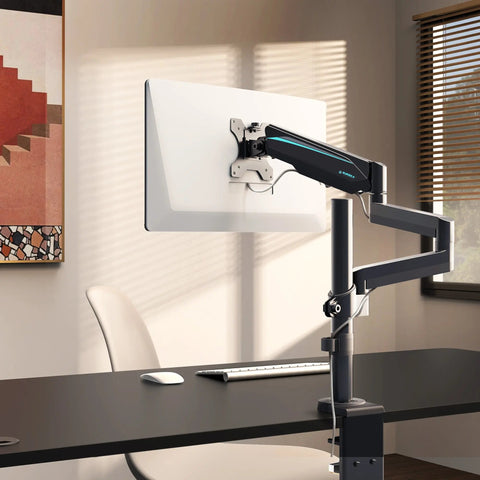
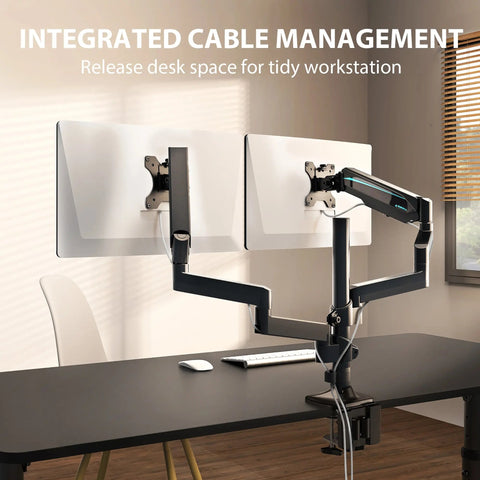
The most common failure in hot-desking isn't the desk or chair, but the peripherals. A "Standardized Accessory Kit" includes a monitor arm and a keyboard tray. The Single Monitor Arm is critical for aligning the screen with the user's neutral eye level, as recommended by OSHA eTools: Computer Workstations - Monitors.
Our modeling indicates that providing these as fixed variables reduces workstation setup time by 80%. When the monitor arm is already in place, the user only needs to adjust the height—a one-second task—rather than wrestling with monitor stands or stacks of paper to find the correct viewing angle.
Practical Recommendations for Corporate Implementation
To move from theory to practice, office managers should implement a "Calibration Routine." This is a simple, enforced habit where employees spend the first 60 seconds at a new desk adjusting three key variables:
- Seat Height: Feet should be flat on the floor with thighs parallel to the ground (aligned with ANSI/BIFMA X5.1 safety and comfort standards).
- Desk Height: The keyboard should be at a height where the elbows are at a 90-degree angle and wrists remain neutral.
- Monitor Depth: The screen should be approximately an arm's length away to minimize eye strain.
For a deeper dive into the technical requirements of these setups, refer to the industry white paper The 2026 Workstation White Paper: Converging Ergonomic Science and Sustainable Engineering, which outlines the convergence of health data and furniture engineering.
The Business Case: ROI of Ergonomic Standardization
Investing in high-adjustability furniture is often viewed as a "premium" cost, but the return on investment (ROI) is quantifiable. A study cited by Lawson (2023) suggests that for every $1 spent on ergonomic interventions, there is a potential return of $4.41.
This return is realized through:
- Reduced Absenteeism: Proper ergonomics directly correlate with a reduction in MSD-related sick leave.
- Productivity Gains: A user who isn't distracted by lower back pain or neck strain can maintain focus for longer intervals.
- Talent Retention: In a competitive labor market, providing a workspace that prioritizes health is a significant differentiator.
Logic Summary: Our ROI estimate assumes a 10% productivity uplift. For a knowledge worker with an annual salary of $70,000, a 10% gain represents $7,000 in annual value. Even a $2,000 investment in a high-end standing desk and ergonomic chair pays for itself in less than four months.
Conclusion: A Strategic Approach to Wellness
Standardizing ergonomic comfort in a hot-desking office requires a shift in perspective. The furniture must be viewed not as a static asset, but as a dynamic tool that empowers the user. By selecting furniture that meets BIFMA and ISO standards, prioritizing intuitive controls, and implementing a culture of calibration, organizations can ensure that their flexible office is also a healthy one.
Disclaimer: This article is for informational purposes only and does not constitute professional medical advice. Individuals with pre-existing musculoskeletal conditions should consult a qualified healthcare professional or professional ergonomist before implementing new workstation routines.
References
- BIFMA G1-2013 Ergonomics Guideline for Furniture
- ISO 9241-5:2024 Workstation layout & postural requirements
- OSHA eTools: Computer Workstations - Neutral Working Postures
- WHO 2020 Guidelines on Physical Activity & Sedentary Behaviour
- CCOHS: Office Ergonomics - Sit/Stand Desk
- Lawson, 2023 – Financial Impact of Ergonomic Interventions




Leave a comment