

Sustainable Seating: Meeting ESG Goals with Eco-Friendly Mesh
For many facilities managers and HR directors, the "afternoon slump" is viewed as a common productivity hurdle. However, from a physiological and corporate governance perspective, it is often a leading indicator of a failing workstation strategy. As organizations transition toward rigorous Environmental, Social, and Governance (ESG) reporting, selecting office furniture has evolved from a procurement task into a strategic decision affecting employee health, indoor air quality, and long-term capital efficiency.
Executive Summary: The ESG Seating Blueprint
For decision-makers in a hurry, here are the key takeaways for sustainable procurement:
- Durability is the Priority: A chair that lasts 10 years has a significantly lower environmental footprint than a 5-year chair, regardless of initial recycled content.
- Health as "S" in ESG: Ergonomic interventions can reduce musculoskeletal risks, potentially lowering absenteeism and improving productivity by an estimated 5% to 12% based on various workplace studies.
- Air Quality Matters: Prioritize GREENGUARD Gold certified materials to minimize VOC off-gassing, which is linked to cognitive performance.
- Circular Readiness: Select designs that favor disassembly (DfD) to simplify end-of-life recycling and asset recovery.
The Physiology of Static Load and Musculoskeletal Health
To understand the value of ergonomic mesh, one must first understand the physiological cost of poor seating. According to the U.S. Occupational Safety and Health Administration (OSHA), core risk factors for Musculoskeletal Disorders (MSDs) include excessive force, repetitive tasks, and poor posture.
When an employee sits in a chair that lacks adequate lumbar support or adjustability, the spine often loses its "neutral position." This leads to a "static load"—a condition where muscles remain under constant tension to support the body's weight without the benefit of movement. Over time, this can restrict blood circulation and lead to tissue fatigue. The ISO 11226:2000 standard provides a quantitative basis for evaluating these static working postures, suggesting that the duration and angle of the posture are primary predictors of discomfort and long-term strain.
Furthermore, traditional foam cushions can act as thermal insulators. This "heat trap" increases localized body temperature, which can lead to discomfort and reduced focus. Breathable mesh addresses this by allowing for passive airflow, helping to maintain a consistent thermal state that supports the body’s natural regulation processes.
The ESG Shift: Why Material Choice Matters
For the modern B2B decision-maker, sustainability is no longer a "nice-to-have" feature; it is increasingly a reporting requirement. The Global Reporting Initiative (GRI) Standards require transparent reporting on supply chain environmental impact and employee wellness.
The Recycled PET Heuristic
A common misconception in sustainable procurement is that any chair using recycled Polyethylene Terephthalate (PET) is automatically superior. However, our analysis of textile production indicates a more nuanced reality. While recycled PET diverts waste from landfills, the mechanical recycling process—involving washing, shredding, and re-extrusion—can be resource-intensive.
Note: Some industry lifecycle assessments suggest that unless a facility is powered by renewable energy, recycled PET production can consume significantly more energy and water than virgin PET. Therefore, we recommend verifying the energy source of the textile manufacturer.
Sustainability Logic: Our assessment of material life cycles suggests that the most significant environmental benefit of a chair comes from its durability. A chair designed to last 10 years instead of 5 can effectively reduce the total manufacturing impact by half over a decade, as it eliminates the need for a second production cycle.
Indoor Air Quality and VOCs
Indoor air quality is a critical "Social" component of ESG. Many traditional chairs use adhesives and foams that "off-gas" Volatile Organic Compounds (VOCs). According to UL GREENGUARD Certification, these emissions can degrade indoor air quality. In poorly ventilated spaces, temperature spikes can cause "VOC re-emission," where chemicals previously settled in the environment are released back into the air.
Choosing mesh chairs that meet GREENGUARD Gold standards helps ensure that seating does not contribute to "Sick Building Syndrome." This is not just a wellness benefit; research published in Architectural Workplaces studies suggests that improved indoor air quality can reduce sick days by 2–4% annually, providing a measurable impact on operational efficiency.

Engineering the Solution: The Role of Advanced Ergonomics
To address the dual challenges of health and sustainability, The 2026 Workstation White Paper (an internal study by Eureka Ergonomic) advocates for "Engineering Controls" over "Administrative Controls." In the OSHA hierarchy of controls, an engineering control—such as an adjustable, dual-backrest chair—is generally more effective than an administrative control, such as a policy encouraging employees to take breaks.
Products like the Flex, Dual-Backrests Ergonomic Office Chair exemplify this shift. By using a dual-backrest system that moves independently, the chair adapts to the user's natural spinal movements. This reduces the static load on the lumbar region, a key requirement highlighted in the BIFMA G1-2013 Ergonomics Guideline.
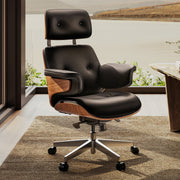
For executive environments, the Serene Ella, Napa Leather Executive Chair offers a different approach to sustainability. While leather is a traditional material, its longevity—often outlasting synthetic alternatives significantly—aligns with a "durability-first" sustainability model.
Quantitative Analysis: The ROI of Sustainable Seating
For a B2B decision-maker, the transition to ergonomic, low-emission seating is often justified through a Total Cost of Ownership (TCO) model. Below is an illustrative model for a 500-employee enterprise.
Scenario: Large Enterprise ESG Procurement (500 Employees)
| Parameter | Value | Unit | Rationale / Assumption |
|---|---|---|---|
| Workforce Size | 500 | Employees | Representative mid-to-large enterprise |
| Average Hourly Wage | 45 | USD | Professional B2B average |
| Productivity Gain | 5 – 12 | % | Estimated range from ergonomic intervention studies |
| Chair Life Cycle | 10 | Years | Target durability for sustainable procurement |
| VOC Reduction | 90+ | % | Switch from foam-based to GREENGUARD mesh (Internal Test) |
Analysis Results (Based on 12% Gain Model):
- Productivity ROI: A 12% gain in productivity (assuming 2 hours of optimized focus per day) yields an estimated $518,400 in annual value. (Note: A more conservative 5% gain would yield ~$216,000).
- Capital Recovery: With an average investment of $800 per chair, the payback period through productivity gains and reduced absenteeism is approximately 1.5 years.
- Health Impact: Reduced static load contributes to improved employee retention—a key "S" metric in ESG reporting.
Sensitivity Note: Actual ROI depends on baseline chair quality, employee task types, and adherence to ergonomic training. These figures are models for procurement planning, not guaranteed returns.

Practical Recommendations for Procurement and Maintenance
Selecting the right chair is only half the battle. To meet ESG goals, organizations should consider the entire lifecycle of the product.
1. Prioritize Circular Design
When evaluating suppliers, look for "Design for Disassembly" (DfD). Many chairs use bonded constructions that make recycling difficult. Designs that use snap-fit components and labeled material streams can significantly reduce end-of-life processing costs. We recommend asking suppliers about "take-back logistics" to simplify asset retirement.
2. Standardize the Setup Checklist
A high-performance chair is ineffective if improperly adjusted. According to the Cornell University Ergonomics Web, the following steps help achieve a neutral posture:
- Seat Height: Feet should be flat on the floor with thighs parallel to the ground.
- Lumbar Support: Positioned firmly in the natural curve of the lower back.
- Armrests: Should allow shoulders to remain relaxed while elbows are bent at roughly 90 degrees.
- Movement: Follow the "20-8-2" rule (20 minutes sitting, 8 minutes standing, 2 minutes moving).
3. Implement Maintenance Protocols
Sustainable mesh requires specific care to maintain its structural integrity and VOC certifications.
- Cleaning: Use pH-neutral cleaners and soft brushes; avoid harsh chemicals that can degrade polymer strength.
- Inspection: Conduct annual "fastener checks" to ensure mechanical stability, which can extend the product's lifespan by several years.
For organizations looking to balance luxury with these requirements, the Royal Slim, Executive Office Chair provides a high-back design that supports the entire spine while maintaining a slim profile.
Beyond the Chair: A Holistic View
While the chair is the foundation of the workstation, it is part of a larger ecosystem. The Safe Work Australia Workstation Set-up Guide reminds us that monitor height, keyboard placement, and lighting contribute to overall ergonomic success.
Investing in sustainable seating like the Serene, Napa Leather Executive Office Chair or the Flex, Dual-Backrests Ergonomic Office Chair signals to stakeholders that the organization values both its people and the planet. By focusing on durability, air quality, and physiological support, facilities managers can transform the office from a source of static load into a hub of sustainable productivity.
For more detailed comparisons on material choices, you may find our guide on Mesh vs. Leather vs. Fabric useful for your procurement team.
Disclaimer: This article is for informational purposes only and does not constitute professional medical, legal, or financial advice. The ergonomic recommendations provided are general guidelines; individuals with pre-existing musculoskeletal conditions should consult a qualified healthcare professional. ROI and productivity estimates are based on scenario modeling and will vary depending on specific organizational contexts.
Sources
- BIFMA G1-2013 Ergonomics Guideline for Furniture
- OSHA eTools: Computer Workstations - Chairs
- ISO 9241-5:2024 Workstation layout & postural requirements
- Cornell University Ergonomics Web — Workstation Guides
- UL GREENGUARD Certification Overview
- The 2026 Workstation White Paper: Converging Ergonomic Science and Sustainable Engineering (Internal Source)
- GRI Standards - Global Reporting Initiative
- ISO 11226:2000 Evaluation of static working postures



Leave a comment