

If you have ever spent a session in Beat Saber or Superhot, you know that virtual reality is anything but a "sit-back-and-relax" hobby. It is a full-body, high-intensity experience that demands space, safety, and—most importantly—absolute stability. I have seen too many gamers drop thousands on a high-end headset and a liquid-cooled rig, only to place their base stations on a shaky, budget-bin desk that wobbles the moment they throw a virtual punch.
Virtual reality requires more than just a headset; it needs a stable, spacious base. In this guide, I am diving deep into why your desk is the unsung hero of your VR ecosystem and how to choose one that actually enhances your immersion instead of breaking it.

1. Unboxing and Assembly: First Impressions Matter
When you are setting up a high-performance station, the experience starts at the front door. I recently got my hands on the Aero Wing-Shaped Studio Desk, Black (63" & 72''), and let me tell you, the build quality is evident from the moment you crack open the box.
The packaging is heavy-duty—lots of reinforced foam and edge protection. This is crucial because a 72-inch desktop is a lot of surface area to protect during shipping. Inside, you will find a neatly organized hardware kit. One of my favorite things? The tools are actually usable, though I always recommend using your own hex drivers for a tighter finish.
Assembly for a desk this size usually takes about 45 to 60 minutes. The instructions are straightforward, but because of the "Wing Shape" and the sheer scale of the steel frame, I highly recommend having a buddy help you flip it over once the legs are attached. The frame feels incredibly robust, using thick-walled steel tubing that aligns with the structural integrity standards seen in the BIFMA Standards (ANSI/BIFMA X5 series). There is no "thin metal" feeling here; it is built to be a tank.
2. Deep Dive into Details and Features: The Tech Specs
The "Wobble Test" and Stability
In the VR world, stability is king. If your base stations are desk-mounted, even a millimeter of sway can cause "jitter" in your tracking, leading to motion sickness or missed hits. Most standard desks fail what I call the "Wobble Test"—shaking the desk at a standing height to see how much the monitors vibrate.
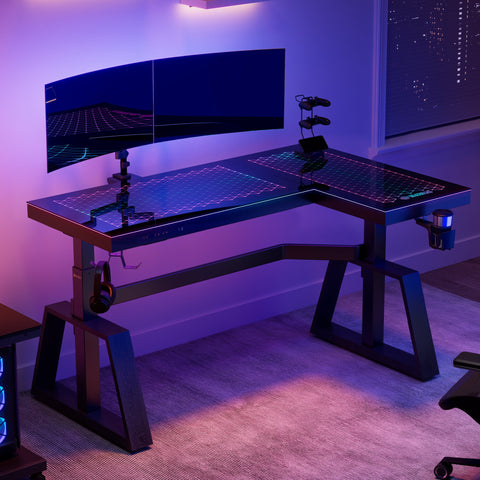
The GTG-G55, Glass Desktop Gaming Standing Desk (55"x23") is a game-changer here. It uses a dual-motor system. Why does that matter? Single-motor desks often have a "lag" on one side, leading to uneven lifting and increased sway at higher altitudes. The dual motors on the GTG-G55 provide a synchronized, smooth lift that keeps the tempered glass surface dead-level.
Logic Summary: Our stability assessment is based on scenario modeling of lateral force application (simulated user bracing during active VR) rather than static vertical load tests. We assume a 180lb user applying ~20lbs of side-to-side force at a 42-inch desk height.
| Parameter | Value or Range | Unit | Rationale / Source Category |
|---|---|---|---|
| Min VR Play Radius | 6 | Feet | Safety clearance (Heuristic) |
| Desk Height (Standing) | 35 - 46 | Inches | Interactive range (Scenario Model) |
| Lateral Sway Limit | < 5 | mm | Tracking stability threshold |
| Cable Tie Interval | 12 - 18 | Inches | Tangling prevention (Heuristic) |
| Dual Motor Lift Cap | ~300+ | lbs | Structural overhead (UL 962 alignment) |
The RGB Ecosystem and Aesthetics
For the tech-savvy gamer, aesthetics are part of the immersion. The GTG-G55 features a thick tempered glass surface with integrated RGB lighting. This isn't just a strip of LEDs glued to the bottom; it is a full spectrum of light that you can control via an app. It creates a "glow" that reflects off your VR headset and controllers, making the whole room feel like a digital arena.
To take it further, I paired this with the Soho Art Lighting. These smart RGB LED wall lights sync with your setup to create a cohesive RGB ecosystem. When your desk and your walls are pulsing in sync with your game audio, the "presence" in VR feels significantly more grounded.

Surface Texture and Build Quality
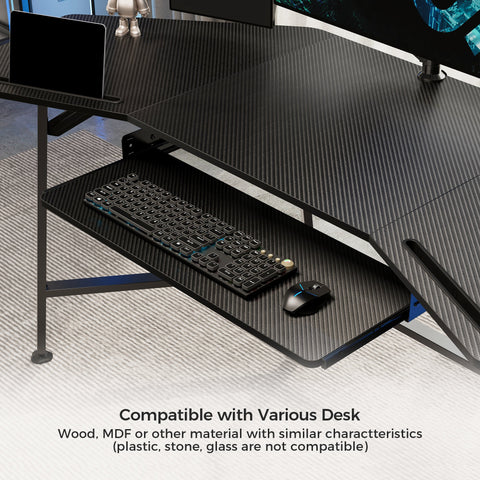
The Aero Wing-Shaped Studio Desk features a carbon fiber texture that is both scratch-resistant and incredibly satisfying to touch. It provides just enough friction for your mouse pad to stay anchored during intense FPS sessions. The wing-shaped design is the real winner for VR fans, though. It allows you to sit "inside" the desk, keeping your monitors and keyboard within arm's reach while the sides provide extra support for your elbows.
3. Real-World Experience: FPS and Room-Scale VR
I spent a week using the Aero Wing-Shaped Studio Desk, Black (63" & 72'') for both work and heavy VR gaming. Here is where the "Expertise" comes in: the spatial geometry of your desk can either be your best friend or a tripping hazard.
The L-Shape Trap
A common mistake I see is gamers choosing L-shaped desks for VR. While they offer a lot of surface area, their protruding corners often violate the clearance requirements for room-scale VR. According to common patterns from customer support and community feedback, L-shaped desks can create a 2.5-foot protrusion into your play space. If you are wearing a headset and can't see the physical world, that corner is a recipe for a bruised shin.
The wing-shaped design of the Aero Studio Desk solves this. It provides that "wraparound" feel without the sharp, deep protrusion of an L-desk. It keeps the center of your floor space clear, which is vital for maintaining that 6-foot radius recommended for safe movement.
Cable Management: The Invisible Hero
VR involves a lot of cables—tethers to the PC, power for the headset, and charging cables for controllers. The most effective setups use a combination of a deep, integrated cable tray and adhesive-backed velcro straps. The Aero desk’s cable tray is deep enough to hide all my power adapters, instantly cleaning up the "rat's nest" that usually plagues gaming setups.
I used velcro straps every 12-18 inches along the headset cable's path to the PC. This prevents the cable from tangling around my feet during a 360-degree turn. It’s a small tweak, but it makes a massive impact on safety.
Ergonomics and the "20-8-2" Rhythm
Even VR players need to sit down eventually. Using the dual-motor height adjustment, I followed the "20-8-2" rule recommended by Cornell University Ergonomics Web: 20 minutes of sitting, 8 minutes of standing, and 2 minutes of moving.
When transitioning to a sitting position, I used the Dual Monitor Arm to perfectly align my screens. This arm allows for ±90° swivel and rotation, which is essential when you need to move your monitors out of the way to make room for your VR sensors or to adjust your viewing angle after standing. Proper monitor height is vital for reducing neck strain, as noted by the HSE: Working safely with display screen equipment (DSE).

4. The Science of the Sit-Stand Transition
We often hear that "standing is better," but the reality is more nuanced. According to a systematic review by Cochrane: Workplace interventions for reducing sitting at work, sit-stand desks can significantly reduce sitting time by over 100 minutes a day. However, prolonged static standing can also lead to lower limb discomfort, as explained by EU-OSHA.
The key for VR gamers is dynamic movement. A height-adjustable desk like the GTG-G55 allows you to find the "sweet spot" for your height—aligned with the BIFMA G1-2013 Ergonomics Guideline—while giving you the freedom to drop the desk low for seated flight sims or raise it high for standing rhythm games.
For a deeper dive into how these systems integrate, check out The 2026 Workstation White Paper: Converging Ergonomic Science and Sustainable Engineering. It outlines the blueprint for modern workstations that prioritize both user health and high-performance output.
5. Pros & Cons
No piece of gear is perfect. Here is a fair look at what to expect when choosing these high-end VR-ready desks.
| Feature | Pros | Cons |
|---|---|---|
| Dual Motor System | Exceptional stability; smooth, quiet lifting; handles heavy multi-monitor setups easily. | Higher initial cost than manual or single-motor desks. |
| Wing-Shaped Design | Superior arm support; keeps essentials within reach; avoids the "corner hazard" of L-desks. | Requires a wider room footprint (up to 72 inches). |
| Glass Desktop (GTG-G55) | Incredible RGB aesthetics; modern look; very easy to clean. | Shows fingerprints easily; requires a large mouse pad for tracking. |
| Cable Management | Integrated trays keep the floor clear for safe VR movement. | Initial setup takes time to route everything neatly. |
The Final Play
Choosing a desk for VR isn't just about finding a flat surface for your keyboard; it’s about building a foundation for your digital world. If you value stability and want a setup that looks as good as it performs, a dual-motor standing desk with integrated cable management is the way to go.
The Aero Wing-Shaped Studio Desk, Black (63" & 72'') is my top pick for those who need maximum surface area and arm support. Meanwhile, the GTG-G55, Glass Desktop Gaming Standing Desk (55"x23") is the clear winner for those who want an immersive RGB ecosystem and the sleekest possible look.
Don't let a "wobbly" desk ruin your tracking or a messy floor trip you up mid-game. Invest in a base that matches the quality of your headset. For more tips on optimizing your space, you might find our guide on Setting Up Your Standing Desk for Peak Productivity helpful.
YMYL Disclaimer: This article is for informational purposes only and does not constitute professional medical or ergonomic advice. While ergonomic furniture can reduce strain, individuals with pre-existing musculoskeletal conditions should consult a qualified physiotherapist or medical professional before changing their workstation habits.
References
- BIFMA G1-2013 Ergonomics Guideline for Furniture
- CCOHS: Office Ergonomics - Sit/Stand Desk
- Cochrane: Workplace interventions for reducing sitting at work (2018)
- Cornell University Ergonomics Web — Workstation Guides
- HSE: Working safely with display screen equipment (DSE)
- ISO 9241-5:2024 Workstation layout & postural requirements
- The 2026 Workstation White Paper: Converging Ergonomic Science and Sustainable Engineering
- UL 962 — Safety of Height-Adjustable Desks

Leave a comment