

Understanding Lumbar Support: The Biomechanical Foundation of Workplace Health
Why does lower back pain often intensify as the workday progresses? For many professionals and gamers, the mid-afternoon "slump" is not merely a sign of fatigue but a physiological response to sustained spinal misalignment. In the modern sedentary environment, the lumbar region—the five vertebrae (L1-L5) between the ribcage and the pelvis—bears the brunt of static loading.
The human spine is naturally curved in an "S" shape to distribute weight and absorb shock efficiently. When standing, the lower spine maintains a natural inward curve known as lordosis. However, the moment one sits, the pelvis rotates backward, often flattening this curve or forcing it into a "C" shape. This postural shift increases intradiscal pressure, strains the posterior ligaments, and can eventually lead to Work-Related Musculoskeletal Disorders (MSDs).
Lumbar support is not a luxury feature; it is a critical engineering intervention designed to preserve the spine's neutral position. By providing a physical counter-pressure to the lower back, ergonomic seating helps maintain the natural lordotic curve, reducing the mechanical stress on the intervertebral discs and surrounding musculature.
The Physiology of Static Load and Spinal Neutrality
To understand why your back needs support, we must examine the concept of static load. Unlike dynamic movement, which promotes blood circulation and nutrient exchange in the spinal discs, static sitting restricts these processes. According to OSHA's guidelines on identifying ergonomic problems, poor posture and repetitive tasks are primary risk factors for MSDs.
When the lumbar curve flattens, the pressure on the anterior portion of the intervertebral discs increases. Over time, this can lead to disc bulging or herniation. Furthermore, the muscles of the lower back—specifically the erector spinae—must work harder to stabilize the torso when the spine is out of alignment. This leads to muscular fatigue, reduced blood circulation, and the familiar dull ache associated with long hours at a desk.
Achieving a "spinal neutral position" is the goal of any ergonomic setup. This position minimizes the energy required to maintain posture and places the least amount of stress on the spinal structures. Research from ISO 11226:2000 regarding the evaluation of static working postures emphasizes that the duration and angle of a posture are quantitative indicators of physical strain. Prolonged static sitting, even in a "good" posture, necessitates the use of adjustable supports to mitigate these risks.

Engineering Solutions: How Ergonomic Chairs Address Lumbar Strain
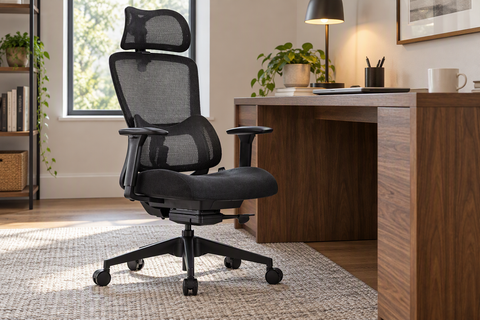
The transition from a standard chair to a precision-engineered ergonomic solution involves moving from "passive" to "active" support. While many budget chairs offer a fixed lumbar bump, high-performance models like the Lira, Ergonomic Office Chair utilize sophisticated mechanisms to adapt to the user's specific anatomy.
The Lira chair features a unique curved frame design that aligns with the natural silhouette of the human back. Its mesh construction provides consistent tension, which is vital for maintaining the lordotic curve without creating "hot spots" of pressure. By incorporating a linkage chassis and adjustable seat depth, the chair ensures that the user remains in contact with the backrest, preventing the common mistake of sliding forward—a move that negates the benefits of any lumbar support.
For those in high-intensity environments, such as competitive gaming or software development, the Axion, Ergonomic Hybrid Chair offers independent lumbar support. This allows the lower section of the backrest to move separately from the upper portion, providing a more tailored response to micro-movements throughout the day. This level of adjustability is consistent with the BIFMA G1-2013 Ergonomics Guideline, which recommends furniture dimensions that accommodate at least 90% of the population (the 5th to 95th percentiles).

The "Belt Line" Rule and Proper Adjustment Heuristics
A frequent observation in ergonomic assessments is that users often set their lumbar support too high. Positioned incorrectly, the support can actually push the pelvis forward into an anterior tilt, exacerbating lower back pressure rather than relieving it.
Practical Adjustment Steps:
- Identify the Curve: Locate the natural inward curve of your lower back.
- The Belt Line Heuristic: Align the peak of the lumbar support with your belt line or the top of your hip bones. It should feel like a gentle, even pressure, not a pronounced "poke" in the kidney area.
- Adjust Seat Depth: Ensure there is a two-to-three-finger gap between the edge of the seat and the back of your knees. If the seat is too deep, you will be forced to sit forward, losing contact with the lumbar support.
- The Tension Test: For chairs with adjustable lumbar tension, start at the lowest setting and incrementally increase it until you feel the support "filling the gap" in your lower back.
Methodology Note: These heuristics are based on common patterns observed in professional ergonomic audits and align with OSHA's eTools for computer workstations. Note that individual preferences may vary based on spinal flexibility and pre-existing conditions.
Modeling the 95th Percentile: A Case Study in Extreme Ergonomics
To demonstrate the importance of adjustability, we modeled a scenario for a "95th percentile" tall user (193cm / 6'4"). This persona represents a significant challenge for standard office furniture, as their limb lengths and torso height often exceed the adjustment ranges of entry-level products.
Analysis: Anthropometric Desk and Chair Scaling
Our analysis used ANSI/HFES 100-2007 ratios to determine the necessary dimensions for maintaining spinal neutrality for a tall user.
| Parameter | 95th Percentile Male (193cm) | Standard Industry Default | Rationale |
|---|---|---|---|
| Recommended Seat Height | ~51 cm | 43-48 cm | Based on popliteal height ratios |
| Recommended Sit Desk Height | ~80 cm | 74 cm (29") | Prevents hunching and lumbar flattening |
| Required Room Depth | 108 inches | 90 inches | Includes chair clearance and circulation |
| Single Motor Utilization | 96% | <80% (Safe) | Based on a heavy dual-monitor setup |
Modeling Transparency: This scenario is a deterministic parameterized model used for illustrative purposes. It assumes a standard male biological anthropometric ratio and does not account for specific physical anomalies. Data derived from ANSI/HFES 100-2007.
The data reveals that for a tall user, a standard 29-inch desk is insufficient. If the desk is too low, the user must lean forward, which causes the pelvis to tilt and renders the chair's lumbar support ineffective. This highlights why high-end executive options, such as the Royal Slim, Executive Office Chair, are designed with higher backrests and more robust tilt mechanisms to support larger frames safely.

Beyond the Chair: The Role of Workspace Synergy
While the chair is the primary tool for lumbar health, it does not act in isolation. The height of your monitors and the position of your input devices directly impact your lower back. If your monitors are too low, you will naturally lean forward (the "turtling" effect), which rounds the lumbar spine.
Utilizing a Dual Monitor Arm allows for precise height and tilt adjustments, ensuring that your gaze remains at the top third of the screen. This promotes an upright torso, which in turn allows the lumbar support to do its job. According to the HSE guidelines for working safely with display screen equipment, a well-configured workstation is essential for preventing long-term MSDs.

Compliance and Quality Standards
When selecting ergonomic furniture, professional buyers often look for third-party certifications to verify safety and durability.
- BIFMA X5.1: This standard defines the test methods for office chair safety and structural adequacy.
- ISO 9241-5:2024: The latest international standard for workstation layout and postural requirements, emphasizing the importance of user-changeable postures.
- UL GREENGUARD: This certification ensures that the materials used in the chair do not emit harmful Volatile Organic Compounds (VOCs), contributing to a healthier indoor environment.
For a deeper dive into how these standards are integrated into modern design, refer to The 2026 Workstation White Paper: Converging Ergonomic Science and Sustainable Engineering. This industry resource explains the shift toward "smart" adjustability and the use of sustainable materials in professional furniture.
The Sit-Stand Rhythm: A Behavioral Intervention
No matter how advanced your chair is, the human body is designed for movement. The World Health Organization (WHO) 2020 Guidelines recommend reducing sedentary time and interrupting long periods of sitting.
A common approach is the "20-8-2" rule pioneered by Cornell University:
- 20 Minutes Sitting: In a neutral, supported posture.
- 8 Minutes Standing: Using a height-adjustable desk to change the load on your joints.
- 2 Minutes Moving: Walking or stretching to stimulate blood circulation.
This behavioral intervention complements the mechanical support provided by your chair. As noted in a Cochrane systematic review, sit-stand desks can significantly reduce sitting time, although they are most effective when paired with a high-quality ergonomic chair for the sitting intervals.
Optimizing Your Lumbar Health
Lumbar support is a fundamental component of a healthy workspace, but its effectiveness depends on proper selection and adjustment. By understanding the physiological principles of spinal neutrality and the mechanical advantages of adjustable seating, you can transform your workday from a source of strain into an environment of productivity and well-being.
Whether you choose a mesh-based solution like the Lira, Ergonomic Office Chair or a high-back executive model, the goal remains the same: to support the natural architecture of your body. Proactively managing your posture today is the most effective way to prevent the chronic musculoskeletal issues of tomorrow.
YMYL Disclaimer: This article is for informational purposes only and does not constitute professional medical advice, diagnosis, or treatment. Always seek the advice of a physician or other qualified health provider with any questions you may have regarding a medical condition or musculoskeletal pain.
Sources
- ANSI/HFES 100-2007: Human Factors Engineering of Computer Workstations
- BIFMA G1-2013: Ergonomics Guideline for Furniture
- ISO 9241-5:2024: Workstation layout and postural requirements
- OSHA eTools: Computer Workstations - Chairs
- WHO 2020 Guidelines on Physical Activity and Sedentary Behaviour
- The 2026 Workstation White Paper: Converging Ergonomic Science and Sustainable Engineering




Leave a comment