

Silencing the Noise: Acoustic Privacy Strategies for Open Huddles
The modern open-plan office was envisioned as a catalyst for transparency and spontaneous collaboration. However, the architectural shift away from private offices has introduced a significant friction point: the erosion of acoustic privacy. In agile meeting zones and huddle spaces, the lack of physical boundaries often leads to "speech spillover," where confidential discussions become public broadcasts. This phenomenon does more than just compromise sensitive data; it triggers a physiological stress response in employees that can diminish cognitive performance and well-being.
Understanding the critical role of sound management is no longer a luxury for corporate facility managers—it is a requirement for maintaining a high-performance culture. This article examines the physiological impact of office noise and provides a technical framework for using ergonomic furniture as a "layered defense" to restore acoustic integrity in collaborative environments.
The Physics of Distraction: Why Huddle Zones Fail
A common misconception in office design is that small huddle spaces naturally avoid acoustic issues due to their compact size. In reality, the physics of small volumes often exacerbates sound problems. According to research on computational studies of speech intelligibility, small, enclosed or semi-enclosed zones frequently suffer from "boxy" distortions and high speech intelligibility.
In these environments, the direct-to-reverberant sound ratio is high. This means that every word spoken is clearly audible to unintended listeners nearby. The primary metric used to quantify this is the Speech Transmission Index (STI). An STI score ranges from 0 to 1.0; for confidential discussions, the target STI should be below 0.45. Most open huddle zones, however, register STI values between 0.50 and 0.65, indicating that 50% to 75% of a conversation is intelligible to those sitting just a few meters away.
Furthermore, the European Agency for Safety and Health at Work (EU-OSHA) highlights that environmental stressors, including noise, can exacerbate the physical strain of prolonged static postures. When employees are forced to strain their ears to hear or lower their voices to maintain privacy, they often adopt awkward, non-neutral postures, leading to increased Musculoskeletal Disorders (MSDs).
Scenario Modeling: The Acoustic Landscape of High-Stakes Negotiation
To understand the practical implications of these acoustic principles, we modeled a common corporate scenario: the "M&A Strategist" persona. In this model, senior executives are tasked with discussing sensitive financial valuations within an agile, open-plan office.
Methodology Note: This analysis employs a deterministic parameterized model based on ISO 3382-3:2012 standards for speech privacy. It is a scenario model designed for strategic planning, not a controlled laboratory study.
| Parameter | Value or Range | Unit | Rationale / Source Category |
|---|---|---|---|
| Ambient Background Noise | 45–50 | dBA | ASHRAE Office Standards |
| Conversation Distance | 1.2 | m | Recommended Privacy Buffer |
| Barrier Height (Furniture) | 1.5 | m | Acoustic Line-of-Sight Interruption |
| Material Absorption (NRC) | 0.70–0.85 | Index | High-Performance Fabric Standards |
| Target Speech Privacy (STI) | < 0.30 | Index | "Excellent" Privacy Threshold |
Our modeling indicates that without intervention, sensitive financial terms and negotiation strategies are highly exposed. However, by implementing a "layered defense" strategy using specialized furniture, the STI can be reduced from a "Fair" 0.55 to an "Excellent" 0.25. This transition represents a reduction in sound transmission of approximately 8–12 dB in the critical 500–2000 Hz speech frequency range.
The Layered Defense: Furniture as an Acoustic Tool
Effective acoustic management in huddle zones does not require expensive architectural retrofits or "pod farms." Instead, practitioners find that a combination of furniture elements creates a more robust buffer zone. This "layered defense" approach addresses sound at three levels: the personal zone, the intermediate zone, and the surface zone.
1. The Personal Zone: Creating Sound Shadows
The first line of defense is the seating itself. High-back chairs or specialized lounge seating can act as individual acoustic baffles. The Lounge Chair-Red Yellow & Blue Yellow Stripe is an example of how form and material converge to support this strategy. Its sculptural silhouette and fabric upholstery contribute to mid-frequency sound absorption, creating what is known as a "personal sound shadow." By wrapping around the user, these chairs help contain the speaker's voice while shielding the listener from external distractions.
2. The Intermediate Zone: Lateral Barriers
To interrupt the direct line of sound between huddle zones, physical barriers are necessary. A common industry rule of thumb is to maintain a minimum of 1.2 meters (approximately 4 feet) between primary conversation points, with a barrier at least 1.5 meters high.
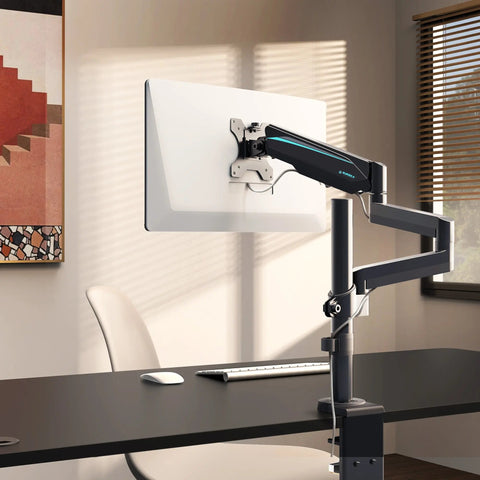
Strategic placement of desks and storage units can serve this purpose. For instance, the Standing Desk with Drawers, Wood Finish (47'' /55'') provides a dual benefit. When used in a huddle configuration, the desk's solid construction and integrated drawers act as a low-level sound block. More importantly, the included ergonomic monitor stand raises the display to eye level—aligned with OSHA eTools: Computer Workstations - Monitors—which also serves as a vertical diffraction point for sound waves traveling across the desk surface.
3. The Surface Zone: Mitigating Flutter Echo
Hard, reflective surfaces are the enemies of acoustic clarity. Tempered glass or high-gloss laminates can exacerbate "flutter echo," where sound bounces rapidly between parallel surfaces, increasing perceived noise levels.
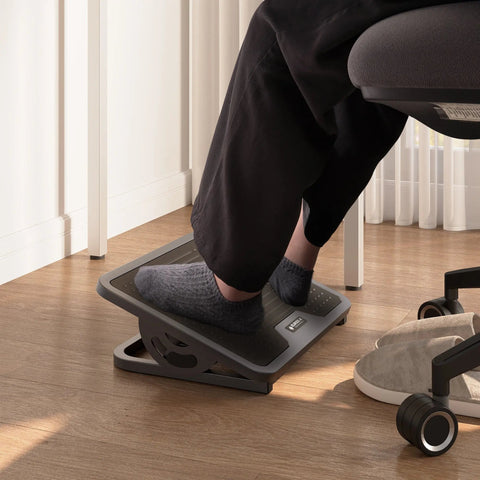
To mitigate this, successful installations pair sleek desks with under-desk acoustic treatments or large, fabric-covered accessories. Incorporating elements like the Footstool with Wheels does more than just support the Neutral Working Posture recommended by OSHA; it adds another layer of soft material to the floor area, helping to dampen floor-level sound reflections.
Practical Recommendations for Acoustic Optimization
Designing a collaborative space that respects privacy requires a balance of ergonomic science and spatial logic. As detailed in The 2026 Workstation White Paper: Converging Ergonomic Science and Sustainable Engineering, the integration of furniture and environment is the key to productivity.

The Sit-Stand Rhythm and Acoustic Load
While the primary focus of a Standing Desk with Drawers, Wood Finish (47'' /55'') is to reduce sedentary time—a goal supported by the WHO 2020 Guidelines on Physical Activity—it also changes the acoustic landscape. When users stand, their voices carry further because they are no longer shielded by the "acoustic shadow" of seated furniture.
Pro-Tip: Position standing workstations so that users face away from quiet zones. This ensures that the directional nature of human speech is aimed toward less sensitive areas of the office.
Material Selection: NRC vs. STC
When selecting furniture for acoustic value, distinguish between two key ratings:
- Noise Reduction Coefficient (NRC): Measures how much sound a surface absorbs. Aim for furniture and panels with an NRC of 0.70 or higher for effective noise dampening.
- Sound Transmission Class (STC): Measures how much sound is blocked from passing through a barrier. Lateral file cabinets and heavy desks typically provide a moderate STC (15–20), which is sufficient for interrupting direct sound lines in open plans.
Layout Checklist for Huddle Rooms
- Stagger Conversation Points: Avoid placing huddle tables directly opposite each other.
- Use "Soft" Barriers: Integrate fabric-upholstered seating like the Lounge Chair-Red Yellow & Blue Yellow Stripe at the perimeter of the zone to absorb peripheral noise.
- Manage Reflections: If the room has large windows, ensure the furniture layout uses vertical elements (like monitor risers) to break up the path of sound toward the glass.
- Prioritize Foot Comfort: Use accessories like the Footstool with Wheels to encourage posture changes, which reduces the physical restlessness that often leads to increased ambient noise (tapping, chair movement).
A Holistic Approach to Workplace Wellness
Acoustic privacy is not just about silence; it is about "cognitive comfort." By reducing the Speech Transmission Index and managing the "layered defense" of the workspace, organizations can create environments where focus and collaboration coexist.
As noted in our previous exploration of Planning a Hybrid Office, the choice of furniture is a strategic investment in the employee experience. When you align your office layout with established standards like BIFMA G1-2013 and ISO 9241-5, you are not just buying desks and chairs—you are engineering a space where ideas can be discussed securely and healthily.
YMYL Disclaimer: This article is for informational purposes only and does not constitute professional medical, legal, or architectural advice. The ergonomic and acoustic strategies discussed should be evaluated based on your specific office environment and local building codes. Individuals with pre-existing musculoskeletal conditions should consult a qualified healthcare professional or professional ergonomist before making significant changes to their workstation.
Sources
- BIFMA G1-2013 Ergonomics Guideline for Furniture
- ISO 9241-5:2024 Workstation layout & postural requirements
- OSHA eTools: Computer Workstations
- WHO 2020 Guidelines on Physical Activity & Sedentary Behaviour
- EU-OSHA: Musculoskeletal disorders and prolonged static sitting
- The 2026 Workstation White Paper: Converging Ergonomic Science and Sustainable Engineering




Leave a comment