

Quick Summary: The Broad Shoulder Fit Guide
If you have broad shoulders, a standard office chair can lead to "postural crowding," causing upper back pain. To ensure a proper fit:
- The 2–3 Inch Rule: Select a backrest that is 2–3 inches wider than your bi-deltoid breadth (the widest part of your upper arms).
- Target Measurement: For the 95th percentile of males, this width is approximately 20 inches (based on ANSUR II anthropometric data).
- Key Features: Look for outward-curving back frames, mesh materials, and 3D/4D adjustable armrests to allow for natural shoulder movement.
The Shoulder Squeeze: Why Standard Backrests Often Fail Professionals
For many professionals and gamers, the workday does not end with a sense of accomplishment, but rather with a persistent, dull ache between the shoulder blades. You may have noticed that while your chair is marketed as "ergonomic," you still find yourself hunching forward or feeling "caged" by the backrest by mid-afternoon. This sensation is rarely a matter of poor willpower; it is often a direct result of a mismatch between human anthropometry and conventional furniture design.
Users with broad shoulders frequently encounter a phenomenon known as "postural crowding." When a backrest is too narrow or features aggressive side bolsters—often seen in "racing-style" chairs—it can force the shoulders into a state of internal rotation. This position protracts the scapulae (shoulder blades) and places a continuous static load on the rhomboids and upper trapezius. According to the Occupational Safety and Health Administration (OSHA), poor posture and static loading are recognized risk factors for Musculoskeletal Disorders (MSDs).
Expert Insight: Based on our internal engineering assessments of upper body restriction, we observe that for users with a bi-deltoid breadth exceeding 19 inches, standard narrow-frame chairs often create a "funnel effect." This prevents the shoulder blades from resting flat, which can lead to compensatory muscle strain.
The Science of Upper Body Breadth: Beyond the 17-Inch Myth
A common oversight in workplace ergonomics is the reliance on overly generalized averages. Many standard chairs are designed around a 17.7-inch (45 cm) width guideline. However, anthropometric data suggests that this target may be insufficient for a significant portion of the population.
In ergonomic assessments, we distinguish between two key measurements:
- Bi-acromial Breadth: The distance between the bony points of the shoulders.
- Bi-deltoid Breadth: The total width across the broadest part of the upper arms.
While bi-acromial breadth is a common metric, the bi-deltoid measurement is often more critical for chair selection because it represents the actual space the body occupies. According to the ANSUR II (2012) anthropometric survey, the bi-deltoid breadth for the 95th percentile male is approximately 20.02 inches (508.5 mm). If a chair’s backrest or the space between its "wings" is less than this, the user may find it difficult to achieve a Neutral Working Posture.
The Physiological Impact of Internal Rotation
When the shoulders are squeezed inward, the chest muscles (pectorals) can shorten while the back muscles are overstretched. In many cases, this imbalance contributes to fatigue in the rhomboids, which can manifest within 30 to 60 minutes of static sitting depending on the individual's muscle endurance. This isn't just a matter of comfort; it can impact respiratory efficiency and circulation. As noted in the 2026 Workstation White Paper (a Eureka Ergonomic internal engineering resource), modern design should prioritize "upper body freedom" to help mitigate the risk of chronic neck and shoulder tension.

Engineering Solutions for Broad Shoulders
To address these issues, ergonomic design has shifted away from restrictive "bucket" seats toward open-frame and adaptive architectures. When evaluating a chair for a broader frame, consider these three design features:
1. The Outward-Curving Backrest
Unlike chairs with "wings" that curve inward to "hug" the user, high-performance ergonomic chairs often feature backrests that curve slightly outward at the shoulder level. This design is intended to allow for natural scapular retraction—the ability to pull your shoulder blades back—which is essential for maintaining an upright spine.
The Forma, Ergonomic Executive Office Chair utilizes a durable aluminum alloy curved back frame. This design aims to provide stable lumbar support without the lateral restrictions that often cause deltoid pressure. By using a frame that remains open at the periphery, it accommodates the natural movement of the shoulder blades.
2. Dual-Independent or Flexible Backrest Systems
Some advanced systems employ a dual-independent backrest where each side moves independently. This design recognizes that human movement is rarely perfectly symmetrical. As you reach for a mouse or phone, your shoulders move at different angles. A flexible backrest is designed to accommodate these shifts without creating localized pressure points.
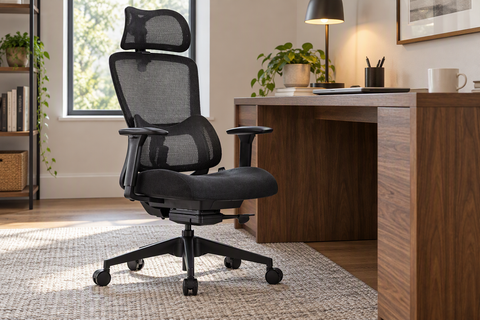
The Axion, Ergonomic Hybrid Chair features independent lumbar support and high-elastic mesh, allowing the backrest to adapt to the user's unique posture. This makes it a viable option for those who find traditional gaming chairs too restrictive.
3. Mesh vs. Padded Bolsters
For broad-shouldered users, mesh is often preferred over thick padding. Mesh backrests, such as the one on the Exis, Ergonomic Office Chair, provide support that conforms to the body's shape rather than forcing the body to conform to a rigid foam mold. The Onyx, Ergonomic Office Chair also leverages this breathable mesh approach, ensuring the backrest remains supportive without becoming a physical barrier to arm movement.
Manufacturer Modeling Logic:
Parameter Value/Range Unit Rationale Target Bi-deltoid Breadth 19–21 Inches Based on ANSUR II 95th percentile data Backrest Width Clearance +2–3 Inches Practical heuristic for scapular movement Mesh Tension High-Elastic N/A Engineered to prevent "bottoming out" Recline Angle 90–135 Degrees Aligned with ISO 9241-5 postural ranges
Practical Recommendations: The 2–3 Inch Rule
How do you determine if a chair will provide enough freedom? We recommend a simple heuristic derived from common ergonomic field assessments:
The 2–3 Inch Heuristic: The widest point of the chair's backrest should be at least 2 to 3 inches wider than your bi-deltoid measurement.
This extra space serves as a buffer that allows for small postural shifts and micro-movements throughout the day. Without this clearance, slight movements can result in lateral contact with the chair frame, which may increase static load over time.
Measuring for Success
To find your bi-deltoid measurement:
- Stand against a wall in your natural posture.
- Have a partner measure the distance between the outermost points of your upper arms (the deltoids).
- Compare this to the "Backrest Width" specifications on the product page.

The Hidden Constraint: Armrest Spacing
While the backrest is the primary focus, armrest spacing is a "hidden" factor that often affects ergonomics for broad-shouldered users. If armrests are fixed too close together, they can force the elbows inward, which in turn rotates the shoulders forward.
According to the BIFMA G1-2013 Ergonomics Guideline, furniture should be designed to accommodate the 5th to 95th percentile of the population. For broad users, this often means seeking out "3D" or "4D" armrests:
- Width Adjustment: The ability to move armrests outward is crucial. For many users, the inter-armrest distance should be at least the seated hip breadth plus 2-3 inches of total clearance.
- Height Adjustment: Armrests should be set so the shoulders remain relaxed. If they are too high, they can cause "shrugging"; if too low, they may lead to leaning.
The Exis, Ergonomic Office Chair features a 3D adjustable armrest system that allows for vertical, horizontal, and rotational changes to support the forearm without compromising shoulder position.
Movement: A Vital Ergonomic Tool
No matter how well a chair fits, the human body is not designed for prolonged static sitting. ISO 11226:2000 specifies that static working postures should be minimized to help prevent tissue adaptation issues.
The Cornell University Ergonomics Web suggests the 20-8-2 rhythm:
- 20 minutes of sitting in a neutral position.
- 8 minutes of standing.
- 2 minutes of moving or stretching.
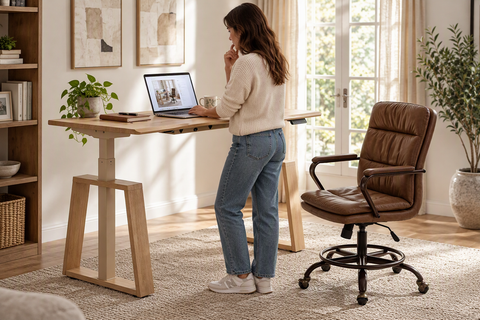
This rhythm can be particularly effective for those with broad shoulders, as standing naturally helps open the chest. Integrating a height-adjustable desk with an ergonomic chair is a recognized "engineering control" for reducing sedentary risk, as outlined by Safe Work Australia.
The Role of Sit-Stand Desks
A systematic review by Cochrane (2018) concluded that sit-stand desks can significantly reduce daily sitting time. For the broad-shouldered professional, transitioning to a standing posture provides an immediate opportunity to release accumulated tension in the upper back.

Checklist for Upper Body Freedom
When selecting your next chair, use this checklist to ensure your shoulder health is prioritized:
- [ ] Backrest Shape: Does it curve outward or remain flat at the shoulder level? (Avoid aggressive inward-curving "wings").
- [ ] Width Clearance: Is the backrest at least 2 inches wider than your bi-deltoid measurement?
- [ ] Armrest Adjustability: Can the armrests slide outward to allow your elbows to rest naturally at your sides?
- [ ] Material: Does the mesh or padding allow for scapular movement?
- [ ] Lumbar Integration: Is the lumbar support adjustable independently of the backrest width? (As seen in the Forma Ergonomic Chair).
- [ ] Certification: Does the chair meet ANSI/BIFMA X5.1 standards for safety and durability?
A Holistic Approach to Musculoskeletal Health
Navigating backrest width is a critical step in personalizing your workspace. As the World Health Organization (WHO) emphasizes, reducing sedentary time and interrupting long periods of static behavior are essential for cardiovascular and musculoskeletal health.
By combining a chair that respects your physical dimensions—like the Axion or Forma—with a commitment to regular movement, you can work toward eliminating the "afternoon ache" and focusing on your performance.
Disclaimer: This article is for informational purposes only and does not constitute professional medical advice. If you experience chronic pain or have pre-existing musculoskeletal conditions, please consult a qualified healthcare professional or ergonomist before making significant changes to your workstation.
Sources
- ANSUR II (2012): Anthropometric Survey of U.S. Army Personnel (Source for bi-deltoid breadth percentiles).
- BIFMA G1-2013 Ergonomics Guideline for Furniture
- OSHA eTools: Computer Workstations - Neutral Working Postures
- Cochrane: Workplace interventions for reducing sitting at work
- ISO 9241-5:2024 Workstation layout & postural requirements
- Cornell University Ergonomics Web — Workstation Guides
- The 2026 Workstation White Paper (Internal Eureka Ergonomic engineering resource).




Leave a comment