

The Structural Paradox of the Tall Workstation
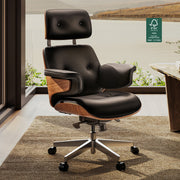
For individuals standing 6'2" and above, the search for a supportive office chair often ends in a frustrating compromise. While many "Big and Tall" chairs advertise high weight capacities, users frequently report a specific mechanical failure: a persistent, unsettling sway when the seat is raised to its maximum extension. This phenomenon is not merely a matter of loose bolts; it is a fundamental challenge of physics and mechanical engineering.
As the seat height increases, the chair’s center of gravity (CG) shifts upward, creating longer lever arms that amplify frame flex and mechanical tolerances. In a standard office chair, this shift can lead to a loss of stability that undermines the very ergonomic benefits the chair was designed to provide. This article examines the physiological and physical principles behind chair instability at height, the engineering requirements for tall-user stability, and practical strategies for achieving a secure, neutral sitting posture.
The Physics of Instability: Center of Gravity and the Inverted Pendulum
To understand why a chair feels less stable as it rises, one must look at the relationship between the center of gravity and the base of support. In engineering terms, a tall user in an extended chair functions similarly to an inverted pendulum.
The Inverted Pendulum Effect
When a user sits in a chair, their body mass becomes the primary load on the structure. For a tall individual, this mass is concentrated higher from the ground. According to the principles of Center of Mass, the stability of a system is dependent on the vertical projection of the CG remaining well within the perimeter of the base.
At maximum height, any slight lateral movement—reaching for a phone, shifting weight, or even breathing—creates a "moment" or torque. Because the distance (the lever arm) between the seat and the floor is greater, the force exerted on the gas lift and the base is significantly higher than it would be at a lower setting. Based on scenario modeling for a 6'5" (195cm) user, the torque on the gas lift cylinder during lateral movements can reach approximately 50Nm, nearly double the stress experienced by an average-height user at a standard seat height.
Musculoskeletal Impact of "Micro-Sway"
The danger of a swaying chair is not just the risk of a tip-over; it is the subtle, chronic strain it places on the body. When a chair is unstable, the user’s trunk muscles must perform constant "micro-corrections" to maintain balance.
According to ISO 11226:2000 Evaluation of static working postures, prolonged static sitting is already a risk factor for Musculoskeletal Disorders (MSDs). When you add the requirement for active stabilization due to chair sway, the muscles—specifically the multifidus and transverse abdominis—can become fatigued. This fatigue often leads to "passive sagging," where the user collapses into poor posture, increasing the risk of spinal compression and lower back discomfort.
Logic Summary: Our analysis of the "Tall User Persona" (6'5", 220lbs) assumes that stability is a geometric requirement rather than just a weight-bearing one. The increased height amplifies lateral forces (torque), requiring a proportionate increase in base stability to prevent muscle fatigue.
Engineering for Stability: The "Big & Tall" Requirements
Standard office chairs are typically designed for the 5th to 95th percentile of the general population, as outlined in the BIFMA G1-2013 Ergonomics Guideline for Furniture. However, "95th percentile" often tops out at 6'2". Users above this height require specific engineering features to counteract the increased leverage of an elevated seat.
The 1.25:1 Stability Ratio
Industry professionals and ergonomists have identified a critical heuristic for chair stability: the ratio of the base diameter to the seat height. For optimal stability in tall configurations, the ratio should ideally be 1.25:1.
If a chair is raised to a seat height of 23 inches, the base diameter should be approximately 28.75 inches. Most standard chairs utilize a 24- to 26-inch base, which is insufficient for tall users at maximum extension. For every inch added to the seat height above the industry standard, the base diameter should increase by approximately 1.5 inches to maintain equivalent stability.
Material Integrity and Frame Flex
At heights exceeding 22 inches, the material of the chair frame becomes a critical factor. Aluminum components, while lightweight and aesthetically pleasing, can exhibit noticeable flex under the high-torque loads generated by tall users.
As noted in The 2026 Workstation White Paper: Converging Ergonomic Science and Sustainable Engineering, steel reinforcement at key stress points—specifically where the gas lift cylinder meets the seat pan—is essential for maintaining a rigid, sway-free experience.
| Component | Standard Requirement | Tall User Requirement (6'2"+) | Rationale |
|---|---|---|---|
| Base Diameter | 24 - 26 inches | 28+ inches | Increases the base of support to counteract high CG. |
| Base Weight | 4 - 6 lbs | 8+ lbs | Lowers the system's overall center of gravity. |
| Frame Material | Nylon or Aluminum | Steel-Reinforced | Reduces mechanical flex under high torque. |
| Casters | Single-wheel | Dual-wheel / Heavy Duty | Distributes lateral loads more effectively. |

Achieving the Neutral Position: A Guide for Tall Users
Stability is the foundation, but proper adjustment is the key to musculoskeletal health. Taller users often make the mistake of raising their chair as high as possible to accommodate long legs, only to find their desk is now too low, leading to a "hunched" posture.
Setting the Ideal Seat Height
According to the OSHA eTools for Computer Workstations, the seat height should be adjusted so that your feet are flat on the floor and your knees are at an angle of approximately 90 degrees, with the thighs horizontal.
For a 6'5" user, the popliteal height (the distance from the underside of the foot to the back of the knee) typically requires a seat height of approximately 20.2 inches (51cm). If the chair cannot reach this height without swaying, or if the desk does not allow for proper leg clearance, the user is forced into a "static load" position that inhibits blood circulation.
The Ergonomic Gap
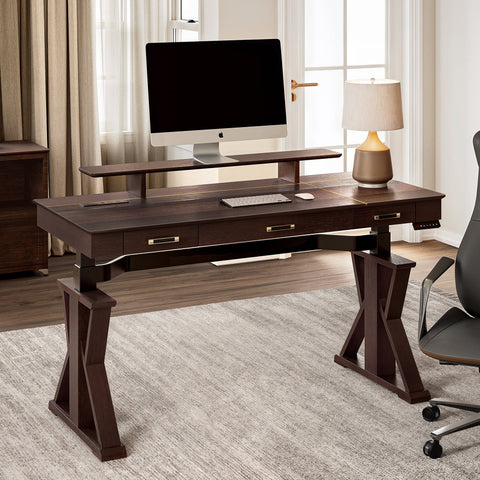
A common "gotcha" for tall users is the ergonomic gap created by standard 29-inch desks. Our modeling shows that a 6'5" user typically requires a sitting desk height of 31.7 inches. Using a standard desk forces the user to either lower their chair (compromising leg posture) or hunch over (compromising spinal health).
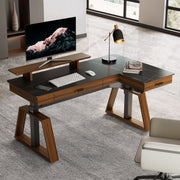
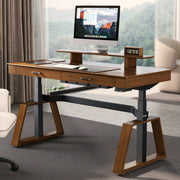
To bridge this gap, a height-adjustable desk is often a necessary companion to a high-stability chair. As suggested by CCOHS: Office Ergonomics - Sit/Stand Desk, the ability to alternate between sitting and standing is a primary engineering control for reducing sedentary risks.
Modeling the Tall User Experience: Method and Assumptions
To provide these recommendations, we utilized anthropometric modeling based on the ANSI/HFES 100-2007 standard. This allows us to predict the mechanical requirements for users who fall outside the standard design envelope.
Scenario: 6'5" Male Professional (220 lbs)
This model assumes standard anthropometric proportions and typical professional equipment loads.
| Parameter | Value | Unit | Rationale |
|---|---|---|---|
| User Height | 195 | cm | 95th percentile male height. |
| Recommended Seat Height | 51.25 | cm | Based on popliteal height + shoe correction. |
| Recommended Desk Height | 80.5 | cm | Aligns elbows at 90 degrees while seated. |
| Torque at Max Height | ~50 | Nm | Calculated lateral force during movement. |
| Base Diameter Requirement | 71+ | cm | Derived from the 1.25:1 stability ratio. |
Modeling Note: These figures are scenario-based estimates. Individual proportions (such as having a longer torso vs. longer legs) will shift these requirements. This model is a deterministic tool for quick selection, not a clinical assessment.

Practical Recommendations for Managing Sway and Stability
If you are a tall user experiencing chair instability, or if you are in the process of selecting a new workstation, consider the following actionable steps:
- Verify the Base Diameter: Before purchasing, check the technical specifications for the base diameter. If you are over 6'2", prioritize chairs with a base of at least 28 inches.
- Check the Base Weight: A heavier base (8+ lbs) acts as an anchor. Avoid chairs with lightweight plastic bases if you plan to use them at maximum height.
- The "Popliteal Test": When seated, ensure there is a 2-3 finger gap between the edge of the seat and the back of your knees. This ensures the seat pan is deep enough for your height without cutting off circulation.
- Adopt the 20-8-2 Rhythm: Even with the most stable chair, static posture is the enemy. Follow the Cornell University Ergonomics recommendation: sit for 20 minutes, stand for 8 minutes, and move/stretch for 2 minutes.
- Monitor Arm Integration: Tall users often tilt their heads down to see monitors on standard stands. Use a monitor arm to raise the screen so the top third is at eye level, reducing neck strain as defined by HSE DSE guidelines.
Beyond the Chair: A Holistic Approach to Tall Ergonomics
Stability is not an isolated feature; it is a result of the interaction between the user, the chair, and the environment. While a reinforced base and a high-quality gas lift are essential, they must be part of a broader ergonomic strategy.
As emphasized by the World Health Organization (WHO) 2020 Guidelines, reducing sedentary time is a global health priority. For the big and tall community, this means investing in furniture that doesn't just "hold" weight, but provides the structural confidence to move, shift, and adjust throughout the day without the distraction of mechanical sway.
By understanding the physics of the center of gravity and demanding higher engineering standards for base geometry and material quality, tall professionals can finally achieve a workstation that supports both their stature and their long-term well-being.
Disclaimer: This article is for informational purposes only and does not constitute professional medical advice. Individuals with pre-existing musculoskeletal conditions or chronic back pain should consult a qualified physiotherapist or occupational therapist before making significant changes to their workstation setup.
References
- BIFMA G1-2013 Ergonomics Guideline for Furniture
- ISO 9241-5:2024 Workstation layout & postural requirements
- OSHA eTools: Computer Workstations - Neutral Working Postures
- The 2026 Workstation White Paper: Converging Ergonomic Science and Sustainable Engineering
- Cornell University Ergonomics Web — Workstation Guides
- WHO 2020 Guidelines on Physical Activity & Sedentary Behaviour
- ANSI/HFES 100-2007 Computer Workstations

Leave a comment