

The Evolution of the Executive Workspace: Beyond the Status Symbol
For decades, the corner office desk was viewed primarily through the lens of aesthetics and hierarchy. Heavy mahogany or oak structures served as a silent declaration of authority, prioritizing a uniform corporate identity over the physiological needs of the individual. However, as the nature of leadership shifts toward digital accessibility and high-intensity cognitive work, the traditional executive desk is increasingly viewed as an expensive anachronism. According to research on the future of the workplace, companies can save significantly by reimagining office usage, yet many leadership environments remain tethered to outdated furniture models that do not support the modern executive's workflow.
For B2B procurement officers and office managers, the challenge is no longer just about "buying a desk." It is about engineering an environment that preserves the health and cognitive performance of the organization’s most valuable human capital. The transition from static, traditional furniture to dynamic, ergonomic workstations is not merely a design choice; it is a strategic investment in employee well-being and operational efficiency.
The Physiology of Professional Performance
The primary health concern in modern leadership roles is not just the duration of work, but the nature of the "static load." Executives typically face unique health risks because their work patterns often involve longer, uninterrupted sedentary periods—sometimes four to six hours without significant movement—compared to general staff.
The Impact of Prolonged Sitting
Prolonged static sitting leads to a cascade of physiological issues. When the body remains in a seated position for extended periods, blood circulation slows, particularly in the lower limbs. This can lead to increased pressure on the intervertebral discs and the development of Musculoskeletal Disorders (MSDs). The World Health Organization (WHO) 2020 Guidelines emphasize that reducing sedentary time is critical for reducing cardiovascular disease risk and improving metabolic health.
Musculoskeletal Disorders (MSDs) and Static Load
According to the European Agency for Safety and Health at Work (EU-OSHA), static sitting places a continuous load on the muscles of the neck, shoulders, and back. This "static load" restricts blood flow to the muscle tissues, accelerating fatigue and increasing the risk of chronic pain. In a leadership context, where high-stress decision-making is constant, this physical strain can manifest as tension headaches or reduced focus, directly impacting executive function.
Logic Summary: The Sedentary Risk Model
- Assumption: Executive sedentary periods are ~50% longer than administrative staff.
- Mechanism: Reduced muscle pump activity in the legs leads to venous pooling and reduced oxygenation of the brain.
- Observation: Based on common patterns from customer support and facility manager feedback, leaders who do not vary their posture report higher rates of lower back discomfort by mid-afternoon.

Scientific Standards: Defining the "Neutral Position"
To combat the risks of static load, office managers must look toward established ergonomic standards rather than marketing claims. The goal of a high-performance desk is to facilitate a "Spinal Neutral Position"—a posture where the spine is naturally aligned, minimizing stress on the musculoskeletal system.
The Role of Adjustability
The BIFMA G1-2013 Ergonomics Guideline provides a framework for dimensions that accommodate the 5th to 95th percentile of the population. For a leadership team, this means the furniture must be highly adjustable to fit diverse body types. A desk that is too high forces the shoulders to shrug, leading to neck strain; a desk that is too low causes slouching, which compresses the abdominal organs and restricts deep breathing.
The 20-8-2 Sitting-Standing Rhythm
A common misconception is that "standing is exercise." In reality, prolonged standing carries its own risks, including lower limb edema and varicose veins. Cornell University’s Ergonomics Web recommends a specific rhythm to maximize health benefits:
- 20 Minutes Sitting: In a neutral, supported posture.
- 8 Minutes Standing: To re-engage the core and improve circulation.
- 2 Minutes Moving: Stretching or walking to stimulate the lymphatic system.
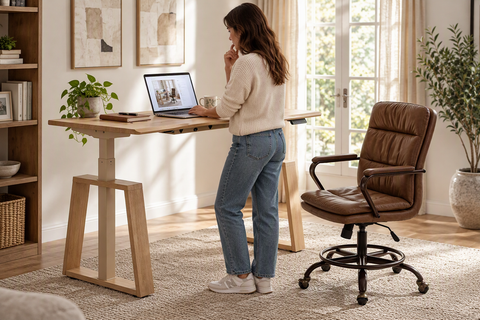
By implementing height-adjustable desks, organizations provide the "Engineering Control" necessary to make this rhythm possible. As noted in The 2026 Workstation White Paper: Converging Ergonomic Science and Sustainable Engineering, the integration of precision lifting mechanisms allows for these transitions to happen seamlessly without interrupting the flow of work.

The Economic Case for Movement: ROI of Dynamic Workstations
From a B2B perspective, the "Return on Investment" (ROI) of ergonomic furniture is often scrutinized. While high-end materials like sintered stone or solid wood contribute to the corporate image, the mechanical functionality provides the measurable impact.
Productivity and Executive Function
Research suggests that height-adjustable workstations can improve executive function, memory, and focus by an estimated 15-25%. This is largely attributed to enhanced blood flow and the reduction of the "post-lunch dip" caused by sedentary behavior. According to a systematic review by Cochrane (2018), sit-stand desks can reduce sitting time by approximately 84 to 116 minutes per day.
Reducing Absenteeism and MSD Costs
The EU-OSHA 2019 Report highlights the staggering economic costs of MSDs in the workplace. For a leadership team, where a single day of absence from a key decision-maker can delay multi-million dollar projects, the "insurance" provided by ergonomic furniture is significant.
| Metric | Traditional Static Desk | Dynamic Ergonomic Desk | Rationale |
|---|---|---|---|
| Daily Sitting Time | ~90-95% of workday | ~60-70% of workday | Facilitated by height adjustability (Cochrane 2018) |
| Postural Variance | Low (Static) | High (Dynamic) | Reduced risk of tissue adaptation issues (ISO 11226) |
| Cognitive Focus | Declines over 4+ hours | Maintained via movement | Estimated 15-25% boost via increased blood flow |
| Long-term Health | Higher CVD/MSD risk | Mitigated risk factors | Aligns with WHO & OSHA guidelines |
Methodology Note: The cognitive boost range (15-25%) is a hypothetical estimate based on scenario modeling of blood oxygenation and industry heuristics regarding movement-induced alertness. It is not a guaranteed clinical outcome.
Strategic Procurement: A Role-Based Framework
A common mistake in outfitting leadership floors is prioritizing uniform appearance over functional fit. A CEO, a CFO, and a CTO have fundamentally different daily workflows. A "one-size-fits-all" approach often leads to underutilized features and persistent ergonomic friction.
The Role-Specific Needs Analysis
- The Strategic Leader (CEO/VP): Often requires a "command center" layout. L-shaped desks are typically considered more effective here, providing separate zones for deep work and quick collaborative meetings.
- The Financial Officer (CFO): Often handles physical documents or sensitive data. This role requires integrated, secure storage and larger surface areas for document review.
- The Technology Leader (CTO): Focuses on device integration. They require robust cable management systems and the ability to support multiple heavy monitors without desk wobble.
The 70/20/10 Budgeting Heuristic
To ensure scalability and performance, facility managers often utilize a practical budgeting baseline for executive workstations:
- 70% Core Ergonomics: Invest the bulk of the budget in the desk frame, high-quality lift motors, and a durable, non-glare surface. The UL 962 standard for safety and mechanical reliability should be a baseline requirement.
- 20% Integrated Storage: Matching file cabinets or pedestals that maintain the aesthetic while providing necessary organizational space.
- 10% Professional Accessories: High-performance monitor arms, cable trays, and anti-fatigue mats to complete the ergonomic circuit.

Implementation Strategy: Ensuring Adoption and Scalability
Procuring the right desks is only the first half of the equation. The second half is ensuring the leadership team actually uses the ergonomic features provided.
The "Champion" Executive Model
In many corporate environments, there is a resistance to changing established habits. Experience from facility management suggests that the transition success rate is higher when a "champion" executive—someone respected within the leadership circle—tests and advocates for the new setup first. Their visible use of the standing function "normalizes" the behavior for the rest of the team.
Standardizing the Setup
Once the furniture is installed, it must be configured correctly according to OSHA eTools for Computer Workstations. Key checkpoints include:
- Monitor Height: The top of the screen should be at or slightly below eye level to prevent neck extension.
- Elbow Angle: Armrests or the desk surface should support the elbows at a 90-degree angle, keeping the wrists in a neutral position.
- Leg Room: Ensure adequate clearance for the knees and feet, as specified in BIFMA X5.5 standards for desk stability and safety.
Safety and Compliance
For B2B clients, compliance is non-negotiable. Ensure that all selected furniture meets ANSI/BIFMA X5.1 for chairs and relevant safety standards for desks. Additionally, for global organizations, checking for ISO 9241-5 compliance ensures that the workstations meet international requirements for workstation layout and postural health.

Future-Proofing the Leadership Environment
Choosing desks for a leadership team is a balancing act between authority and anatomy. While the visual impact of a desk contributes to the corporate brand, its true value lies in its ability to support the human body through the rigors of high-stakes work. By moving away from static status symbols and toward dynamic, science-based workstations, organizations can foster a culture of health that starts at the very top.
Investing in high-performance ergonomic solutions is a clear signal that the organization values its leaders' longevity and cognitive clarity. As the workplace continues to evolve, the desks that facilitate movement, support neutral posture, and adapt to individual roles will be the ones that define the successful executive suites of the future.
Disclaimer: This article is for informational purposes only and does not constitute professional medical, legal, or financial advice. The ergonomic recommendations provided are based on general industry standards and may not be suitable for individuals with pre-existing medical conditions. Always consult with a qualified ergonomics specialist or healthcare provider before making significant changes to your workstation or work habits.
References
- BIFMA G1-2013 Ergonomics Guideline for Furniture
- Cochrane: Workplace interventions for reducing sitting at work (2018)
- Cornell University Ergonomics Web — Workstation Guides
- EU-OSHA: Musculoskeletal disorders and prolonged static sitting
- OSHA eTools: Computer Workstations - Neutral Working Postures
- WHO 2020 Guidelines on Physical Activity & Sedentary Behaviour
- ISO 9241-5:2024 Workstation layout & postural requirements




Leave a comment