

The Mechanics of Desk Oscillation: Why Stability Defines Professional Performance
Many professionals encounter a subtle but persistent frustration during the workday: the high-frequency tremor of a monitor while typing or the slight lateral sway of a desk when transitioning from sitting to standing. This phenomenon, often dismissed as a minor nuisance, is a significant indicator of structural inadequacy. In an executive or high-output environment, desk stability is not merely a matter of "feel"; it is a foundational requirement for focus, precision, and musculoskeletal health.
When a workstation lacks rigidity, the user often compensates with micro-adjustments in posture. These subconscious movements can lead to increased muscle tension in the neck and shoulders, contributing to what the U.S. Occupational Safety and Health Administration (OSHA) identifies as risk factors for Musculoskeletal Disorders (MSDs). To build a truly ergonomic workspace, one must understand the engineering trade-offs between two primary structural philosophies: the reinforced steel frame and the traditional solid wood design.
The Physics of Workstation Stability: Static vs. Dynamic Loads
To evaluate a desk, one must distinguish between static load capacity and dynamic stability. Static load refers to the total weight a desk can support without structural failure. However, professional workstations are rarely static. They are subject to "dynamic loads"—the force of a user leaning on the edge, the vibration of mechanical keyboards, and the movement of motorized columns.
Understanding the WobbleIndex
In technical evaluations, stability is often quantified through the measurement of deflection at the work surface edge under a standardized lateral force. This is aligned with BIFMA X5.5 standards, which define test methods for the safety and durability of desk products. A common metric used in scenario modeling is the WobbleIndex, calculated as:
$$WobbleIndex = \frac{\Delta_{top}}{F_{lateral}}$$
Where $\Delta_{top}$ represents the displacement in millimeters and $F_{lateral}$ is the applied force in Newtons. A lower index indicates a more rigid structure. For height-adjustable desks, this index typically increases as the desk rises, because the center of gravity shifts and the overlap between telescoping leg segments decreases.
The Role of Vibration Dampening
While rigidity prevents "wobble" (low-frequency oscillation), dampening addresses "vibration" (high-frequency oscillation). According to research on Vibration Dampening Properties, solid wood possesses excellent natural dampening characteristics compared to hollow metal tubes. This is why high-end audio equipment often sits on wooden blocks. In a desk environment, a solid wood top or frame can absorb the "clack" of a heavy typist, whereas a poorly engineered steel frame might resonate, amplifying the noise and sensation.
Steel Frame Engineering: Rigidity Through Geometry
For the modern executive, the steel frame—particularly in height-adjustable models—offers a level of precision and structural integrity that is difficult to replicate with wood alone. The stability of a steel desk like the Ark EL Executive Standing Desk (60"x26") is derived from its leg geometry and the quality of its joinery.
Trapezoidal Legs and Lateral Resistance
Traditional T-frame or C-frame desks often struggle with lateral (side-to-side) stability at maximum height. The Ark EL Executive Standing Desk (60"x26") utilizes a trapezoidal leg design. By widening the base of the leg where it meets the floor and narrowing it toward the desktop, the frame creates a more stable geometric "footprint."
Key engineering features to look for in steel frames include:
- Continuous Welds: Unlike spot welding, continuous welds at the junction of the leg and the feet ensure that the frame acts as a single, unyielding unit.
- Internal Gussets: These are small triangular reinforcement plates hidden inside the joints. They prevent the "parallelogram effect," where a rectangular frame begins to lean under stress.
- Dual-Motor Synchronization: In motorized desks, stability is also a function of movement. Dual motors ensure that both sides of the desk rise at the exact same rate, preventing the "binding" that occurs in single-motor designs with hex-rod drives.

Solid Wood and Composite Designs: The Weight of Tradition
Solid wood desks are often perceived as the gold standard for executive offices due to their permanence and aesthetic "groundedness." A standard 60x30 inch solid oak slab can weigh approximately 85 lbs (38 kg), providing a massive inertial base that naturally resists movement.
The Joinery Factor
The stability of a wood desk is almost entirely dependent on its joinery. In professional-grade furniture, such as the Ark Executive Standing Desk (63"x29"), the use of high-quality veneers over a stable core combines the dampening benefits of wood with the structural predictability of engineered materials.
For pure solid wood designs, practitioners often look for:
- Mortise-and-Tenon Joints: These provide significantly more surface area for glue and mechanical interlocking than simple screws.
- Breadboard Ends: These are narrow strips of wood joined to the ends of the main panel. They allow the wood to "breathe" (expand and contract with humidity) without warping or cracking the main surface.
- Solid Wood Aprons: A thick wood frame directly under the desktop (the apron) acts as a structural beam, preventing the top from sagging under the weight of heavy monitors or CPUs.
Environmental Sensitivity
A critical "gotcha" for solid wood is its response to the environment. According to the ISO 9241-5:2024 standard, workstation layout must account for environmental stability. Wood is hygroscopic; it absorbs and releases moisture. In environments where humidity swings exceed 40%, solid wood can move by as much as 2mm across its width. If the desk relies on rigid steel brackets screwed directly into the wood without slotted holes, these seasonal movements can eventually loosen the fasteners, inducing a wobble that wasn't there during the first year of ownership.
Hybrid Solutions: The Best of Both Worlds
The most advanced executive desks, such as the Zen Pro Series, 87"/72" Executive Standing Desk with Cabinets Set, utilize a hybrid approach. These designs often pair a high-mass desktop—such as sintered stone or heavy wood—with a reinforced steel lifting system.
The Zen Pro Series, 87"/72" Executive Standing Desk with Cabinets Set leverages the extreme weight and rigidity of a Lauren Black Gold Sintered Stone top. Sintered stone is virtually impervious to the environmental warping that affects wood, while its high density provides an exceptional dampening effect for the dual-motor steel frame beneath.
The "Monitor Arm" Variable: How Accessories Induce Wobble
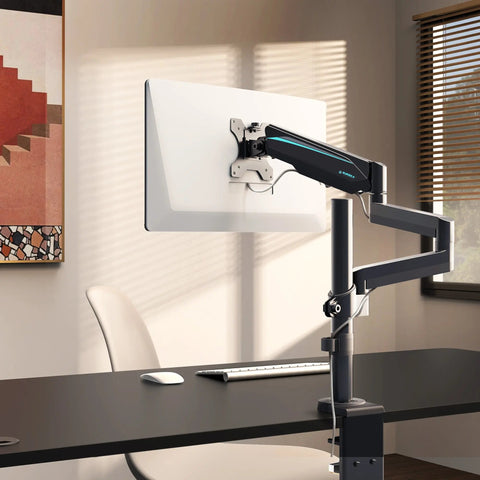
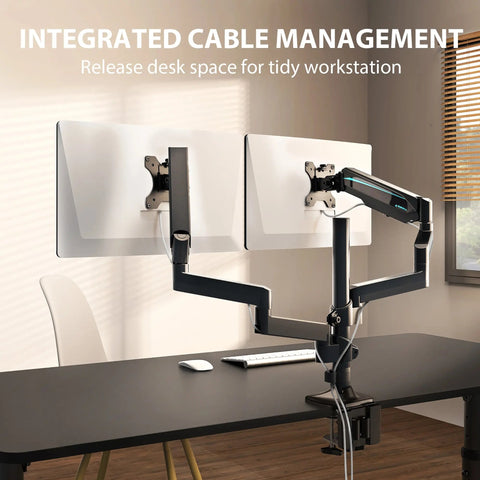
A common mistake in ergonomic assessments is underestimating how monitor placement affects perceived stability. When a user installs a Dual Monitor Arm, they are creating a "cantilevered load."
The Cantilever Effect
A cantilever is a beam supported at only one end. When two 27-inch monitors are extended forward on an arm, they act as a lever, multiplying the force applied to the desk's edge. If the arm is clamped only to a thin desktop, every keystroke on the desk can cause the monitors to vibrate because the energy travels through the desktop and is amplified by the arm's length.
Expert Insight: To reduce high-frequency vibration by an estimated 60%, mount monitor arms directly over a reinforced steel frame leg or a solid wood apron rather than the middle of a thin desktop. This ensures the energy is transferred directly into the vertical support structure rather than being absorbed by the flexible "membrane" of the desktop.

Scenario Modeling: The Professional Content Creator
To demonstrate how these principles apply in a high-stakes environment, we modeled a professional streamer setup. This "Power User" persona represents the upper limit of desk stress.
Method & Assumptions
This analysis is a scenario model based on common industry heuristics and BIFMA X5.5 safety factors. It is not a controlled lab study, but an engineering-based estimate of load distribution.
| Parameter | Value | Unit | Rationale |
|---|---|---|---|
| Total Equipment Load | ~98 | kg | Dual 34" Ultrawides + Full Tower PC |
| Surface Depth | 30 | inches | Required for 34" viewing distance |
| Frame Utilization | 82 | % | Relative to 120kg dual-motor capacity |
| Lateral Force (Typing) | ~15 | Newtons | Force generated by aggressive mechanical typing |
| Target WobbleIndex | <0.15 | mm/N | Threshold for professional camera stability |
Analysis Result: For this persona, a steel-frame desk with a minimum 100kg capacity is required. A solid wood desk without a reinforced steel sub-frame would likely experience "creep" (permanent deformation) over 24–36 months under this sustained 98kg load. For users in this category, the Zen Pro Series, 87"/72" Executive Standing Desk with Cabinets Set provides the necessary structural headroom to maintain a low WobbleIndex even at standing heights.
Practical Recommendations for a Stable Setup
Regardless of the material you choose, the following steps are essential to maintaining the integrity of your workstation over time:
- The Leveling Rule: An uneven floor is the most frequent cause of "phantom wobble." Use a bubble level during assembly. Most professional desks include adjustable feet; ensure they are locked into place. An unlevel desk induces uneven stress on the joints, which can degrade the frame over time.
- The 80% Capacity Heuristic: To preserve motor life and frame rigidity, aim to keep your total equipment weight at or below 80% of the desk's rated capacity. This provides a "buffer" for dynamic forces.
- Hardware Maintenance: For wood-on-metal or wood-on-wood joints, check the tightness of screws every 12 months. Seasonal humidity changes can cause slight shifts that loosen fasteners.
- Cable Tension Check: At maximum standing height, ensure your cables have enough "slack." According to the HSE: Working safely with display screen equipment (DSE), restricted movement can lead to poor posture. Furthermore, tight cables can act like guitar strings, transferring vibrations from the floor or PC directly to your monitors.
- Sit-Stand Rhythm: Follow the "20-8-2" rule recommended by Cornell University Ergonomics: sit for 20 minutes, stand for 8, and move/stretch for 2. This prevents the static load fatigue that affects both your body and the desk's structural components.
Summary of Structural Choice
| Feature | Reinforced Steel Frame | Solid Wood / Hybrid |
|---|---|---|
| Primary Benefit | Precision & High-Height Stability | Vibration Dampening & Aesthetics |
| Best For | Height-Adjustable Workstations | Permanent Executive Suites |
| Durability Factor | Resistant to humidity and warping | Requires humidity control for longevity |
| Load Handling | Excellent for cantilevered monitor arms | Excellent for heavy, centered static loads |
As detailed in The 2026 Workstation White Paper: Converging Ergonomic Science and Sustainable Engineering, the future of office design lies in the intelligent integration of these materials. Whether you prioritize the industrial rigidity of steel or the natural dampening of wood, the goal remains the same: a stable, unyielding foundation that allows your mind to focus while your body remains in a spinal neutral position.
YMYL Disclaimer: This article is for informational purposes only and does not constitute professional medical, legal, or engineering advice. Ergonomic needs vary significantly based on individual physical health and pre-existing conditions. Always consult with a qualified ergonomist or healthcare professional before making significant changes to your workspace, especially if you suffer from chronic back or neck pain.
References
- BIFMA G1-2013 Ergonomics Guideline for Furniture
- ISO 9241-5:2024 Workstation layout & postural requirements
- OSHA eTools: Computer Workstations - Neutral Working Postures
- Cornell University Ergonomics Web — Workstation Guides
- Cochrane: Workplace interventions for reducing sitting at work
- The 2026 Workstation White Paper




Leave a comment