

Key Takeaways for Dual‑Motor CAD Workstations
- Keep loads within tested limits, with margin. Treat the capacity and utilization numbers in this article as scenario examples based on common spec sheets, not as ratings for your specific desk. Always check your manufacturer’s datasheet.
- Prioritize balance over raw capacity. Aim to keep your setup’s center of mass within the central third of the desktop. Treat the “Central Third Rule” as a practical rule of thumb, not a formal standard.
- Favor dual motors for heavy, asymmetric CAD loads. In the example model below, a dual‑motor system runs with substantially more headroom than a single motor under similar loads, reducing the risk of drift and uneven lift.
- Use a repeatable “Slow Cycle” check. Run a slow, full travel test about once a month using a simple measurement method (tape measure or laser line) to detect leg drift and decide when to recalibrate.
- Health guidance is general, not medical. The sit–stand rhythms and MSD comments here summarize general ergonomic guidance from bodies like OSHA/WHO and are not a substitute for medical advice.
The Precision Mandate: Why Motor Synchronization Matters in CAD Workstations
For a professional engineer or CAD designer, the workstation is more than a desk; it is a high-precision instrument. When supporting a hardware array that may include dual 34-inch ultrawide monitors, a liquid-cooled full-tower PC, and sensitive peripheral devices, the mechanical integrity of the lifting system becomes a critical failure point. A slight desynchronization—where one side of the desk rises faster than the other—is not merely an aesthetic annoyance. For a top-heavy CAD setup, a small tilt can translate to significant lateral stress on monitor arms, potentially leading to equipment damage or the gradual loosening of precision-mounted components.
A common cause of lift failure in high-end setups is not usually the inherent quality of the motors, but the management of asymmetric load distribution. Mounting a heavy tower PC on one side and multiple large-format monitors on the other can create a persistent torque that strains one motor, leading over time to additional wear. Maintaining the level stability of these surfaces requires an understanding of both the physiological needs of the user and the mechanical limits of dual-motor synchronization.
The Physiology of the Technical Workspace: Beyond "Sitting vs. Standing"
The transition to height-adjustable workstations is often framed as a health trend, but for technical professionals, it is also a tool for managing Musculoskeletal Disorders (MSDs). According to the Occupational Safety and Health Administration (OSHA), core risk factors for MSDs include repetitive tasks and poor posture. In CAD environments, where designers often remain in static positions for hours while performing high-precision mouse movements, the risk of "static load" is high.
Static load occurs when muscles remain contracted to hold a position, impeding blood circulation and contributing to fatigue. The World Health Organization (WHO) 2020 Guidelines emphasize reducing sedentary time to mitigate cardiovascular risks. However, simply standing is not a panacea. Prolonged static standing can lead to lower limb discomfort and related issues. A practical approach, summarized in The 2026 Workstation White Paper: Converging Ergonomic Science and Sustainable Engineering (a manufacturer white paper), lies in dynamic movement and the maintenance of a "spinal neutral position."
An often-cited ergonomic strategy utilizes the "20-8-2" rhythm discussed by the Cornell University Ergonomics Web: roughly 20 minutes of sitting, 8 minutes of standing, and 2 minutes of moving or stretching. This is a heuristic pattern, not a rigid prescription, derived from general ergonomic principles and field guidance rather than a single mandatory standard.
For this rhythm to be practical, the desk must transition between heights with reliable, repeatable motion. If the desk exhibits "stutter" or tilt during frequent transitions, the user is less likely to use the sit-stand functionality consistently, reducing the ergonomic benefit.
Health boundary note: The information in this section summarizes general ergonomic guidance (e.g., OSHA/WHO/Cornell) and is not medical advice. If you have existing MSDs or other health concerns, consult a medical professional or occupational therapist for individualized recommendations.
The Engineering Challenge: Asymmetric Torque and Motor Wear
In a dual-motor system, synchronization is achieved through electronic controllers that monitor the position and speed of each motor in real time. Modern systems use integrated encoders—often Hall effect sensors—to send pulses to the control box. If the pulses from Motor A and Motor B diverge, the controller attempts to compensate.
However, a significant imbalance in weight distribution creates "dynamic torque control" challenges. Based on common patterns seen in customer support and warranty cases (informal field data, not a controlled study), users frequently place their heaviest equipment at the extreme edges of the desk. A full-tower PC weighing on the order of 30 kg placed on the far right, balanced only by a keyboard on the left, forces the right-side motor to operate at a higher current draw. Over thousands of cycles, this can contribute to heat-induced degradation of components such as motor brushes or gear lubricants.
Logic Summary: Field analysis of high-performance workstation builds suggests that motor longevity is strongly influenced by safety margin. Operating a motor near its rated capacity under an uneven load increases the risk of positional drift, where the internal encoders lose their effective zero-point calibration.
To mitigate this, professional practitioners often use the "Central Third Rule": a practical heuristic suggesting that the center of mass for all desk-mounted equipment should ideally reside within the central third of the desktop surface. This rule is based on general mechanical principles and shop experience, not on a named formal standard.
For components that cannot be centered, such as a large PC tower, using an Adjustable CPU Stand, Mobile, Black to move the weight off the desk surface entirely is an effective engineering control. This linked product is a house-branded accessory, and similar solutions are available from other manufacturers.
Modeling the CAD Battlestation: A Technical Analysis
To understand the stress placed on dual-motor systems, we can look at a scenario model of a typical high-performance CAD professional setup. This scenario assumes a tall user (185 cm) and a heavy, asymmetric equipment load. The numbers below are illustrative estimates, not test results for any specific desk.
Method & Assumptions: Battlestation Load & Motor Safety Margin
This is a scenario model, not a controlled lab study. It uses component weight estimates from high-end hardware specifications and typical motor spec sheets to evaluate motor utilization. Always confirm the rated load and duty cycle for your actual frame with the manufacturer’s datasheet.
| Parameter | Value | Unit | Rationale / Source Category |
|---|---|---|---|
| User Height | 185 | cm | 75th percentile male (US/EU anthropometric datasets, approximate) |
| Total Static Load | ~79 | kg | Example sum: tabletop (~22 kg) + equipment (~57 kg), using typical weights from high-end monitor/PC spec sheets |
| Single Motor Capacity | 80 | kg | Illustrative entry-level value based on common single-motor frame spec sheets; check your specific model’s rating |
| Dual Motor Capacity | 120 | kg | Illustrative high-performance value based on typical dual-motor workstation frames; not a universal standard |
| Recommended Max Utilization | ~80 | % | Rule-of-thumb margin inspired by durability guidance in standards such as BIFMA X5.x and general engineering practice; not a mandated limit |
| Asymmetric Weight Bias | ~3:1 | ratio | Example ratio representing a heavy PC tower side vs. peripheral side; actual setups vary |
Example Utilization Calculation (Replicable Steps)
To make this model usable for your own setup, you can follow the same basic calculations:
-
Measure or look up component weights
- Tabletop mass (kg)
- Monitor(s) mass (kg)
- PC tower mass (kg)
- Other desk-mounted gear (kg)
-
Compute total static load
[\text{Total Static Load (kg)} = \sum \text{component weights (kg)}]
-
Find your frame’s rated capacity
- From the manufacturer datasheet or user manual: rated load for the full frame (kg).
-
Calculate utilization
[\text{Utilization (%)} = \frac{\text{Total Static Load}}{\text{Rated Capacity}} \times 100]
-
Apply a safety margin heuristic
- If utilization is well below your comfort threshold (for example, below ~70–80% as a practical rule-of-thumb for continuous use), you have more headroom for dynamic loads (leaning, occasional added items).
- If utilization approaches or exceeds that threshold, consider reducing desk-mounted weight or moving to a higher-capacity frame.
Using the illustrative values in the table above:
- Total static load ≈ 79 kg
- Example dual-motor capacity ≈ 120 kg
- Utilization ≈ 79 / 120 ≈ 0.66 → ~66% utilization in this scenario
By contrast, if the setup were placed on a frame with only ~80 kg of rated capacity (an example single-motor class):
- Utilization ≈ 79 / 80 ≈ 0.99 → ~99% utilization in this scenario
These results are scenario-specific, intended to show how utilization changes with capacity. They are not guarantees for your equipment.
The model supports two practical conclusions:
- Running close to a frame’s rated capacity leaves little margin for dynamic loads (leaning, temporary items) and may increase the risk of desynchronization under asymmetric loads.
- A higher-capacity dual-motor frame, when operated with conservative utilization, can run cooler and maintain more consistent synchronization for similar equipment.
In many cases, a standard fixed desk height is also slightly too low for taller users. For a 185 cm user, common ergonomic guidance suggests that a typical 29-inch (~74 cm) fixed desk will often be somewhat low for seated keyboard work, reinforcing the need for precise adjustability. Exact values depend on arm length, chair height, and input device position.
Advanced Synchronization: Encoders and Calibration
While basic desks rely mainly on speed matching, industrial-grade CAD workstations typically use integrated encoders that monitor both position and speed. According to general descriptions of smart furniture lifting systems, advanced algorithms now support features like "one-button alignment" and soft-start/soft-stop to keep motors synchronized.
A frequent misconception is that dual-motor systems are "set and forget." In reality, manufacturers of many frames state that a significant share of issues—from error codes to uneven legs—can be resolved with a factory reset or recalibration.
For a CAD setup where precision is important, a "Slow Cycle" test performed at regular intervals (for example, monthly) helps detect drift early.
The Monthly "Slow Cycle" Protocol (with Measurement Method)
Tools:
- A tape measure, ruler, or caliper; or
- A simple laser level / laser line (optional but improves accuracy)
Steps:
-
Clear the area
- Remove obstructions from under and around the desk.
- Ensure no cables are taut or snagging.
-
Mark reference points
- Choose a fixed reference on the wall or a column (e.g., a shelf edge or a projected laser line).
- Identify two measurement points on the underside of the desktop: one above each lifting leg.
-
Raise to maximum height
- Move the desk to its maximum rated height.
- Measure the vertical distance from the floor to each reference point on the underside of the desktop and note the readings.
-
Slow full descent
- Lower the desk to its lowest point at the slowest available speed (if the controller allows speed control).
- During motion, watch for visible stutter or uneven travel.
-
Measure at low position
- At the lowest height, repeat the floor-to-desktop measurements at both leg positions.
-
Assess drift
- Compare left vs. right readings at both high and low positions.
- As a practical threshold for many desks, if you see a difference clearly exceeding about 3 mm–4 mm (around 1/8 inch) between sides, it is reasonable to perform a factory reset/recalibration according to your manufacturer’s instructions.
This proactive maintenance is often more effective than waiting for error codes. A slight whine or grind from one side frequently appears before visible uneven lifting. Catching this early reduces the chance that the motor controller will misinterpret position due to voltage fluctuations or thermal stress.
Optimizing the Ergonomic Layout
Once the mechanical stability is secured, the layout must be optimized to reduce neck and eye strain. The ISO 9241-5:2024 standard provides updated requirements for workstation layouts, emphasizing the need for adjustability to accommodate different body types.
Monitor Alignment
For CAD work, many ergonomic sources recommend setting the top of the main monitor at or slightly below eye level to avoid excessive neck extension. This helps prevent the user from tilting their head back, which can increase cervical spine load.
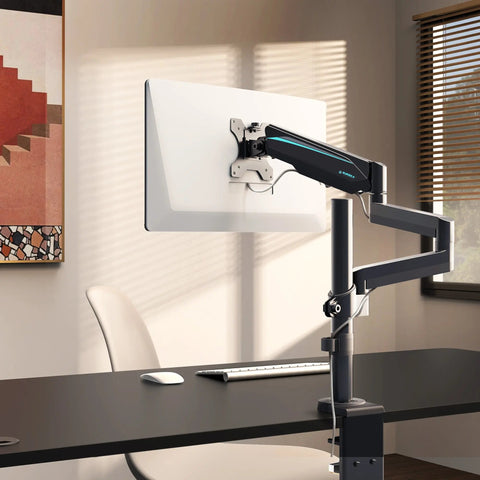
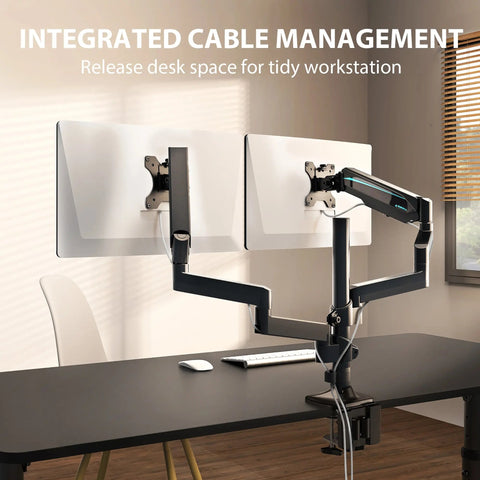
Using a Carbon Fiber Dual Monitor Stand allows for precise vertical alignment of displays while also providing a "bridge" that helps distribute the weight across the center of the desk, aiding motor balance. This is a vendor product example; equivalent monitor stands from other brands can provide similar effects.
Keyboard and Mouse Placement
The Canadian Centre for Occupational Health and Safety (CCOHS) recommends that keyboards be placed at a height that allows the elbows to remain around a 90-degree angle with wrists in a neutral position. For many engineers, the desk surface is too high for comfortable seated typing.
An Adjustable Keyboard Tray can help align input devices with a neutral arm posture without lowering the entire desk and disrupting monitor eye-level alignment. As with other product examples, this is a house-branded accessory; similar trays exist across the market.
Managing the Technical Environment
Environmental factors also influence workstation stability. Voltage fluctuations in an office or studio can interfere with motor controllers’ position sensing. A stable power supply, such as a high-quality surge protector or Uninterruptible Power Supply (UPS), is a commonly recommended ancillary investment for any dual-motor desk.
Temperature consistency matters as well. Extreme cold can thicken lubricants in lifting columns, increasing resistance on the motors. While most professional desks use components tested for standard office temperature ranges (per manufacturer datasheets), keeping the workstation in a climate-controlled environment supports the longevity of electronic and mechanical components.
Strategic Storage and Load Management
To maintain the "Central Third" balance, storage should be managed vertically or independently of the lifting surface. A 23" Rolling File Cabinet with Drawer provides a way to store heavy manuals, extra hardware, and office supplies without adding "dead weight" to the motorized desk. By decoupling storage from the desk surface, you reduce the total load the motors must lift, increasing the safety margin and supporting more reliable synchronization.
Summary of Practical Recommendations
To protect high-value CAD equipment and support long-term workstation reliability, technical professionals can use the following framework:
- Load Balancing (heuristic): Aim to keep the center of mass within the central third of the desk. Treat this as a rule of thumb, not a formal requirement. Use mobile CPU stands or floor-mounted solutions to remove heavy towers from the lifting surface when possible.
- Safety Margin (rule of thumb): Choose a dual-motor system whose rated capacity comfortably exceeds your total equipment weight. Many practitioners target at least roughly 20–30% additional capacity as an engineering margin, but you should always prioritize the limits specified in your frame’s datasheet.
- Calibration & Checks: Perform a "Slow Cycle" test about once a month using the measurement protocol above. Follow your manufacturer’s instructions for factory reset or recalibration if you detect drift beyond a few millimeters.
- Ergonomic Precision: Align monitor height so that your main viewing area is slightly below eye level and within a modest downward gaze angle, consistent with guidance such as the HSE Display Screen Equipment guidelines. Adjust keyboard/mouse position so elbows are near 90 degrees and wrists are neutral.
- Environmental Stability: Use an appropriate surge protector or UPS to reduce the impact of voltage spikes on motor controllers, and keep the workstation within a typical indoor temperature range as recommended by the desk manufacturer.
By treating the workstation as an engineered system rather than just furniture, professionals can build a stable, level, and ergonomically tuned environment for demanding CAD and engineering projects.
Disclaimer: This article is for informational purposes only and does not constitute professional medical or engineering advice. The health-related content (including MSD discussion and sit–stand rhythms) is based on general ergonomic guidance from organizations such as OSHA, WHO, and CCOHS. Proper workstation setup depends on individual anthropometric measurements and specific equipment requirements. Consult with a medical professional, occupational therapist, or ergonomic specialist if you have pre-existing musculoskeletal conditions or other health concerns, and follow your desk manufacturer’s documentation for load limits and maintenance procedures.
References
- BIFMA G1-2013 Ergonomics Guideline for Furniture
- OSHA eTools: Computer Workstations - Neutral Working Postures
- ISO 9241-5:2024 Workstation layout & postural requirements
- Cornell University Ergonomics Web — Workstation Guides
- WHO 2020 Guidelines on Physical Activity & Sedentary Behaviour
- ANSI/HFES 100-2007 Computer Workstations
- The 2026 Workstation White Paper (manufacturer white paper)




Leave a comment