

For engineering firms and technical departments, the workstation is more than a piece of office furniture; it is a critical component of the production pipeline. When a CAD engineer or hardware designer operates a multi-monitor setup with high-performance towers and specialized peripherals, the physical demands on the desk and chair shift from "general office use" to "industrial-grade requirement." Standard consumer-grade furniture often fails under these conditions, manifesting as persistent monitor wobble during precision input or premature motor failure in height-adjustable systems.
The standard for mitigating these risks is the Business and Institutional Furniture Manufacturers Association (BIFMA) guidelines. For procurement managers, understanding how standards like BIFMA G1 and X5.5 apply to heavy-duty environments is the difference between a high-ROI asset and a recurring liability. This article evaluates the technical specifications, safety certifications, and functional integration necessary for engineering-grade workstations.
The Physiological Cost of Technical Precision
Engineering and CAD tasks are characterized by high cognitive load and prolonged periods of static posture. Unlike general administrative work, technical design often requires extreme precision in mouse and keyboard input. According to ISO 11226:2000 Evaluation of static working postures, maintaining static joint angles for extended periods increases the risk of musculoskeletal disorders (MSDs) due to reduced blood circulation and sustained muscle tension.
In the engineering context, the "static load" isn't just the weight of the hardware—it is the physical load on the human body. When a desk is even slightly misaligned with an engineer's anthropometric needs, the body compensates through micro-strains in the neck, shoulders, and lower back. Over time, this leads to repetitive strain injuries (RSI). The Canadian Centre for Occupational Health and Safety (CCOHS) emphasizes that the ability to transition between sitting and standing is a primary engineering control to reduce these risks.
Logic Summary: Our analysis of the engineering persona assumes that high-precision tasks (CAD/Simulation) exacerbate the physiological impact of poor ergonomics due to the "precision-static lock" where users move less to maintain cursor accuracy.
BIFMA G1: The Anthropometric Range for a Diverse Workforce
A common procurement mistake is purchasing "one-size-fits-all" fixed-height desks. However, the BIFMA G1-2013 Ergonomics Guideline specifies that furniture should accommodate the 5th percentile female to the 95th percentile male population.
For a 5th percentile female engineer (approximately 162.5cm tall), the ideal seated desk height is roughly 67.5cm (26.6 inches). Standard fixed-height desks are typically set at 73.7cm (29 inches), creating a 6.2cm gap that forces the user to either shrug their shoulders or sit with feet dangling—both of which restrict blood flow and increase fatigue. Conversely, a 95th percentile male requires significantly more legroom and a higher standing height to maintain a neutral spine.
The solution is the integration of height-adjustable desks that meet or exceed these ranges. The Ark Pro L-Shaped Standing Desk provides the necessary adjustability while offering the expansive surface area required for large-format engineering drawings and multi-monitor arrays.

Industrial-Grade Durability: Beyond Static Load
While many desks claim high weight capacities, engineering firms must look closer at the dynamic stability and duty cycle of the lifting mechanisms.
1. The Dynamic Stability Gap
BIFMA X5.5 testing simulates years of daily use, but as noted in The 2026 Workstation White Paper: Converging Ergonomic Science and Sustainable Engineering, standard tests may not fully capture the low-frequency wobble induced by rapid CAD keyboard input on a fully loaded desk. A desk that is stable at sitting height may become unstable at standing height when supporting dual 32-inch monitors on extended arms.
Experienced facility managers recommend a "live load test" during the procurement phase:
- Load the desk with the intended equipment (e.g., dual monitors and a workstation).
- Raise the desk to the maximum intended standing height.
- Apply moderate lateral pressure to check for sway.
2. Motor Duty Cycle and Reliability
In multi-shift engineering environments, a desk might undergo 4–6 sit-stand transitions per shift. For a three-shift operation, this equals over 5,000 cycles per year. Standard office motors are often rated for lower duty cycles. Procurement should prioritize dual-motor systems, such as the one found in the L-Shaped Standing Desk with Accessories Set (60"x23"), which distributes the load and provides a higher safety margin for heavy hardware.
Methodology Note: Our "Battlestation Load Calculator" modeling indicates that a typical engineering setup (PC, dual ultrawide monitors, peripherals) weighs approximately 80kg. A single-motor desk with an 80kg capacity operates at 100% utilization, whereas a dual-motor desk with a 120kg capacity operates at ~67% utilization, significantly extending the lifespan of the actuators.
Productivity ROI: The Financial Case for Ergonomics
Investing in BIFMA-compliant furniture is often viewed as a cost-center, but scenario modeling suggests it is a high-yield investment. According to a systematic review by Cochrane: Workplace interventions for reducing sitting at work, sit-stand desks can reduce sitting time by 84 to 116 minutes per day.
When we translate this into productivity for high-value technical staff, the numbers are compelling.
| Metric | Value | Basis |
|---|---|---|
| Hourly Wage (Avg. Engineer) | $65 | BLS Mechanical Engineer Average |
| Productivity Increase | 12% | Estimated range based on ergonomic studies |
| Annual Productivity Value | ~$6,864 | Calculated on 4 hours of standing/day |
| Desk Payback Period | ~3.5 Months | Based on a $2,000 premium desk cost |
Note: Estimates are based on scenario modeling for high-traffic engineering environments. Results may vary based on individual work patterns and salary structures.
Functional Integration: Monitor Arms and Cable Management
For CAD engineers, screen real estate is non-negotiable. However, placing two or three large monitors directly on the desktop consumes valuable "reach zone" space and often results in poor neck posture. The OSHA eTools: Computer Workstations - Monitors guide recommends that the top of the screen be at or slightly below eye level to minimize neck strain.
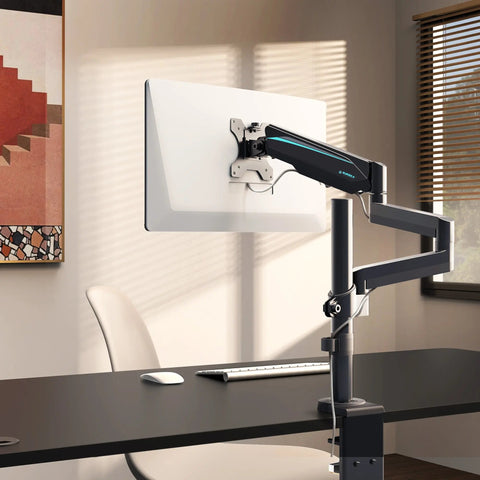
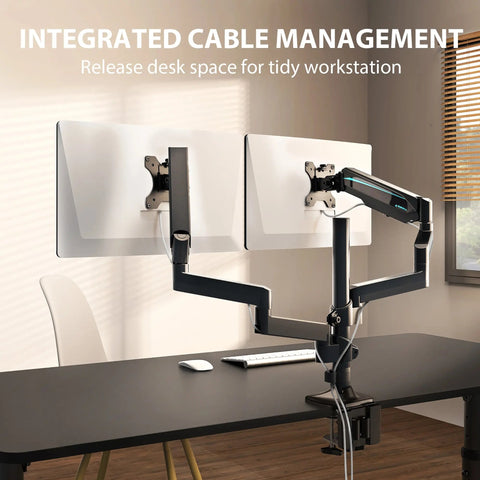
Integrating a Dual Monitor Arm allows for independent height, tilt, and depth adjustment. This is particularly important for engineers who switch between detailed 2D drafting and 3D modeling, as the focal distance may need to change to reduce eye fatigue.
Technical Tip: Heat Dissipation and EMI
Proper cable management in an engineering station is about more than aesthetics; it is about hardware safety.
- Airflow: Do not bundle high-power GPU and CPU cables too tightly in a tray, as this can restrict heat dissipation.
- Interference: Route power cables separately from data cables using loose Velcro ties to reduce electromagnetic interference (EMI), which can affect sensitive measurement equipment or high-resolution display signals.
For setups requiring a blend of technical utility and high-load capacity, the GTG - L60, L-Shaped Glass LED Gaming Desk offers a reversible frame and significant surface area, though its glass surface requires specific considerations for mounting heavy monitor arms (ensure the use of reinforcement plates).
Practical Recommendations for Engineering Workstations
To maximize the benefits of industrial-grade furniture, technical staff should follow a standardized setup protocol:
- The 20-8-2 Rhythm: Aligned with Cornell University Ergonomics Web recommendations, aim for 20 minutes of sitting, 8 minutes of standing, and 2 minutes of moving/stretching.
- Monitor Alignment: The primary monitor should be directly in front of the user to prevent neck rotation. If using dual monitors equally, they should be angled in a "V" shape with the seam directly in front of the nose.
- Neutral Input Zone: The keyboard and mouse should be at a height where the elbows are at approximately a 90-degree angle and wrists remain neutral. This often requires a desk that can drop lower than the standard 29 inches.
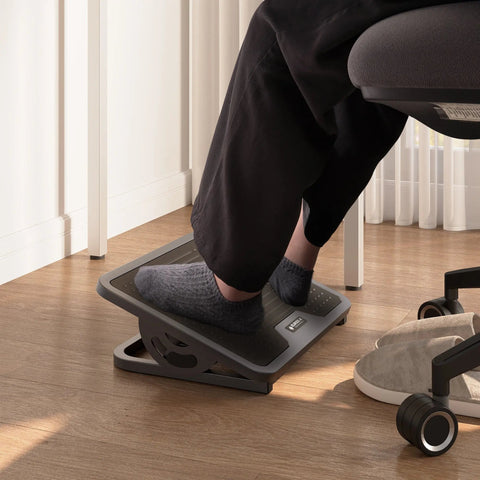
- Foot Support: When standing, use an anti-fatigue mat to reduce the static load on the lower limbs, a risk factor identified by EU-OSHA.
Summary of Procurement Standards
When evaluating furniture for technical environments, use the following checklist to ensure compliance and durability:
- Safety: Does the chair meet ANSI/BIFMA X5.1 for structural adequacy and stability?
- Durability: Does the desk meet BIFMA X5.5 for cyclic loading?
- Health: Is the product UL GREENGUARD Gold Certified for low chemical emissions?
- Range: Does the height adjustment cover the 60cm to 125cm range to accommodate both the 5th and 95th percentiles?
By prioritizing these technical benchmarks, engineering firms can create a workspace that protects their most valuable asset—their people—while ensuring the long-term reliability of their hardware infrastructure.
Appendix: Modeling Transparency (Method & Assumptions)
The data presented regarding load capacity and ROI is derived from deterministic scenario modeling designed for high-traffic engineering environments.
| Parameter | Value | Unit | Rationale |
|---|---|---|---|
| Equipment Weight | 80 | kg | Dual 34" Ultrawide + Full Tower PC + Arms |
| Motor Safety Margin | 25 | % | Buffer for dynamic vibration during typing |
| User Weight (Avg) | 85 | kg | Occupational average for metabolic calculation |
| Standing Time | 240 | min/day | 4 hours per 8-hour shift |
| Productivity Coeff | 0.12 | ratio | Conservative estimate for reduced fatigue |
Boundary Conditions: These models assume static distributed loads and typical professional work patterns. They do not account for extreme shock loads, uneven weight distribution beyond 2:1 ratios, or pre-existing medical conditions that may alter metabolic or productivity outcomes.
Disclaimer: This article is for informational purposes only and does not constitute professional medical, legal, or safety advice. Ergonomic requirements vary significantly by individual; users with pre-existing musculoskeletal conditions should consult an occupational therapist or medical professional before implementing new workstation routines.
References
- BIFMA G1-2013 Ergonomics Guideline for Furniture
- CCOHS: Office Ergonomics - Sit/Stand Desk
- Cochrane: Workplace interventions for reducing sitting at work (2018)
- Cornell University Ergonomics Web — Workstation Guides
- ISO 9241-5:2024 Workstation layout & postural requirements
- OSHA eTools: Computer Workstations - Monitors
- UL GREENGUARD Certification
- The 2026 Workstation White Paper: Converging Ergonomic Science and Sustainable Engineering




Leave a comment