

The Precision Dilemma: Why Desktop Stability is a Technical Requirement
For a mechanical engineer or a CAD professional, a workstation is more than furniture; it is a high-precision instrument. When working on complex assemblies or intricate 3D models, even a microscopic vibration in the display can lead to visual fatigue or input errors. This issue is often exacerbated in height-adjustable setups where the center of gravity shifts as the desk rises.
The frustration often peaks in the afternoon. You might notice your monitors oscillating slightly as you type or a subtle "rocking" sensation when you lean forward to inspect a detail. While many attribute this to the floor or the monitor arms, the root cause is frequently found in the structural engineering of the desk frame—specifically, its ability to resist torsional stress and lateral forces under heavy equipment loads.
Understanding the physics of structural rigidity is essential for procurement decisions involving high-value technical gear. This article evaluates the critical role of crossbars, reinforced leg geometry, and weld integrity in maintaining a stable, professional environment.
The Physics of Instability: Torsional Stress and Lever Arms
In a standard fixed-height desk, four legs provide a broad, stable base. However, a height-adjustable workstation typically relies on a T-frame or C-frame design with two vertical columns. As the desk reaches standing height, these columns act as long lever arms. Any force applied to the desktop—typing, leaning, or the dynamic movement of the motors—is magnified at the base.
The Role of Torsional Stress
Torsional stress refers to the twisting of an object due to an applied torque. For engineering workstations featuring multiple high-resolution monitors and full-tower PCs, the weight is rarely perfectly centered. This offset creates a rotational force on the vertical columns. Without adequate reinforcement, the frame will "give" slightly, resulting in the dreaded side-to-side wobble.
According to the International Organization for Standardization (ISO 9241-5:2024), workstation layout and postural requirements must minimize static loads and support the dynamic nature of office work. In heavy-duty technical environments, this standard implies that the furniture must maintain its ergonomic integrity even under the maximum rated load.
The Center of Gravity and Mass Distribution
A common mistake in technical setups is placing the heavy full-tower workstation directly on the desktop. This raises the entire system's center of gravity, making it more susceptible to oscillations. Practitioners in the field often observe that removing this concentrated mass from the desktop and placing it on a dedicated, stable support can significantly reduce the moment of inertia that causes frame swaying during height transitions.
Logic Summary: Our analysis of the 'Precision CAD Power User' persona assumes that stability is directly proportional to the frame's ability to resist the leverage created at standing heights. We categorize this as an engineering requirement, not merely a comfort feature.

The Crossbar: Engineering's Answer to Lateral Force
The most visible solution to frame instability is the crossbar (or stability bar). However, not all crossbars are engineered equally. In the context of heavy engineering gear, the placement and connection method of the crossbar are more important than its mere presence.
Low-Placement vs. High-Placement
Research into structural behavior suggests that for setups with high-leverage components (like triple monitor arms), a crossbar positioned low between the vertical legs is significantly more effective at reducing side-to-side wobble than one placed higher up near the desktop. A low crossbar creates a more rigid "U" or "H" shape that anchors the columns against lateral shifting.
However, there is a technical trade-off. While crossbars increase rigidity, over-engineered or poorly placed bars can complicate dynamic stability in specific specialized structures. For example, in heavy civil engineering applications like arch bridges, adding certain types of cross-bracing can actually introduce complex failure modes (Source: Journal of Earthquake Engineering & Structural Dynamics). In furniture, this translates to the "accessibility vs. rigidity" conflict—a bar that is too low might interfere with legroom or the BIFMA G1-2013 Ergonomics Guideline for knee clearance.
The "WobbleMeter" and Standardized Testing
While many manufacturers claim "rock-solid" stability, professional evaluators often use tools like the WobbleMeter to quantify movement. Standardized tests, such as those defined by BIFMA X5.5, involve applying specific forces (e.g., 50 lbs) to the desk and measuring the deflection. For CAD environments, we recommend seeking frames that exceed these baseline requirements to account for the dynamic forces introduced by high-mass peripherals.
Weld Quality and Material Fatigue: The Hidden Failure Points
In heavy-duty B2B environments, the most common point of failure is not the desktop snapping or the motor burning out—it is the weld points where the crossbars or motor housings meet the vertical legs.
Detecting "Cold Welds" and Stress Concentration
A high-quality weld should be smooth, consistent, and look like a "stack of beads." In contrast, "cold welds" (where the base metal didn't reach the proper temperature) appear lumpy and sit on the surface rather than penetrating the joint. Under the cyclic loading of daily sit-stand transitions, these weak points can develop micro-fractures.
For users with heavy equipment, the "1.5x Load Rule" is a critical heuristic:
- The Heuristic: Always select a desk with a stated weight capacity at least 1.5 times your total static load.
- Why this number: This margin accounts for the dynamic forces introduced when you lean on the desk or when the motors accelerate/decelerate. If your equipment weighs 80kg, your desk should be rated for at least 120kg.
Leg Geometry: Trapezoidal vs. Rectangular
The shape of the leg itself contributes to rigidity. Rectangular columns are standard, but trapezoidal legs—wider at the base and tapering toward the top—can offer a more stable footprint. The Ark EL Executive Standing Desk utilizes this trapezoidal geometry to enhance lateral stability while maintaining a professional aesthetic suitable for executive or engineering offices.

Motor Dynamics: Why Dual Motors are Mandatory for Engineering
For a setup involving multiple monitors and liquid-cooled workstations, single-motor systems are generally insufficient. Our scenario modeling for a "Precision CAD Power User" reveals why.
Modeling Note: The Engineering Workstation Load Analysis
We modeled a typical high-end engineering setup to assess the safety margins of different motor configurations.
| Parameter | Value | Unit | Rationale |
|---|---|---|---|
| PC Case (Full Tower) | ~25 | kg | High-end workstation with liquid cooling |
| Triple 27" Monitors | ~18 | kg | Standard engineering multi-display setup |
| Heavy-Duty Monitor Arms | ~10.5 | kg | Required for triple-display stability |
| Peripherals & Buffer | ~5 | kg | SpaceMouse, keyboard, calibration tools |
| Solid Wood Tabletop | ~25 | kg | High-density top for vibration damping |
| Total System Load | ~83.5 | kg | Combined static weight |
Analysis Results:
- Single-Motor Desk (80kg capacity): Operates at 104% load. This violates safety factors and will likely lead to audible motor strain and "cogging" (stuttering) during adjustment.
- Dual-Motor Desk (120kg capacity): Operates at ~70% load. This falls within the 80% utilization threshold recommended for mechanical longevity.
Methodology Note: This is a deterministic scenario model based on BIFMA X5.5 safety factor principles. It assumes a static distributed load and does not account for accidental impact loads.
For these reasons, a dual-motor system, such as the one found in the Ark Executive Standing Desk (63"x29"), is considered a mandatory requirement for technical professionals. Dual motors ensure that the lifting force is synchronized across both columns, reducing the risk of the frame "binding" or tilting during movement.
Ergonomic Integration: Beyond the Frame
Structural rigidity provides the foundation, but the interface between the user and the gear determines long-term productivity.
The 20-8-2 Rhythm
According to Cornell University Ergonomics Web, the ideal sit-stand rhythm is the "20-8-2" rule: 20 minutes of sitting, 8 minutes of standing, and 2 minutes of moving or stretching. This approach, supported by Cochrane research, has been shown to reduce sitting time by approximately 84–116 minutes per day, which may mitigate the risks of prolonged static behavior identified by the World Health Organization (WHO).
Viewing Distance and Desk Depth
A significant challenge for triple-monitor users is the viewing distance deficit. For a 30° SMPTE field of view (the standard for critical detail work), the recommended distance for 27" monitors is approximately 44 inches. A standard 24-inch deep desk creates a deficit of nearly 20 inches, forcing the monitors to be placed at the very rear edge. This placement increases the leverage on the frame, making the desk more prone to front-to-back rocking.
Using an L-Shaped Standing Desk with Accessories Set can help by providing deeper corner space, allowing for a more ergonomic focal length and a more stable distribution of monitor weight.
Seating for the Interstitial Periods
Even with a standing desk, the quality of your seated support remains paramount. The Flex, Dual-Backrests Ergonomic Office Chair is designed to support the "neutral position" defined by OSHA eTools. Its dual backrest system responds to micro-movements, which is essential for engineers who may spend hours in deep focus, alternating between various seated postures.

The 2026 Workstation Blueprint: A Strategic Approach
As technical requirements evolve, the line between "office furniture" and "industrial equipment" continues to blur. The industry is moving toward a convergence of ergonomic science and sustainable engineering, as detailed in the authoritative white paper The 2026 Workstation White Paper: Converging Ergonomic Science and Sustainable Engineering.
For B2B procurement and individual engineering professionals, the selection process should prioritize the following structural checklist:
- Frame Material: High-grade cold-rolled steel with a minimum gauge thickness specified for heavy loads.
- Motor Configuration: Dual-motor synchronized lifting to prevent torsional binding.
- Crossbar Design: Low-positioned stability bars to resist lateral forces without compromising BIFMA G1-2013 knee clearance.
- Weld Integrity: Verified robotic or high-quality manual welds at all critical load-bearing junctions.
- Certification Compliance: Adherence to ANSI/BIFMA X5.5 for desks and UL 962 for electrical safety.
Maintaining Stability Over Time
Structural rigidity is not a "set it and forget it" feature. Over months of use, the dynamic forces of a standing desk can cause fasteners to loosen.
- Quarterly Maintenance: We recommend a quarterly check of all frame bolts. A loose bolt in the crossbar can negate the structural benefits of the entire design.
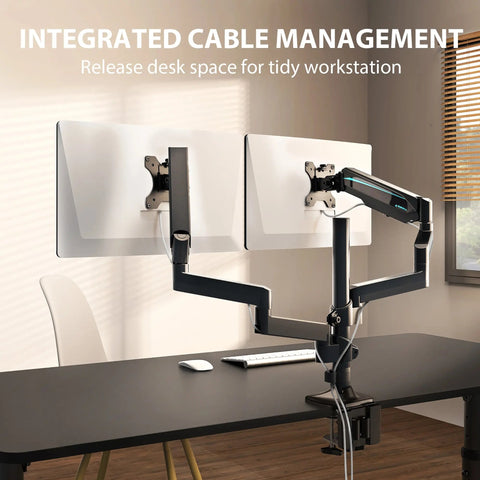
- Cable Management: Ensure that cables for high-mass equipment have adequate slack. Tight cables can act as "tethers" that pull on the monitors during height adjustments, introducing unnecessary vibration and stress on the monitor arms.
- Floor Leveling: Even the stiffest frame will wobble if the floor is uneven. Use the adjustable leveling glides at the base of the legs to ensure 100% contact with the floor surface.
By treating the workstation as a foundational component of the engineering stack, professionals can ensure a stable, vibration-free environment that supports precision work and long-term musculoskeletal health.
Disclaimer: This article is for informational purposes only and does not constitute professional medical, legal, or engineering advice. For specific ergonomic concerns or pre-existing musculoskeletal conditions, please consult a qualified healthcare professional or a certified professional ergonomist (CPE).
Sources
- BIFMA G1-2013 Ergonomics Guideline
- ISO 9241-5:2024 Workstation layout & postural requirements
- OSHA eTools: Computer Workstations - Neutral Working Postures
- Cochrane: Workplace interventions for reducing sitting at work
- Cornell University Ergonomics Web — Workstation Guides
- WHO 2020 Guidelines on Physical Activity & Sedentary Behaviour
- UL 962 — Safety of Height-Adjustable Desks
- BIFMA X5.5 - Desk/Table Products Standards




Leave a comment