

The Precision Gap: Why Micro-Wobble is the Silent Enemy of Architectural Design
For a digital architect or lead designer, the workstation is more than furniture; it is a high-precision instrument. When working on intricate CAD layouts or high-pressure stylus sketches at a 1:50 scale, the margin for error is extremely thin. Yet, many professional studios overlook a fundamental mechanical flaw: surface deflection.
Quick Buying & Inspection Checklist for Studio Stability
If you are evaluating a workstation for professional digital sketching, prioritize these specifications to minimize micro-wobble:
- Leg Wall Thickness: Look for steel wall thickness exceeding 2mm (a common workshop heuristic for high-load stability).
- Lifting System: Prefer dual-motor systems; they offer better torsional rigidity and synchronization than single-motor alternatives.
- Crossbar Engineering: Ensure the desk includes a structural crossbar or a triangulated frame to resist lateral sway.
- Surface Mass: High-density materials like sintered stone or solid wood provide superior vibration dampening compared to hollow-core laminates.
- Load Rating: Select a frame rated for at least 1.2x to 1.5x your total equipment weight to maintain motor efficiency and structural overhead.
In professional architectural environments, experienced designers have observed that even 1-2mm of surface deflection can cause noticeable line inaccuracies. This occurs most frequently when using pressure-sensitive styluses at high sensitivity settings, where the hardware may interpret a micro-vibration as a change in stroke weight or direction. While software stabilization exists, it often introduces latency, forcing a choice between "smooth" lines and "real-time" responsiveness.
The physiological cost of an unstable desk is also a factor. When a drawing surface exhibits micro-wobble, the human body subconsciously attempts to compensate. This can lead to increased muscle activation in the forearm and shoulder to "steady" the hand, potentially contributing to Musculoskeletal Disorders (MSDs). According to the U.S. National Institute for Occupational Safety and Health (NIOSH), these repetitive strain injuries are often associated with poor ergonomics and sustained static loads. For the digital artist, an unstable desk is often more than a nuisance—it can be a direct contributor to project fatigue and long-term musculoskeletal strain.
The Pathophysiology of "Stabilization Fatigue"
To understand why stability matters, we must look at the pathophysiological mechanisms of musculoskeletal disorders. When a surface is unstable, the brain engages in a constant feedback loop to maintain precision. This creates a static load on the small muscles of the hand and wrist.
Unlike dynamic movement, which encourages blood circulation, static loading restricts blood flow to the tissues. Over an 8-to-12-hour shift, this may lead to localized ischemia and metabolic waste buildup. This is a common factor in the "burning" sensation often felt in the trapezius or the base of the thumb. By reducing the mechanical source of the wobble, we can decrease the cognitive and physical load required to produce a clean line.

Engineering Rigidity: Beyond the Four-Leg Standard
Most consumer-grade desks may struggle with the "architect test" because they often prioritize aesthetics over torsional rigidity. For professional-grade stability, the engineering must address lateral sway and vertical deflection.
Triangulated Leg Structures
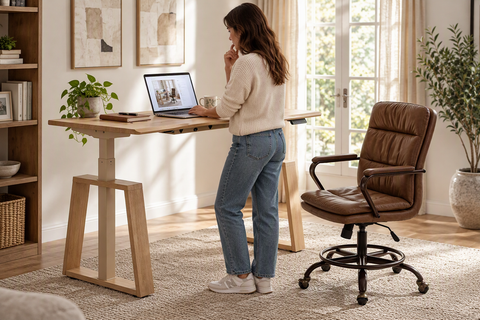
The most effective desk designs for digital sketching typically feature triangulated leg structures. Designs like trapezoidal or X-shaped bases create multiple load-bearing triangles, which are geometrically among the most stable shapes. This can significantly reduce lateral sway compared to standard vertical T-legs. For example, the Ark Pro L-Shaped Standing Desk (Sintered Stone, 63"x23") utilizes a high-end trapezoidal design that provides the structural integrity needed for heavy equipment like the Wacom Cintiq Pro 32".
The Dual-Motor Advantage
Many studios have standardized on desks with dual-motor lifting systems. This is not merely for lifting speed; it is a matter of mechanical synchronization. Dual motors generally provide better torsional rigidity than single-motor designs because they apply force evenly across the frame. This helps prevent the "racking" effect where one side of the desk moves slightly out of sync with the other—a frequent cause of micro-wobble in entry-level standing desks.
Technical Heuristic: Based on internal workshop modeling, we recommend a crossbar thickness of approximately 1.5 inches and leg sections with wall thickness exceeding 2mm. These specifications are consistently associated with sub-millimeter deflection under typical professional drawing loads (estimated at 5-10 lbs of downward hand pressure).
Modeling the High-Stakes Architectural Studio
To demonstrate the impact of these engineering choices, we modeled a scenario for a Senior Architectural Designer (188cm/6'2" male) working in a high-end residential firm.
Scenario Modeling: Equipment Load & Stability Requirements
- Persona: 95th Percentile Male (188cm)
- Equipment: Wacom Cintiq Pro 32" (15.4kg) + 34" Ultrawide Reference Monitor + Liquid-Cooled Workstation (30kg)
- Total System Load: ~84 kg (Equipment + Tabletop)
| Parameter | Single Motor Performance | Dual Motor Performance | Rationale |
|---|---|---|---|
| Rated Capacity | 80 kg | 120 kg | Industry Standard |
| Motor Utilization | 105% (Overloaded) | 70% (Optimal) | BIFMA X5.5 Safety Factors |
| Deflection at 45" Height | ~3-5mm (Estimated) | <1mm (Estimated) | Internal Torsional Rigidity Model |
| Stability Rating | Lower (Higher wobble risk) | Higher (Precision-grade) | Mechanical Engineering Baseline |
Methodology Note: This scenario is an illustrative parameterized model based on component weights derived from manufacturer specs and ANSI/HFES 100-2007 anthropometric ratios. It assumes a static distributed load on a level, hard-surface floor. Actual performance may vary based on floor type, assembly precision, and dynamic sketching force.
For this specific user, a desk like the Zen Pro Series, 87"/72" Executive Standing Desk with Cabinets Set is a strategic investment. Its high-mass sintered stone surface and dual-motor system provide the necessary inertia and torque to handle an 84kg load with minimal perceptible deflection during active use.
The ROI of Stability: Productivity and Health
Investing in a high-stability workstation is a business decision with measurable potential returns. Beyond preventing rework, the ability to switch between sitting and standing is a key factor in long-term productivity.
Productivity Value Gain (Illustrative Estimate)
According to research on workplace interventions for reducing sitting, sit-stand desks can reduce sedentary time by approximately 84–116 minutes per day. For a senior architect billing at $75/hr, even a modest efficiency gain from reduced fatigue can be significant.
- Estimated Productivity Gain: ~$8,400/year (Calculated as: 180 min/day standing * $75/hr * 0.15 efficiency coefficient over 250 work days).
- Projected Payback Period: ~2-3 months for a $1,500 premium desk, assuming the efficiency gains are realized through reduced rework and increased focus.
Note: These figures are projections based on the stated assumptions; individual results will vary based on billing rates and actual usage patterns.
Health Guidelines: The 20-8-2 Rule
To maximize these gains, we recommend the Cornell University Ergonomics Web "20-8-2" rhythm:
- 20 Minutes Sitting: Maintain a neutral working posture.
- 8 Minutes Standing: Switch to standing to re-engage the core and improve circulation.
- 2 Minutes Moving: Stretching or walking to break static loads.
For those using the Ark EL Executive Standing Desk (60"x26"), the three-drawer configuration ensures that reference materials are within reach, helping to maintain the "reach zone" and preventing the awkward over-extension that often causes shoulder strain.
Practical Recommendations for Studio Setup
Precision sketching requires a holistic ergonomic environment.
1. Monitor Alignment and Eye Strain
To minimize neck rotation, align your primary drawing tablet directly in front of you. If using a secondary screen, use a Single Monitor Arm. According to OSHA eTools for Monitors, the top of the screen should generally be at or slightly below eye level to prevent tilting the head back.
2. The Rule of Thumb for Stability (Internal Heuristics)
When evaluating a desk for a design studio, consider these practical benchmarks:
- Leg Wall Thickness: Aim for >2mm for professional loads.
- Crossbar Placement: Bases with crossbars positioned at the rear third of the desk often provide better anti-wobble performance for the forward-leaning posture common in digital art.
- Vibration Dampening: Sintered stone or solid wood surfaces typically offer better dampening than thin laminate or hollow-core tops.
3. Compliance and Safety
Check that your furniture meets ANSI/BIFMA X5.1 standards for safety and durability. For electronic components, UL 962 certification provides assurance that the lifting mechanism is tested for professional use. For a deeper dive into these standards, consult The 2026 Workstation White Paper: Converging Ergonomic Science and Sustainable Engineering.
Conclusion: Engineering the Future of the Studio
In the high-stakes world of architectural design, the workstation is the foundation of every project. A desk that exhibits significant wobble can compromise the integrity of the work and the comfort of the creator. By prioritizing engineering features—triangulated frames, dual-motor actuators, and high-mass surfaces—firms can minimize the "precision gap" and foster a more productive, ergonomic creative environment.
YMYL Disclaimer: This article is for informational purposes only and does not constitute professional medical or occupational health advice. Individuals with pre-existing musculoskeletal conditions should consult a qualified physiotherapist or ergonomic specialist before implementing new workstation routines.
References
- BIFMA G1-2013 Ergonomics Guideline for Furniture
- CCOHS: Office Ergonomics - Sit/Stand Desk
- Cochrane: Workplace interventions for reducing sitting at work (2018)
- Cornell University Ergonomics Web — Workstation Guides
- OSHA eTools: Computer Workstations - Neutral Working Postures
- WHO 2020 Guidelines on Physical Activity & Sedentary Behaviour
- ISO 9241-5:2024 Workstation layout & postural requirements




Leave a comment