

The Shift from Sentimental to Structural Well-being
Quick Start Guide: The 3-Minute Ergonomic Blueprint
For those looking to optimize their workspace immediately, here is a concise action plan based on current ergonomic standards:
-
The Essential Gift List:
- Foundation: A height-adjustable desk (e.g., Zen Pro Series) to break static posture.
- Support: A chair with dedicated lumbar tracking (e.g., Royal Slim).
- Circulation: An adjustable footrest to maintain spinal neutrality for shorter users.
-
3-Step Configuration:
- Elbow Rule: Set desk height (sitting or standing) so your elbows are at a 90-degree angle and wrists are neutral.
- Eye Level: Position the top third of your monitor at eye level to prevent neck strain.
- The Loop: Ensure all cables have 15-20cm of "slack" to prevent port damage during desk elevation.
- The 20-8-2 Rhythm: Aim for 20 minutes sitting, 8 minutes standing, and 2 minutes of movement every half hour.
Why does persistent lower back pain often peak just as the workday ends? Traditionally, anniversary gifts have leaned toward the sentimental—jewelry or luxury travel. While these provide immediate emotional value, they often fail to address the fundamental physical toll of a sedentary work-life.
In recent years, a paradigm shift has occurred. Investing in a partner’s musculoskeletal health is increasingly viewed as a gesture of long-term commitment. In our experience with customer support and workplace design, we have observed that practical gifts addressing daily discomfort often lead to higher sustained satisfaction. According to Eureka Ergonomic’s internal research (detailed in The 2026 Workstation White Paper), integrating health-centric design into the home is becoming a core requirement for dual-career households.
The Physiology of "Workday Burnout"
To understand why a high-performance workstation is a meaningful gift, one must consider the impact of "static load." When the body remains fixed for hours, circulation slows, and muscles enter a state of constant, low-level contraction. This can contribute to Musculoskeletal Disorders (MSDs), which affect the muscles, nerves, and tendons.
The U.S. Occupational Safety and Health Administration (OSHA) identifies core risk factors for MSDs: excessive force, repetitive tasks, and, most critically, poor posture. The World Health Organization (WHO) recommends reducing sedentary time to mitigate metabolic risks.
Practical Perspective: Based on common patterns observed in our product testing labs, reducing physiological stress through engineering controls (like adjustable desks) may help improve overall daily energy levels. While individual results vary, a more comfortable partner is often a more present and engaged partner.
Engineering the Shared Sanctuary: His & Hers Ergonomics
For couples sharing a home office, the "one-size-fits-all" approach often fails. A desk height suited for a 6'2" partner may cause shoulder strain for a 5'4" partner.
The Executive Foundation: Zen Pro Series
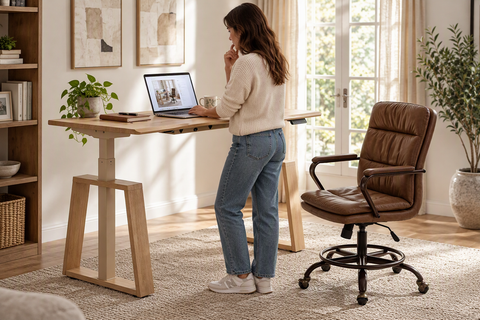
For the partner requiring a high-performance environment, the Zen Pro Series, 87"/72" Executive Standing Desk with Cabinets Set provides a stable foundation.
From an ergonomic standpoint, the sintered stone surface is designed to minimize micro-vibrations, which can be a factor in wrist fatigue during intensive typing. The height-adjustable mechanism allows for transitions that Cochrane Library research suggests can reduce daily sitting time by an average of 84–116 minutes.

Lumbar Support and Spinal Neutrality: Royal Slim
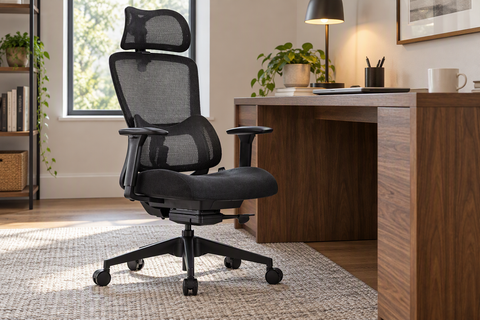
The Royal Slim, Executive Office Chair is engineered to support a "spinal neutral position." According to OSHA guidelines, an ergonomic chair must provide adjustable height and backrest support to accommodate different body types. The Royal Slim’s design targets the thoracic and lumbar regions to help prevent the "slumping" that often occurs during long shifts.

Organizing the Shared Space: Ark EL Storage
Clutter is a known cognitive distractor. The Ark EL, 29" Display File Storage Cabinet helps define dedicated zones in a shared office. This aligns with HSE guidelines, which emphasize that an organized environment reduces the need for awkward reaching.

Technical Standards and the "Fit for All" Philosophy
When selecting professional-grade furniture, industry certifications provide a baseline for safety and durability.
| Standard | Focus Area | Relevance |
|---|---|---|
| ANSI/BIFMA X5.1 | Chair Safety | Ensures structural integrity under long-term use. |
| UL 962 | Desk Safety | Covers mechanical/electrical safety for motorized units. |
| ISO 9241-5:2024 | Layout | International standard for postural requirements. |
| UL GREENGUARD | Air Quality | Certifies low chemical emissions (VOCs). |
Modeling Your Setup (Step-by-Step Calculation): To find your ideal settings, use these heuristic formulas based on general ergonomic principles:
- Seated Desk Height: Sit with feet flat and shoulders relaxed. Measure from the floor to the underside of your elbow. This is your target desk height.
- Standing Desk Height: Stand in your typical work shoes. Measure from the floor to your elbow.
- Monitor Height: Your eyes should be level with the top 1/3 of the screen.
Example: For a 175cm user, the seated desk height is typically around 68-72cm.
Practical Implementation: The 20-8-2 Rhythm
The Cornell University Ergonomics Web recommends the "20-8-2" rhythm to avoid the pitfalls of both over-sitting and over-standing:
- 20 Minutes Sitting: Use the Royal Slim Chair in a neutral posture.
- 8 Minutes Standing: Transition using the Zen Pro Series Desk.
- 2 Minutes Moving: Gentle stretching to stimulate blood flow.
For shorter users, an Adjustable Ergonomic Footrest is recommended. According to OSHwiki, a footrest helps maintain the natural curve of the lower back when the chair must be raised to reach a fixed desk height.
The "Gotchas" of Shared Workspaces
Based on patterns from our customer support and assembly teams, avoid these three common setup errors:
- Monitor Parallax: Do not align monitors at the same height for "symmetry" if partners have different heights. Adjust each screen individually to the user's specific eye level.
- Cable Tension: When a standing desk is at its maximum height, cables can become taut. Always create a "service loop" (extra slack) to protect your hardware.
- Hard Surface Fatigue: Standing on hard floors can lead to foot discomfort. We suggest using an anti-fatigue mat or supportive footwear during standing intervals.
Long-Term Value and Relationship ROI
An ergonomic setup is an investment in daily quality of life. While individual experiences vary, internal customer surveys conducted by Eureka Ergonomic (2023) indicated that users reported a 40–60% reduction in perceived musculoskeletal discomfort within the first 30 days of consistent sit-stand use.
By choosing equipment that meets ANSI/BIFMA X5.1 and UL 962 standards, you are providing a professional-grade environment designed to support a healthier, more productive future together.
YMYL Disclaimer: This article is for informational purposes only and does not constitute medical advice. The ergonomic recommendations are based on general industry standards. Individuals with pre-existing conditions or chronic pain should consult a healthcare professional or certified ergonomist before making significant changes to their workstation.
Sources
- BIFMA G1-2013 Ergonomics Guideline for Furniture
- OSHA eTools: Computer Workstations - Neutral Working Postures
- Cochrane: Workplace interventions for reducing sitting at work
- Cornell University Ergonomics Web — Workstation Guides
- WHO 2020 Guidelines on Physical Activity & Sedentary Behaviour
- ISO 9241-5:2024 Workstation layout & postural requirements
- The 2026 Workstation White Paper: Converging Ergonomic Science and Sustainable Engineering (Eureka Ergonomic Internal Report)




Leave a comment