

The Content Creator’s Paradox: Why Creativity Often Comes with a Physical Cost
For content creators—video editors, streamers, and graphic designers—the "flow state" is the ultimate goal. It is that elusive period where hours vanish, and the creative output is at its peak. However, this mental immersion often leads to a physical oversight. When you are deep into a complex edit or a high-stakes live stream, your body remains in a fixed, static position for extended durations.
Commonly, creators experience a dull ache in the lower back by mid-afternoon, or a sharp tightness between the shoulder blades. Many dismiss this as "part of the job" or rely on a "gaming chair" designed more for aesthetics than anatomical support. This is the Creator's Paradox: the tools used to facilitate digital brilliance often contribute to physical degradation.
The reality is that sitting is not a passive activity for the musculoskeletal system. It is a state of "static load," where specific muscles must work continuously to maintain an upright posture against gravity. Without the correct intervention, this leads to Work-Related Musculoskeletal Disorders (WMSDs). Understanding the science behind these issues is the first step toward building a workstation that sustains both your health and your career.
The Science of Static Load and Spinal Neutrality
To understand why a chair matters, we must look at the physiological principles of the human body at work. According to the U.S. Occupational Safety and Health Administration (OSHA), the primary risk factors for MSDs include repetitive tasks, excessive force, and, most importantly for creators, awkward or static postures.
The Pathophysiology of Prolonged Sitting
When you sit, the natural "S-curve" of your spine—specifically the lumbar lordosis (the inward curve of the lower back)—tends to flatten out. This creates a "C-shape" posture, which significantly increases the pressure on the intervertebral discs. Research discussed by EU-OSHA regarding prolonged static sitting indicates that this pressure can lead to reduced blood circulation and the premature degeneration of spinal tissues.
Furthermore, static sitting causes blood to pool in the lower extremities. This is why many creators experience swelling or a "heavy" feeling in their legs after an eight-hour session. The World Health Organization (WHO) emphasizes that reducing sedentary time and interrupting long periods of static behavior is critical for long-term cardiovascular and musculoskeletal health.
The Neutral Working Posture
The goal of any ergonomic intervention is to achieve a "Neutral Working Posture." This is a position where the joints are naturally aligned, reducing stress and strain on the muscles, tendons, and skeletal system. According to OSHA eTools on Neutral Working Postures, this involves:
- Head/Neck: Level or tilted slightly forward, facing straight ahead.
- Shoulders: Relaxed, with upper arms hanging normally at the sides.
- Elbows: Close to the body, bent between 90 and 120 degrees.
- Back: Fully supported by the chair with appropriate lumbar support.
- Feet: Fully supported by the floor or a footrest.

Logic Summary: The Static Load Model Our analysis of creator workflows assumes a high-intensity creative cycle (e.g., 90-minute "sprints") where cognitive load is high, leading to "posture neglect." In this model, the chair must act as a passive corrective force that maintains neutrality even when the user is not consciously thinking about their form.
Engineering the Solution: The Ergonomic Chair as an "Engineering Control"
In the hierarchy of safety controls, OSHA identifies "Engineering Controls" as the most effective way to mitigate risk. In a home office, a high-performance ergonomic chair is exactly that—a piece of engineered equipment designed to remove the hazard (physical strain) at the source.
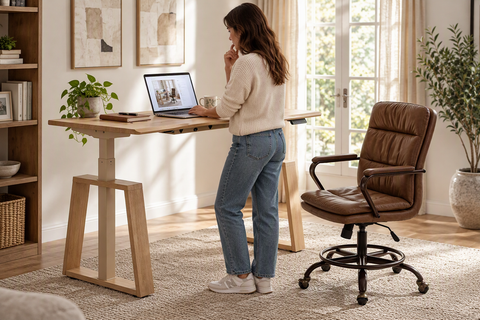
For creators who value both aesthetic and function, the Regal, PU Leather Home Office Chair offers a blend of mid-century design and modern support. While many "retro" chairs sacrifice ergonomics for style, a well-engineered chair ensures that the slimline cushioning still provides the necessary support for the lumbar region.
The Necessity of Adjustability
The BIFMA G1-2013 Ergonomics Guideline specifies that furniture should accommodate the 5th to 95th percentile of the population. This means a chair must be highly adjustable to fit a wide range of body types.
When selecting a chair, look for these critical adjustment points:
| Feature | Ergonomic Requirement | Why It Matters |
|---|---|---|
| Seat Height | Feet flat on floor, thighs horizontal. | Prevents pressure on the underside of thighs. |
| Lumbar Support | Aligned with the natural curve of the lower back. | Maintains the lumbar lordosis and reduces disc pressure. |
| Seat Depth | 2-3 fingers gap between seat edge and back of knees. | Prevents "popliteal" pressure and circulatory restriction. |
| Armrest Height | Elbows at 90-100°, shoulders relaxed. | Reduces strain on the trapezius and neck muscles. |
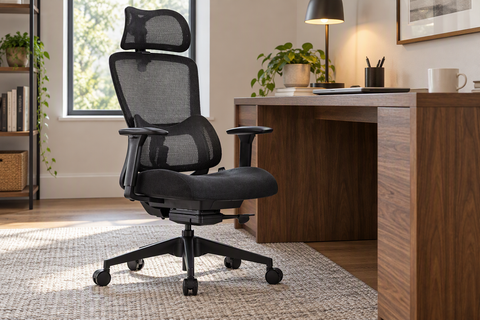
For those who prefer a more cushioned, "high-back" experience during long editing sessions, the Cameron, Ultra Soft Cushion Adjustable Office Chair provides a segmented backrest. This design is particularly effective for creators who alternate between an upright "tasking" posture and a slightly reclined "review" posture.

Beyond the Chair: The Integrated Workstation System
A common misconception is that a good chair is a standalone solution. However, ergonomics is a "system science." As noted in The 2026 Workstation White Paper: Converging Ergonomic Science and Sustainable Engineering, true ergonomic fit is a coupled system involving anthropometrics, viewing geometry, and task cycles.
The Role of the Footrest
If your desk is at a fixed height that requires you to raise your chair to reach the keyboard, your feet may no longer reach the floor. This creates pressure on the back of the thighs and restricts blood flow. The Footstool with Wheels is a vital accessory in this scenario. It allows you to maintain the 90-degree angle at your knees and hips, even if your chair is elevated.

Monitor Placement and Neck Health
Neck strain is often caused by improper monitor height. According to OSHA eTools on Monitors, the top of the screen should be at or slightly below eye level. For creators using multiple displays, a Dual Monitor Arm is essential. It allows for the precise adjustment of height, tilt, and rotation, ensuring that your neck remains in a neutral position regardless of which screen you are focusing on.

Practical Recommendations for the Creative Workday
Achieving a healthy setup requires more than just high-quality gear; it requires a behavioral shift. Based on the Cornell University Ergonomics Web, the ideal work rhythm is the "20-8-2" rule.
The 20-8-2 Protocol:
- Sit for 20 minutes: Use your ergonomic chair in a neutral posture.
- Stand for 8 minutes: If you have a sit-stand desk, transition to a standing position to change the load on your spine.
- Move for 2 minutes: Walk, stretch, or do a quick "micro-break."
This rhythm prevents the buildup of static load and encourages blood circulation. Research by Cochrane (2018) confirms that sit-stand interventions can significantly reduce sitting time by up to 116 minutes per day, though the effectiveness depends heavily on the user actually making the transition.
How to Set Your Monitor and Chair (Step-by-Step)
- Adjust the Seat Height: Sit so your feet are flat on the floor (or footrest) and your knees are at a 90-degree angle.
- Set Seat Depth: Ensure there is a small gap (about the width of your fist) between the edge of the seat and the back of your knees.
- Position Lumbar Support: Move the support so it fits into the curve of your lower back. Expert Tip: The firmest part of the support should align with your belt line, not your shoulder blades.
- Adjust Armrests: Set them so your shoulders are relaxed. If you are typing, your elbows should be at roughly 90-100 degrees.
- Align the Monitor: Use your Dual Monitor Arm to bring the screens to eye level. You should be able to see the entire screen without tilting your head up or down.
Common Ergonomic "Gotchas" and Expert Insights
In our observations of home office setups, we often see recurring mistakes that negate the benefits of expensive furniture.
- The Recline Myth: Many believe they must sit at a rigid 90-degree angle. In fact, locking your chair at a slight recline (100–110 degrees) can reduce disc pressure by up to 40% compared to sitting perfectly upright. Use the recline function dynamically throughout the day.
- The Armrest Pivot: If you use a mouse frequently, pivot your armrests inward. This prevents "ulnar deviation" (turning your wrist outward), which is a major contributor to Repetitive Strain Injury (RSI).
- The Parallax Error: When setting monitor height, users often set the screen too high because they measure from a standing position. Always set your monitor height while seated in your final working posture.
Methodology Note: The "Three-Finger" Seat Depth Heuristic This rule of thumb is used to ensure the seat pan is long enough to support the thighs without compressing the popliteal fossa (the area behind the knee). If the seat is too deep, the user will naturally slide forward, losing contact with the lumbar support and causing the spine to collapse into a "C-shape."
Investing in Your Creative Longevity
For the professional content creator, an ergonomic setup is not a luxury; it is a critical investment in your career's longevity. By combining high-performance furniture like the Regal, PU Leather Home Office Chair or the Cameron, Ultra Soft Cushion Adjustable Office Chair with active habits like the 20-8-2 rule, you create an environment where focus is sustained and injury is prevented.
Remember that ergonomics is not a one-time adjustment but an ongoing process of fine-tuning your environment to match your body's needs. As you upgrade your workstation, prioritize adjustability and scientific standards like those set by BIFMA and ISO to ensure your setup is truly supporting your health.
YMYL Disclaimer: This article is for informational purposes only and does not constitute professional medical advice. If you suffer from chronic back pain or pre-existing musculoskeletal conditions, please consult a qualified healthcare professional or physical therapist before making significant changes to your workstation or work habits.
References
- BIFMA G1-2013 Ergonomics Guideline for Furniture
- OSHA: Computer Workstations - Neutral Working Postures
- EU-OSHA: Prolonged static sitting at work: health effects and good practice advice
- Cochrane: Workplace interventions for reducing sitting at work (2018)
- Cornell University Ergonomics Web — Workstation Guides
- The 2026 Workstation White Paper: Converging Ergonomic Science and Sustainable Engineering
- WHO 2020 Guidelines on Physical Activity & Sedentary Behaviour




Leave a comment