

The Physiological Cost of the Digital Stage: Why Ergonomic Gifting Matters
Professional streaming and content creation represent a unique subset of computer-intensive labor. Unlike traditional office work, which often allows for natural breaks and varied movement, streamers are frequently tethered to their workstations for six to twelve hours at a time. This environment creates a high-intensity "static load"—a physiological state where muscles remain contracted to maintain a specific posture without the benefit of movement-driven blood circulation.
The results of this static load are not merely a matter of discomfort; they are documented health risks. According to research published in the Thai Journal of Ergonomics, studies on high-frequency computer users show a prevalence of neck pain in up to 63.5% of subjects, shoulder disorders in 57.7%, and lower back pain in 54.1%. For streamers, these issues are often exacerbated by the need to lean toward microphones or maintain a specific on-camera "frame," leading to a condition known as anterior head carriage (or "tech neck").
Gifting ergonomic equipment to a streamer is more than a gesture of support; it is a targeted intervention in their long-term musculoskeletal health. By addressing the physical principles of the workspace, these gifts help maintain the "spinal neutral position"—the alignment where the spine is most resilient to the forces of gravity and internal pressure.
The Foundation of Movement: Sit-Stand Dynamics
The most significant risk factor in a streamer's setup is prolonged static sitting. The World Health Organization (WHO) emphasizes that adults should limit sedentary time and interrupt long periods of static behavior with physical activity. However, for a streamer in the middle of a live broadcast, "getting up for a walk" is often impossible.
This is where the engineering of a sit-stand workstation becomes critical. A height-adjustable desk allows the user to transition between postures without interrupting their workflow. As highlighted in The 2026 Workstation White Paper: Converging Ergonomic Science and Sustainable Engineering, the ability to alternate positions is a cornerstone of modern occupational health.
The Standing Desk with Drawers, Wood Finish (47'' /55'') provides a height range of 29" to 48". This range is designed to accommodate the 5th to 95th percentile of the adult population, aligning with the BIFMA G1-2013 Ergonomics Guideline.
Logic Summary: The 20-8-2 Rule Our recommendation for sit-stand usage follows the heuristic developed by the Cornell University Ergonomics Web.
- 20 Minutes: Sitting in a neutral, supported posture.
- 8 Minutes: Standing (ensure weight is distributed evenly).
- 2 Minutes: Moving or stretching (micro-breaks).
- Assumption: This model assumes the user has no pre-existing joint conditions and uses supportive footwear during standing intervals.

Technical Features for Streamers
The inclusion of programmable memory presets is not just a convenience; it ensures that the desk returns to the mathematically correct height for the user every time. This eliminates the "visual parallax" error, where users often set their standing height too high, causing them to shrug their shoulders and increase tension in the trapezius muscles. Furthermore, the integrated charging stations and dual storage drawers address the cognitive load of a cluttered workspace, which EU-OSHA guidelines link to increased stress and physical tension.
Cervical Alignment and Visual Ergonomics
One of the most common postural failures in streaming is the misalignment of the monitor. When a monitor is too low, the streamer naturally tilts their head forward. This increases the effective weight of the head on the cervical spine—at a 60-degree tilt, a 10-12 lb head can exert up to 60 lbs of force on the neck muscles and discs.
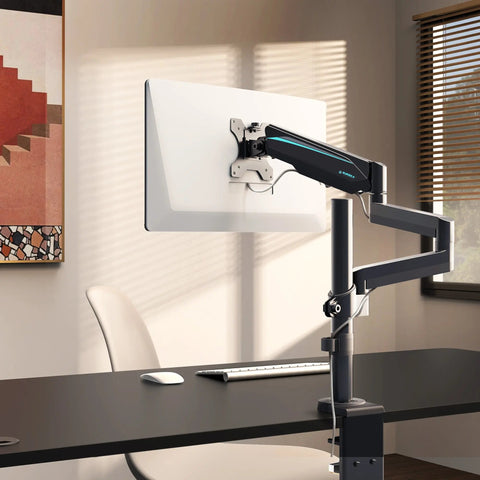
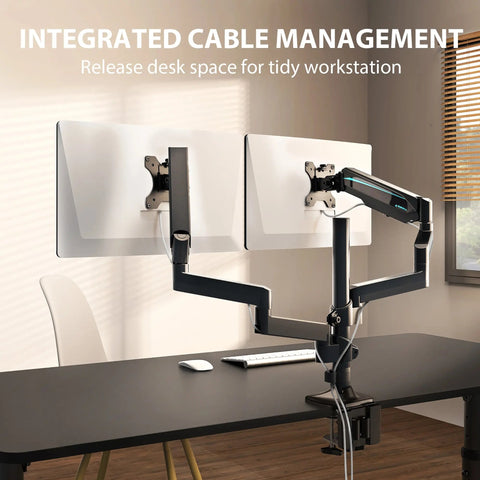
A Dual Monitor Arm is a high-impact gift because it allows for precision adjustment that standard monitor stands cannot achieve. For dual-screen users, symmetry is vital; an asymmetrical setup forces constant neck rotation, a leading risk factor for work-related musculoskeletal disorders (MSDs) as defined by OSHA.
The "Top-Third" Heuristic
To minimize neck strain, the monitor should be positioned so that the top third of the screen is at or slightly below eye level. This allows the eyes to maintain a downward gaze of 15 to 20 degrees, which is the natural resting position for the ocular muscles. The Dual Monitor Arm supports this with a 27.3" reach and ±90° swivel, ensuring the streamer can pull the monitors closer during high-focus gaming and push them back during "just chatting" segments.
| Feature | Specification | Ergonomic Benefit |
|---|---|---|
| Max Extension | 27.3" | Allows for proper focal distance (~20-30 inches). |
| Tilt Range | ± 45° | Reduces screen glare and accommodates standing heights. |
| Gas Spring | Adjustable Tension | Ensures the monitor stays in place without drifting. |
| VESA Pattern | 75x75 / 100x100 | Standardized compatibility for professional displays. |
Methodology Note: The focal distance recommendation is based on ISO 9241-5:2024 standards for workstation layout, which suggests that the screen should be at a distance where the user can comfortably read text without leaning forward.

Lower Limb Health and the Role of Footrests
While much attention is paid to the back and neck, the lower limbs are often neglected. When a streamer sits for hours, the front edge of the chair can press against the underside of the thighs, potentially restricting blood flow—a phenomenon known as "seat edge pressure." If the chair is too high and the feet do not rest flat on the floor, this pressure increases, leading to swelling (edema) and discomfort.
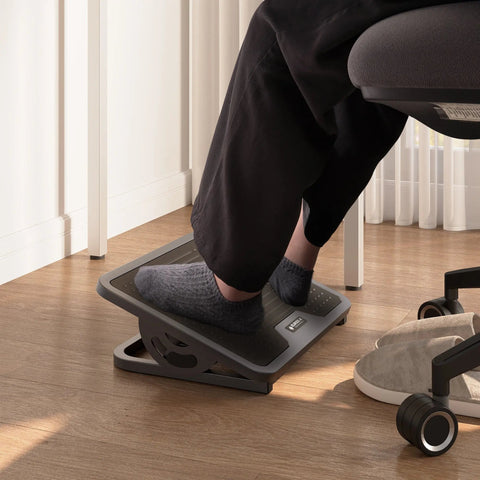
The Adjustable Ergonomic Footrest addresses this by providing a stable platform for the feet. This allows the user to shift their weight and maintain a 90-degree angle at the hips and knees, which is the recommended posture by the Canadian Centre for Occupational Health and Safety (CCOHS).
Promoting Micro-Movement
The textured surface of the footrest serves a dual purpose: it provides tactile feedback and encourages "micro-movements" of the feet. The 0-20 degree tilt range allows for ankle flexion and extension, which helps activate the "calf muscle pump," assisting in venous return and reducing the risk of lower limb MSDs as discussed in OSHwiki research.
Organizational Ergonomics: Reducing Cognitive and Physical Friction
An overlooked aspect of ergonomics is the "reach zone." Frequently used items should be within the "primary reach zone" (elbow to hand distance), while less frequent items should be in the "secondary zone" (full arm reach). A streamer's desk is often crowded with audio interfaces, controllers, and lighting remotes.
The 23" Rolling File Cabinet with Drawer provides a solution for "Organizational Ergonomics." By moving non-essential hardware into a mobile storage unit, the streamer can clear the primary reach zone on their desktop. This reduces the need for repetitive over-reaching, which can lead to shoulder impingement over time.
For streamers who frequently swap hardware or modify their setup, the lockable casters on the cabinet are essential. They allow for easy reconfiguration of the work area, reducing the physical strain of lifting or moving heavy equipment—a key principle in OSHA's hierarchy of controls.

Practical Recommendations for a Healthy Stream
When setting up these ergonomic gifts, streamers should follow a systematic approach to ensure the equipment is working for them, not against them.
1. Identify the Neutral Posture
Before adjusting the desk or monitor, the streamer should sit in their chair with their back fully supported. The lumbar support should align with the natural inward curve of the lower back, typically at the belt-line. A common mistake is setting the support too high, which can push the mid-back forward and cause the shoulders to round.
2. Calibrate the Desk Height
Adjust the Standing Desk with Drawers, Wood Finish (47'' /55'') so that the elbows are at a 90-degree angle and the wrists are in a neutral, straight position while typing. If the desk is too high, the streamer will shrug their shoulders; if it is too low, they will lean forward, compromising the spine.
3. Manage Cable Tension
One "gotcha" for sit-stand desks is cable length. Ensure that all monitor and peripheral cables have enough slack to accommodate the desk at its maximum height (48"). Using the magnetic cable ties included with the desk can prevent cables from snagging or pulling on the hardware during transitions.
4. The Ideal Sit-Stand Ratio
As noted earlier, standing all day is as detrimental as sitting all day. OSHwiki research on prolonged static standing indicates risks of varicose veins and joint stiffness. The goal is alternation. Use a timer or a stream-deck command to remind the creator to switch positions every 30-60 minutes.
| Parameter | Recommended Value | Source / Rationale |
|---|---|---|
| Monitor Height | Top 1/3 at eye level | OSHA eTools: Monitors |
| Viewing Distance | 20" - 30" (Arm's length) | HSE DSE Guidelines |
| Keyboard Angle | Flat or slightly negative | OSHA eTools: Keyboards |
| Footrest Angle | 10° - 15° (Adjustable) | ISO 11226:2000 |
Summary of Ergonomic Principles
The transition from a standard setup to an ergonomic one is a process of removing "friction"—both physical and mental. By gifting tools like the Dual Monitor Arm and the Adjustable Ergonomic Footrest, you are providing the streamer with the mechanical means to maintain a healthy relationship with their workspace.
These interventions are most effective when combined with behavioral changes, such as the 20-8-2 rule and regular posture self-checks. For further reading on the intersection of design and health, refer to the Ergonomic Setups for Long Editing Sessions and How to Break Bad Gaming Posture Habits with Ergonomics guides.
Disclaimer: This article is for informational purposes only and does not constitute professional medical advice. Individuals with pre-existing musculoskeletal conditions or chronic pain should consult a qualified physiotherapist or medical professional before making significant changes to their workstation or adopting new standing routines.
References
- BIFMA G1-2013 Ergonomics Guideline for Furniture
- Cornell University Ergonomics Web — Workstation Guides
- OSHA eTools: Computer Workstations - Neutral Working Postures
- WHO 2020 Guidelines on Physical Activity & Sedentary Behaviour
- ISO 9241-5:2024 Workstation layout & postural requirements
- Canadian Centre for Occupational Health and Safety (CCOHS) - Sit/Stand Desk Guide
- The 2026 Workstation White Paper: Converging Ergonomic Science and Sustainable Engineering




Leave a comment