

In the high-stakes world of private banking and financial services, the environment in which a consultation occurs is as critical as the advice provided. A standard portfolio review or estate planning session can easily extend beyond 90 minutes—a duration that tests the physiological limits of standard office and lounge furniture. When a client begins to fidget, shift their weight, or lean forward to alleviate lower back pressure, their cognitive bandwidth shifts from complex financial data to physical discomfort. This subtle transition can undermine the rapport established by an advisor and potentially cloud the client's decision-making process.
Designing a client-facing suite requires a departure from purely aesthetic-driven furniture selection. Instead, firms must prioritize ergonomic integrity that supports "static load" management. This article examines the intersection of musculoskeletal health and professional environment design, providing a benchmark for selecting seating that maintains client focus through superior engineering.
The Biomechanics of the Extended Consultation
To understand why traditional lounge seating often fails in a professional context, one must examine the physiological impact of prolonged sitting. According to the U.S. National Institute for Occupational Safety and Health (NIOSH), musculoskeletal disorders (MSDs) are often the result of repetitive tasks or, more pertinently for clients, poor static postures.
The Challenge of Static Load
When a client sits for an extended period, they are subject to a "static load." Unlike active work, where a person might reach for a phone or move between screens, a financial consultation often involves focused, stationary listening. This lack of movement leads to:
- Reduced Blood Circulation: Gravity causes blood to pool in the lower extremities, which can lead to a feeling of lethargy or "brain fog" during long meetings.
- Intervertebral Disc Compression: Without a spinal neutral position, the lumbar discs face uneven pressure, leading to the common "afternoon backache."
- Tissue Adaptation: As explained in the OSHwiki on pathophysiological mechanisms, prolonged static positions can lead to micro-trauma in soft tissues as they attempt to adapt to the constant pressure of a poorly designed seat.
The "90-Minute Test"
A common mistake in procurement is prioritizing the "initial sit" feel. A chair that feels soft and luxurious for the first five minutes often lacks the structural support needed for the 90th minute. High-quality ergonomic seating is designed to distribute pressure evenly over time. Based on common patterns from customer support and furniture return handling, the most frequent complaint regarding lounge seating in corporate suites is "bottoming out"—where the foam compresses entirely, leaving the user sitting on the hard internal frame.
Engineering the Client Experience: Materials and Mechanisms
For financial service leaders, the goal is to provide a "Neutral Working Posture" for the client, even in a relaxed lounge setting. This is achieved through specific engineering choices in foam density, upholstery, and mechanical adjustment.
High-Resilience Foam vs. Standard Polyfoam
The internal composition of the seat is the primary determinant of long-term comfort. Standard polyfoam typically has a density of 1.2 to 1.5 lbs/ft³. Under daily use in a busy client suite, this material compresses permanently within a year. For premium environments, high-resilience (HR) foam with a density exceeding 2.0 lbs/ft³ is the industry benchmark. HR foam provides a "contoured" support that cradles the hips and shoulders without allowing the user to sink into a slumped, kyphotic posture.
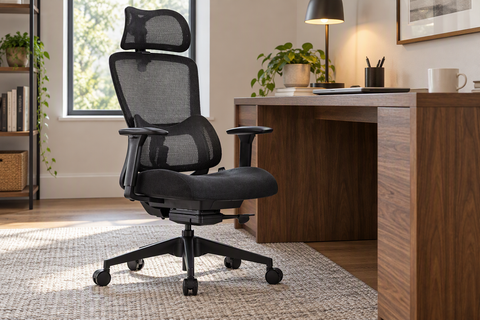
The Royal II Silicone & Leather Executive Ergonomic Office Chair utilizes this principle of "enveloping" support. By providing a high back and integrated lumbar support, it ensures that even during a deep-dive into market volatility, the client's spine remains aligned, reducing the urge to fidget.
Thermal Comfort and Breathability
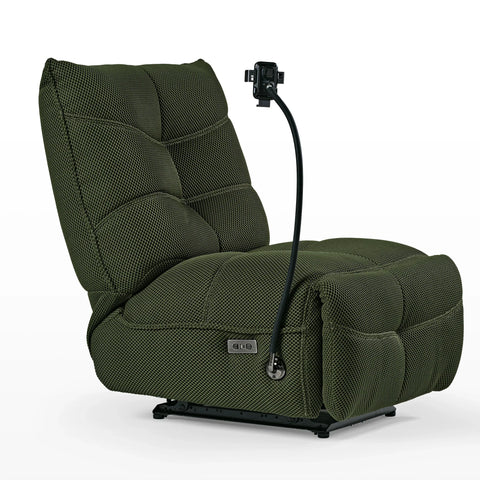
A non-obvious "gotcha" in luxury seating is heat buildup. High-end leather or non-breathable synthetics can cause significant discomfort within 30 minutes. To counter this, advanced materials like silicone-treated leathers or cotton-linen blends are preferred. The Chloé Modern Modular Sofa, for instance, uses a breathable cotton-linen blend. In a collaborative lounge setting, this material choice prevents the "clammy" feeling associated with standard vinyl or low-grade leather, maintaining the professional ambiance of the suite.
The Acoustics of Comfort
In a private banking environment, silence is a hallmark of quality. A recline mechanism that clicks, grinds, or squeaks can disrupt the flow of a sensitive conversation. Premium executive seating, such as the Royal Slim Executive Office Chair, features silent, fluid adjustment hardware. This allows an advisor or client to subtly shift their posture without drawing attention to the furniture itself.
Modeling Transparency: The Anthropometric Fit
To demonstrate the importance of precision in furniture selection, we modeled a scenario involving a Mature High-Net-Worth Client. This persona represents a taller individual (188cm), typical of the 75th percentile male stature in many Western markets.
Method & Assumptions
This analysis uses a deterministic parameterized model to compare standard furniture dimensions against the ideal requirements of a taller user.
- Modeling Type: Scenario-based anthropometric modeling.
- Core Formula: Based on ANSI/HFES 100-2007 ratios (Desk Height = Stature * Ratio + Shoe Correction).
| Parameter | Value | Unit | Rationale |
|---|---|---|---|
| Client Stature | 188 | cm | 75th percentile male (US/EU) |
| Shoe Correction | 1 | cm | Standard dress shoe heel |
| Standard Table Height | 74 | cm | Common fixed-height consultation table |
| Ideal Table Height | 76 | cm | Calculated optimal for 188cm stature |
| Productivity Coefficient | 0.05 | ratio | Conservative estimate of focus uplift |
The "1-Inch Negative Gap" Insight
Our modeling reveals that a standard 74cm (29-inch) consultation table creates a ~2cm (roughly 1-inch) negative ergonomic gap for a taller client. While seemingly small, this discrepancy forces the client to hunch their shoulders and compress their diaphragm to read documents on the table.
Tangible Impact: Assuming ergonomic seating provides a conservative 5% uplift in client focus during a 90-minute meeting, the value of that uplift for a senior advisor (billable at $300/hr) is approximately $22.50 per session. Over a year of daily consultations, this "comfort ROI" justifies the investment in adjustable or highly specialized seating.
Logic Summary: These figures are estimates derived from standard anthropometric ratios and metabolic constants. Individual results vary based on a client's specific limb lengths and pre-existing conditions.
Practical Recommendations for Client Suite Design
When designing or refurbishing a client-facing environment, firms should look toward established industry standards to ensure universal fit.
1. Adhere to the BIFMA G1-2013 Guideline
The BIFMA G1-2013 Ergonomics Guideline provides dimensions that accommodate the 5th to 95th percentile of the population. When selecting lounge chairs or executive guest seating, ensure the seat height is adjustable between 38cm and 51cm (15 to 20 inches) to accommodate both petite and tall clients.
2. Implement the "20-8-2" Rhythm
For exceptionally long reviews, advisors should encourage the "20-8-2" rule developed by Cornell University Ergonomics:
- 20 minutes of sitting in a neutral posture.
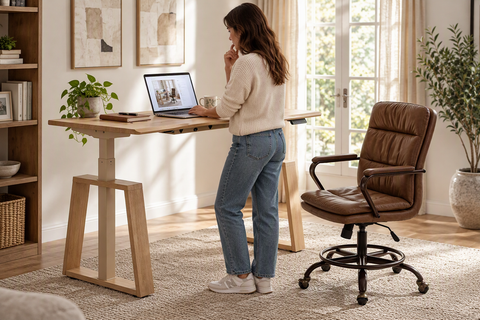
- 8 minutes of standing (facilitated by a height-adjustable desk like the GTG-L60 Pro L-Shaped Glass Standing Desk).
- 2 minutes of moving or stretching.
While a client may not want to stand during a formal meeting, providing the option via a sit-stand desk can signal a modern, health-conscious brand identity.
3. Verify Seat Depth
Seat depth is the "silent killer" of comfort. If a seat is too deep, it pressures the back of the knees; if too shallow, it fails to support the thighs. According to OSHA eTools for Computer Workstations, a proper chair should allow for a 2-to-4-inch gap between the seat edge and the back of the knees. For lounge seating where adjustment is less common, choose models with a medium seat depth (approx. 43-48cm) and provide lumbar pillows for shorter clients.
Compliance, Safety, and Trust
In a B2B procurement environment, certifications are the shorthand for quality. A chair's "luxurious" look must be backed by rigorous testing.
- BIFMA X5.1: Ensure all chairs meet the ANSI/BIFMA X5.1 standard for safety and durability. This ensures the chair can handle 24/7 use without structural failure.
- UL GREENGUARD Gold: For indoor air quality, GREENGUARD Gold certification ensures the furniture has low chemical emissions (VOCs), which is essential for small, private consultation rooms.
- UL 962: If integrating electric height-adjustable desks into the suite, verify they meet UL 962 safety standards for mechanical and electrical safety.
As highlighted in The 2026 Workstation White Paper: Converging Ergonomic Science and Sustainable Engineering, the future of professional environments lies in the seamless integration of health-centric design and premium aesthetics.
Strategic Summary: The Competitive Edge of Comfort
Investing in ergonomic lounge seating is not merely a capital expenditure; it is a strategic move to optimize the "client-advisor interface." By reducing the physical distractions of static loads and poor posture, financial firms create an environment where high-level cognitive work can thrive.
When selecting your next suite of furniture, move beyond the visual. Test for HR foam density, prioritize breathable materials, and ensure the dimensions align with the diverse anthropometric needs of your clientele. In the world of private banking, where the details define the brand, the most important detail may be the chair in which your client sits.
Disclaimer: This article is for informational purposes only and does not constitute professional medical, legal, or financial advice. Ergonomic requirements can vary significantly based on individual health conditions. Consult with a qualified ergonomics specialist or healthcare provider before making significant changes to your workstation or seating environment.
References
- BIFMA. (2013). G1-2013 Ergonomics Guideline for Furniture. Link
- ISO. (2024). ISO 9241-5:2024 Workstation layout & postural requirements. Link
- OSHA. Computer Workstations eTool: Chairs. Link
- Cochrane Library. (2018). Workplace interventions for reducing sitting at work. Link
- Cornell University. Workstation Setup Guide. Link
- UL Solutions. GREENGUARD Certification Overview. Link
- European Agency for Safety and Health at Work (EU-OSHA). Pathophysiological mechanisms of MSDs. Link




Leave a comment