

The Strategic Imperative of Ergonomic Scaling
Why does your team’s productivity seem to peak at 11:00 AM and crater by 3:30 PM? For many design studios and tech firms, the answer isn't found in project management software or caffeine levels—it is found in the physical toll of the workstation. As teams scale, the "static load" of prolonged sitting becomes a silent drain on both human health and the corporate bottom line.
In the high-stakes environment of digital creation, where precision and focus are the primary currencies, musculoskeletal health is often overlooked until it reaches a crisis point. We view ergonomic scaling not as a furniture procurement task, but as a strategic business investment. When a studio manager or tech lead overlooks the physiological needs of their team, they are effectively pricing in a high rate of employee burnout and absenteeism.
According to the World Health Organization (WHO) 2020 Guidelines on Physical Activity & Sedentary Behaviour, reducing sedentary time and interrupting long periods of static behavior are critical for adult health. For a design studio, this means moving beyond the "one-size-fits-all" chair and desk. It requires a standardized, evidence-based approach to outfitting the workspace that addresses Musculoskeletal Disorders (MSDs) before they manifest as chronic pain.
The Physiology of the "Static Load"
To understand why ergonomic furniture is essential, we must first understand what happens to the human body during a typical eight-hour shift. The primary culprit is the "static load"—the physical stress placed on muscles and joints to maintain a single posture for extended periods.
When a designer sits in a non-adjustable chair, the lumbar spine often loses its natural curve, leading to increased pressure on the intervertebral discs. This is compounded by poor blood circulation in the lower limbs. OSHwiki research on musculoskeletal disorders and prolonged static sitting highlights that static postures lead to muscle fatigue and reduced metabolic exchange, which over time, contributes to the development of MSDs.
The goal of professional-grade ergonomics is to achieve a "Spinal Neutral Position." This is the posture where the spine is properly aligned, and the muscles are under the least amount of tension. Achieving this requires furniture that conforms to the user, rather than forcing the user to conform to the furniture.
Logic Summary: The Mechanism of Strain Our physiological analysis is based on the principle of tissue adaptation. When static loads exceed the body's recovery capacity, micro-trauma occurs. We model the "Neutral Position" as the baseline for all ergonomic recommendations to minimize this micro-trauma.
The Business Case: ROI of Ergonomic Intervention
For tech leads, the most compelling argument for ergonomic scaling is the measurable Return on Investment (ROI). Ergonomics is often perceived as a "soft" benefit, but the data suggests a direct impact on financial performance.
A meta-analysis of 42 studies regarding workplace health interventions found that structured ergonomic programs reduced absenteeism by an average of 30% and healthcare costs by 21.8%. Furthermore, 16 cost-benefit analyses reported that every $1 spent on ergonomic improvements yielded a positive financial return (Source: ResearchGate - Barriers to Implementation of Workplace Health Interventions).
| Parameter | Estimated Value | Rationale |
|---|---|---|
| Absenteeism Reduction | ~30% | Based on meta-analysis of structured interventions |
| Healthcare Cost Savings | ~21.8% | Derived from employer-sponsored health plan data |
| Productivity Gain | 10–15% | Estimated from reduced fatigue and "micro-break" efficiency |
| Employee Retention | High | Qualitative correlation with workplace satisfaction |
| Payback Period | 12–18 Months | Typical amortization of high-quality furniture costs |
Methodology Note: This ROI model is a scenario analysis based on industry heuristics. Actual returns may vary based on the baseline health of the workforce and the consistency of the ergonomic program's implementation.
Standardizing the Solution: Desk and Chair Selection
When scaling a studio, standardization is key to maintenance and training. However, standardization must not come at the expense of adjustability. We recommend adhering to the BIFMA G1-2013 Ergonomics Guideline for Furniture, which provides dimensions intended to fit the 5th to 95th percentile of the population.
The Dynamic Workstation: Sit-Stand Desks
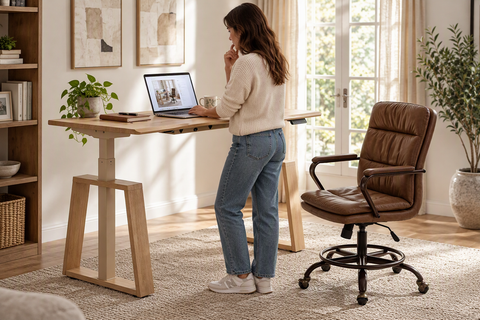
The transition from sitting to standing is the most effective way to break the static load. According to Cochrane: Workplace interventions for reducing sitting at work, sit-stand desks can reduce sitting time by approximately 84 to 116 minutes per day. For a professional studio, dual-motor desks are preferred over single-motor alternatives due to their increased weight capacity and smoother height transitions, which are essential for multi-monitor setups.
The Foundation: High-Performance Seating
A chair is the most critical piece of equipment in the studio. It must meet ANSI/BIFMA X5.1 standards for safety and durability. For teams engaged in diverse tasks—from deep coding to creative brainstorming—we look for chairs that offer dynamic lumbar support.
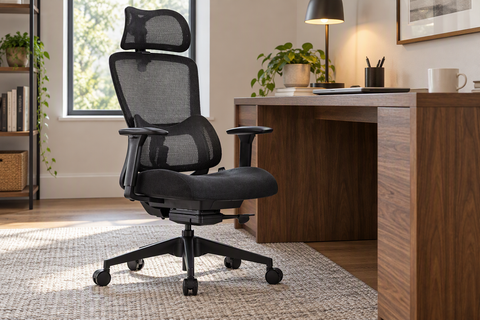
The Flex, Dual-Backrests Ergonomic Office Chair is a prime example of this logic. Its dual-backrest design moves independently to adapt to the body’s natural shape, providing targeted support to both sides of the lower back. This is particularly important for designers who frequently shift their posture while working across multiple screens.

Practical Recommendations for Studio Implementation
Simply buying the furniture is not enough. Successful scaling requires a protocol for setup and usage. Based on our observations of high-performance design teams, we recommend the following three-step implementation framework.
1. The 20-Minute Rule for Transitions
A common mistake is standing for too long, which can lead to lower limb MSDs. Cornell University’s Ergonomics Web recommends the "20-8-2" rhythm: 20 minutes of sitting, 8 minutes of standing, and 2 minutes of moving or stretching. We have found that prompting a posture change every 20-30 minutes dramatically reduces afternoon fatigue compared to longer, static periods.
2. The Eye-Level Monitor Heuristic
Improper monitor height is a leading cause of neck strain. According to OSHA eTools for Monitors, the top of the screen should be at or slightly below eye level. However, many users set their monitors too high, causing neck extension.
Using a Dual Monitor Arm allows for precise adjustment, especially when using different sized screens. This ensures that the designer can maintain a neutral neck posture while maximizing their digital workspace.

3. The "Three-Finger" Seat Depth Rule
To maintain blood circulation in the legs, there should be a 2-3 finger gap between the back of the knee and the edge of the seat. If the seat is too deep, it can cut off circulation; if it is too shallow, it fails to provide adequate thigh support. This is a quick heuristic that leads can use to audit their team’s setups during routine walkthroughs.
Workflow Mapping: Beyond the Physical Fit
One insight that the general consensus often misses is that ergonomics must fit the workflow, not just the body. A motion graphics artist engaged in repetitive timeline scrubbing has different postural demands than a UI designer focused on pixel-precision.
- Precision Work: Requires stabilized forearm support to reduce micro-movements in the wrist.
- Creative Brainstorming: Often involves reclining; the chair must provide consistent lumbar support during the tilt.
- Collaborative Review: Requires desks that can easily adjust to a shared standing height for quick "huddle" sessions.
For more on the convergence of science and workflow, see The 2026 Workstation White Paper: Converging Ergonomic Science and Sustainable Engineering.
Budgeting for a Scalable Rollout
When outfitting a studio, budget allocation should be balanced to ensure no single component becomes a weak link. We suggest the following "60/30/10 Rule" for a functional rollout:
- 60% on Core Desks: Prioritize dual-motor stability and height range.
- 30% on Chairs: Focus on BIFMA-certified durability and dynamic lumbar support.
- 10% on Essential Accessories: This includes monitor arms, cable management, and footrests.
The Adjustable Ergonomic Footrest is a frequently overlooked 10% item. It is vital for shorter team members who may find that their feet do not rest flat on the floor once their chair is at the correct height relative to the desk. This accessory ensures that the "Neutral Position" is maintained across the entire team, regardless of height.
Eureka Ergonomic Adjustable Footrest under a desk, supporting a user's feet for better circulation.
Managing the "Hygiene-First" Shared Studio
In modern studios that utilize hot-desking, hygiene becomes an ergonomic factor. Safe Work Australia and other health authorities emphasize the importance of cleanable surfaces.
To scale effectively in a shared environment:
- Select Breathable Materials: Mesh or high-quality fabrics that are easy to sanitize.
- Centralized Storage: Use units like the Ark EL, 29" Display File Storage Cabinet to allow employees to store personal peripherals (mice/keyboards) overnight, reducing the shared touchpoints on the desks.
- Standardized Training: Every new hire should receive a 5-minute "Ergonomic Orientation" on how to adjust their chair and desk to their personal specs.
Cultivating a Culture of Well-being
Scaling ergonomics is as much about culture as it is about hardware. Providing the world's best furniture will not solve burnout if the studio culture rewards "powering through" pain.
We encourage leads to model healthy behavior. If the tech lead is seen using a standing desk and taking micro-breaks, the rest of the team will feel empowered to do the same. This behavioral intervention, combined with high-performance engineering, creates a workplace that doesn't just look professional—it feels professional.
For further reading on optimizing specific setups, you may find our guides on Finding Your Ideal Ergonomic Standing Desk Height and What Makes an Office Chair Truly Ergonomic? helpful for individual team assessments.
By treating ergonomic scaling as a core pillar of studio operations, you are doing more than just buying chairs; you are building a resilient, high-performance team capable of long-term creative output.
Disclaimer: This article is for informational purposes only and does not constitute professional medical advice. Always consult with a qualified healthcare provider or a certified professional ergonomist before making significant changes to your workstation, especially if you have pre-existing musculoskeletal conditions.




Leave a comment