

The Developer’s 30-Day Transition to a Standing Desk Workflow
For many professional developers, the mid-afternoon "slump" is a familiar adversary. It often manifests as a dull ache in the lumbar region, a tightening between the shoulder blades, or a noticeable drop in cognitive clarity during complex debugging sessions. While the industry has long debated whether "sitting is the new smoking," the reality for tech professionals is more nuanced. The problem is not merely sitting; it is the static load—the prolonged maintenance of a single posture that compromises blood circulation and places undue stress on the musculoskeletal system.
Transitioning to a standing desk is frequently proposed as the solution, yet many developers abandon the practice within the first week. The common mistake is an "all-or-nothing" approach: attempting to stand for eight hours on day one. This sudden shift often leads to plantar fascia strain, lower back fatigue, and a significant decrease in "flow state" as physical discomfort distracts from the code.
To achieve a sustainable, high-performance workflow, developers require a phased, data-driven transition. This 30-day guide provides a scientific framework for integrating standing into a coding routine without sacrificing productivity or health.
The Physiology of the Static Workstation
To understand why a phased transition is necessary, one must look at the physiological impact of prolonged sitting. According to the European Agency for Safety and Health at Work (EU-OSHA), prolonged static sitting is linked to a range of Musculoskeletal Disorders (MSDs). When you sit, the natural S-curve of the spine often collapses into a C-shape, increasing intradiscal pressure. Furthermore, the lack of muscle activity in the lower limbs leads to venous pooling, which can reduce the efficiency of blood return to the heart and brain.
Conversely, standing is not a passive "cure." Prolonged static standing carries its own risks, including increased venous pressure and lower limb fatigue. The WHO 2020 Guidelines on Physical Activity & Sedentary Behaviour emphasize that the goal should be the reduction of total sedentary time through frequent interruptions rather than replacing one static posture with another.
The core objective of an ergonomic workstation is to maintain a spinal neutral position. This is the posture where the spine is naturally aligned, minimizing the energy required to maintain balance and reducing the strain on ligaments and muscles. Achieving this requires furniture that adheres to rigorous standards, such as BIFMA G1-2013 Ergonomics Guideline, which provides dimensions designed to fit the 5th to 95th percentile of the population.
Logic Summary: The Static Load Model Our analysis of developer fatigue assumes that musculoskeletal strain is a function of duration ($T$) and postural deviation ($D$). A static posture ($D > 0$) held for $T > 30$ minutes triggers a "discomfort cascade." The transition plan aims to reset $T$ before the cascade begins.
Phase 1: Days 1–7 – The Acclimation Period
The first week is about neurological and muscular adaptation. You are training your body to engage the core and posterior chain muscles that have likely been underutilized during years of sitting.
The 20-8-2 Rule
The most effective heuristic for this phase is the 20-8-2 Rule, developed by ergonomics experts at Cornell University. For every 30-minute cycle:
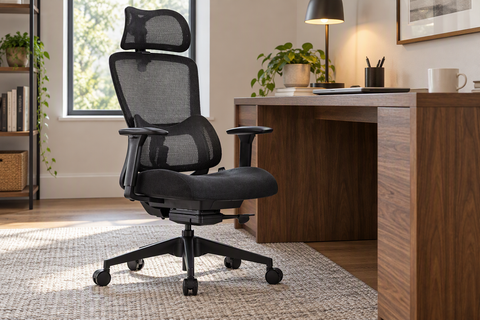
- 20 Minutes Sitting: Use a high-quality chair like the Exis, Ergonomic Office Chair, ensuring the 4-level adjustable lumbar support is positioned to maintain your natural spinal curve.
- 8 Minutes Standing: Transition your desk to a standing height.
- 2 Minutes Moving: Walk, stretch, or perform light micro-movements to stimulate blood circulation.
Setting the Foundation
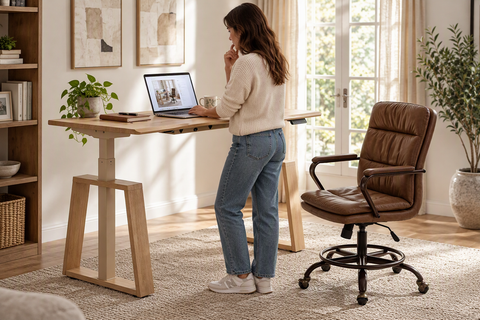
During these first seven days, do not worry about "standing for the sake of standing." Focus on the transition itself. Use a desk with programmable memory presets, such as the Standing Desk with Drawers, Wood Finish (47'' /55''), to ensure you return to the exact same ergonomic heights every time.
A developer using a standing desk with drawers and a monitor riser to maintain an organized and ergonomic workspace.
Phase 2: Days 8–15 – Hardware Calibration and Eye-Level Accuracy
By the second week, your legs may feel a slight "tiredness," which is normal muscle adaptation. Now, you must refine your hardware geometry. A common pitfall is maintaining a "seated" monitor height while standing, leading to "tech neck"—a forward head posture that puts immense strain on the cervical spine.
Monitor and Input Device Placement
According to OSHA eTools for Computer Workstations, the top of your screen should be at or slightly below eye level. When you stand, your perspective shifts.
- Monitor Height: Use a Single Monitor Arm to adjust your screen dynamically. The monitor should be approximately an arm’s length away (20–30 inches).
- Keyboard Angle: Your elbows should be at a 90-degree angle, with wrists in a neutral, flat position. Avoid resting your wrists heavily on the desk edge, which can compress the carpal tunnel.
- The Parallax Effect: Most developers set their standing height too high because they visually compensate for the floor distance. Ensure your desk surface is at elbow height, not chest height.
The Importance of Flooring
Research indicates that the surface you stand on significantly impacts fatigue. A study on the effect of flooring on standing comfort suggests that hard surfaces increase subjective discomfort. For developers, an anti-fatigue mat is non-negotiable. It encourages micro-oscillations in the calf muscles, which acts as a "venous pump" to return blood to the heart.
Phase 3: Days 16–23 – Active Standing and Flow State Integration
In the third week, the focus shifts from standing to active standing. Static standing can be just as harmful as static sitting if you "lock" your knees or lean heavily on one hip.
Incorporating Micro-Movements
To maintain focus during deep work or long debugging sessions, incorporate these "active" techniques:
- Weight Shifting: Gently shift your weight from the left foot to the right foot every few minutes.
- Calf Raises: Perform 5–10 slow calf raises during a compile break or while reading documentation.
- Glute Squeezes: Engaging the glutes helps stabilize the pelvis and reduces pressure on the lower back.
Managing "Flow State"
Developers often fear that standing will break their concentration. The key is to sync your postural changes with your task type.
- Standing Tasks: Code reviews, emails, meetings, and short bursts of scripting.
- Sitting Tasks: Deep architectural design, complex logic debugging, or tasks requiring intense "tunnel vision."
If you find yourself losing focus while standing, it is a signal from your body that your "static endurance" has been reached. Respect the signal and return to your Exis, Ergonomic Office Chair to recover.

Phase 4: Days 24–30 – Sustaining the Habit
The final week is about cementing the habit. Long-term adherence is the greatest challenge; according to data regarding standing desk adherence, usage often drops significantly after the first few months if a behavioral reinforcement mechanism isn't in place.
Customizing Your Ratio
While the 20-8-2 rule is a high-performance starting point, the "ideal" ratio is highly individual. A study on tested sit-stand ratios suggests that users should experiment with ratios ranging from 1:1 to 3:1 (sitting to standing) based on their specific cognitive load and physical comfort.
Large-Scale Setups
For developers using triple-monitor arrays or large ultrawide screens, a standard desk may feel cramped. A spacious surface like the Blossom Dynamics® Office Standing Desk (70"x46") provides the necessary depth to maintain proper focal distance while offering the stability required for heavy equipment at maximum height.
Modeling Note: The 30-Day Transition Model This model estimates the gradual increase in "Standing Tolerance" ($ST$) over 4 weeks.
Week Suggested Sit:Stand Ratio Target Daily Standing Time unit Rationale 1 3:1 (45m sit / 15m stand) 1.5 - 2 hours Acclimation & core activation 2 2:1 (40m sit / 20m stand) 2.5 - 3 hours Hardware calibration focus 3 1:1 (30m sit / 30m stand) 3.5 - 4 hours Active standing integration 4 Task-Dependent 4+ hours Habitual optimization Boundary Conditions: This model assumes a healthy adult with no pre-existing lower-limb vascular issues. If sharp pain occurs, revert to the previous week's ratio.
Common Pitfalls and Expert Insights
As you finalize your transition, be aware of these non-obvious "gotchas" that we frequently observe in professional tech environments:
- The "Leaner" Trap: Many developers begin to lean on their elbows or a single hip as they tire. This creates asymmetrical loading on the spine. If you cannot stand with a straight back and engaged core, you should sit down.
- Cable Tension: Ensure your cables have enough slack for the desk's maximum height. We have seen many "desk-stop" errors and port damages caused by a single short DisplayPort cable.
- The Productivity Metric Myth: Do not measure your success by "Lines of Code" (LOC). While some claim standing boosts productivity, quantitative evidence is limited. Instead, measure success by your Discomfort Score at 5:00 PM. If you finish the day without a "burning" sensation in your neck or back, the transition is working.
- Footwear Matters: Standing in flat, unsupportive sneakers or barefoot on a hard floor can exacerbate plantar fasciitis. Wear supportive indoor shoes or use a high-density anti-fatigue mat.
For a deeper dive into the intersection of materials science and human factors, refer to The 2026 Workstation White Paper: Converging Ergonomic Science and Sustainable Engineering.
Summary of Ergonomic Recommendations
To maximize the success of your 30-day transition, adhere to the following checklist derived from Safe Work Australia's Workstation Setup Guidelines and HSE (UK) DSE standards:
- Desk Height: Elbows at 90 degrees, shoulders relaxed.
- Monitor: Top of screen at eye level, arm's length distance.
- Chair: Seat height allows feet to be flat on the floor; lumbar support matches the lower back curve.
- Movement: Never stay in one position for more than 60 minutes.
- Environment: Ensure adequate lighting to prevent "leaning in" to read code, which compromises posture.
Transitioning to a standing desk is not about a sudden lifestyle overhaul; it is about engineering a work environment that supports your biological needs. By following a phased approach and utilizing tools designed for adjustability and support, you can transform your workstation into a high-performance hub that sustains both your code and your health.
Disclaimer: This article is for informational purposes only and does not constitute professional medical advice. Individuals with pre-existing musculoskeletal conditions, cardiovascular issues, or chronic pain should consult a qualified healthcare professional or physiotherapist before making significant changes to their workstation habits.
References
- BIFMA G1-2013 Ergonomics Guideline for Furniture
- CCOHS: Office Ergonomics - Sit/Stand Desk
- Cornell University Ergonomics Web — Workstation Guides
- ISO 9241-5:2024 Workstation layout & postural requirements
- OSHA eTools: Computer Workstations
- WHO 2020 Guidelines on Physical Activity & Sedentary Behaviour
- Agarwal et al., 2018 – Sit-Stand Desks & Low Back Discomfort




Leave a comment