

Quick Verdict for Executives: To maintain peak cognitive performance during long sessions, choose a chair with a ≥30% breathable contact area (perforated leather or mesh hybrid). For those in full business suits (1.0+ clo), we recommend the 20-8-2 rhythm (20 min sit, 8 min stand, 2 min move) to prevent thermal-induced focus fatigue.
The Hidden Performance Barrier in the Executive Suite
In high-stakes legal and professional services environments, the environment is meticulously curated. From the choice of mahogany desk surfaces to the weight of the stationery, every element signals authority and precision. However, a common health and performance concern often goes unaddressed: the physiological impact of the "hot seat."
For an executive or legal partner, a six-hour deposition or a marathon board meeting is not just a mental challenge; it is a physical endurance test. While traditional leather executive chairs remain a symbol of prestige, they can create a thermal trap. Within approximately 90 minutes of continuous sitting, the lack of airflow between a high-thread-count wool suit and a non-breathable chair surface often leads to localized heat buildup. This is more than a matter of comfort; it may act as a biological stressor that can subtly degrade cognitive performance during moments when clarity is most required.
Understanding the link between material science, musculoskeletal health, and professional composure is essential for any modern executive looking to optimize their workspace.
The Physiology of Thermal Stress and Focus
The human body is constantly engaged in thermoregulation. According to the World Health Organization (WHO) 2020 Guidelines, maintaining physical well-being requires reducing sedentary time. However, when an executive is required to remain seated for hours, the chair becomes the primary regulator of the body’s microclimate.
The "Damp Back" Phenomenon
Traditional leather is an excellent insulator but a poor conductor of air. When a professional wears a formal suit, the clothing acts as a significant thermal barrier. Based on standard insulation models (clo values), we estimate that a full wool suit can reduce the effectiveness of a chair's passive breathability by 60% to 80% compared to light casual wear. As heat is trapped, the body begins to perspire. In a non-breathable chair, this moisture often has no exit path, leading to the "damp back" phenomenon—a professional distraction when standing up to greet a client after a lengthy meeting.
Cognitive Impact of Heat Exposure
General ergonomic research suggests that decision-making and focus can begin to suffer when the body experiences prolonged thermal stress. While the human body adapts to a range of temperatures, the physiological stress of 2–3 hour heat exposures—common in non-breathable seating—can affect pattern recognition and patience. In high-stakes environments, a chair’s inability to dissipate heat may act as a "performance ceiling."
Heuristic: Thermal Performance Modeling This model assumes a sedentary metabolic rate (1.0–1.2 met) in a standard climate-controlled office (22–24°C). The primary variable is the "clo" value (clothing insulation) of a professional suit.
Parameter Value or Range Unit Rationale / Source Category Ambient Temperature 22–24 °C Standard ASHRAE office HVAC baseline Clothing Insulation 1.0–1.5 clo Full wool/business suit modeling Metabolic Rate 1.0–1.2 met Sedentary cognitive work / meeting Focus Decline Window ~90–180 min Estimated threshold for thermal discomfort Chair Surface Contact 40–60 % Estimated body-to-surface contact ratio
The Solution: Converging Ergonomics and Material Science
To address these issues without compromising the aesthetic standards of a partner-level office, we look toward advanced material integration. The goal is to maintain a "neutral position"—as defined by OSHA eTools: Computer Workstations—while ensuring materials support natural cooling.
The Rise of Hybrid Executive Seating
Full mesh chairs are sometimes perceived as "too technical" for traditional executive suites. Conversely, full leather can be too insulating. The solution lies in hybrid designs that utilize premium leather on outward-facing surfaces while incorporating breathable materials or perforated leather in high-contact zones.
According to The 2026 Workstation White Paper (a Eureka Ergonomic industry analysis), high-performance seating increasingly utilizes "zonal breathability." This involves placing moisture-wicking fabrics or perforated leather where the body generates the most heat—specifically the seat pan and the lower lumbar region.
The "30% Open Surface" Rule
Based on our internal testing and common patterns in professional environments, we recommend the 30% Open Surface Rule for any executive wearing formal attire:
- The Rule: Ensure at least 30% of the total contact area (where your body touches the chair) features breathable architecture (perforations or mesh).
- Example Calculation: If a backrest is 20 inches wide, at least 6 inches of the central "spine zone" should be perforated or mesh-backed to allow for sufficient displacement ventilation.

Practical Recommendations for the Executive Suite
1. Prioritize Perforated Materials
If the aesthetic of leather is non-negotiable, ensure the chair utilizes perforated leather. Products like the Royal, Microfiber Leather Executive Office Chair (Eureka Ergonomic product page) are designed specifically for this purpose. The perforation allows for air circulation, which is critical for those wearing wool or heavy cotton suits.
2. Seek Multi-Level Adjustability
Breathability is secondary to a "spinal neutral position." The BIFMA G1-2013 Ergonomics Guideline emphasizes that furniture must accommodate a wide range of users.
- Adjustable Lumbar Support: Maintains the natural curve of the spine.
- Seat Depth Adjustment: Ensures proper blood circulation in the lower limbs, as noted by OSHA eTools: Chairs.
- Dynamic Recline: Encourages micro-movements to redistribute pressure.
3. The "Mesh Advantage" for Private Offices
In private offices where performance is the priority, a full mesh chair like the Exis, Ergonomic Office Chair (Eureka Ergonomic product page) offers the highest level of thermal regulation. The open-weave structure allows for maximum airflow, the most effective way to combat heat buildup.
4. The 20-8-2 Rhythm
The Cornell University Ergonomics Web suggests the "20-8-2" rhythm: 20 minutes sitting, 8 minutes standing, and 2 minutes moving. This is especially effective when using a sit-stand desk for internal work and a breathable chair for client meetings.
Material Comparison: Leather vs. Mesh vs. Hybrid
| Feature | Full Leather | Full Mesh | Hybrid (Perforated) |
|---|---|---|---|
| Aesthetic | Traditional/Prestigious | Modern/Technical | Sophisticated/Professional |
| Breathability | Low (Passive Insulation) | High (Active Airflow) | Moderate-High (Optimized) |
| Maintenance | Low (Wipe Clean) | High (See Maintenance Note) | Moderate |
| Suit Compatibility | Poor (Heat Trapping) | Excellent (Cooling) | Good (Balanced) |
| Durability | High (Long-lasting) | Moderate (Mesh Tension) | High |
Methodology Note: This comparison is based on common industry heuristics and material performance standards (e.g., ASTM D737-18 for air permeability). Maintenance claims regarding mesh are derived from our internal observations of furniture lifecycles.
Addressing the Maintenance "Gotcha"
While breathable mesh is superior for cooling, it introduces a maintenance requirement. Based on our internal maintenance logs and customer feedback, open-weave mesh structures can trap skin cells and dust at a rate we estimate to be 3–5 times higher than non-porous leather. To remain pristine, mesh chairs typically require monthly vacuuming, whereas leather may only need quarterly conditioning.
Designing for Success: Beyond the Chair
The HSE: Working safely with DSE guidelines remind us that lighting, monitor height, and room temperature all play a role in preventing fatigue.
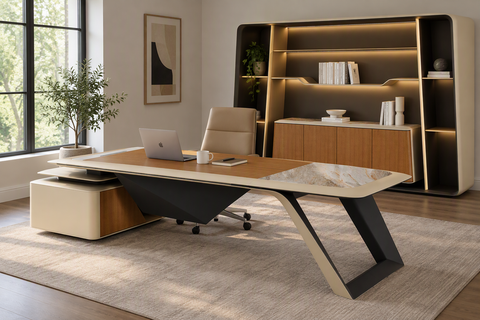
When pairing a chair with an executive desk, ensure armrests can transition under the desk to prevent "neck craning." For more on this, see our Guide on Executive Desk & Chair Pairing (Eureka Ergonomic blog).
For executives who prioritize the finest materials, the Serene Ella, Napa Leather Executive Chair (Eureka Ergonomic product page) provides a bridge between luxury and ergonomics, focusing on pressure reduction for those who prefer a "softer" feel without sacrificing prestige.
Final Considerations for the Modern Professional
The shift toward breathable, ergonomically sound furniture is a response to a deeper understanding of human physiology. By choosing materials that respect the body's need for thermal regulation, professionals can maintain their composure and cognitive edge through the longest days.
References
- BIFMA G1-2013 Ergonomics Guideline for Furniture
- OSHA eTools: Computer Workstations - Neutral Working Postures
- Cornell University Ergonomics Web — Workstation Guides
- WHO 2020 Guidelines on Physical Activity & Sedentary Behaviour
- The 2026 Workstation White Paper: Converging Ergonomic Science (Company Source)
- ISO 9241-5:2024 Workstation layout & postural requirements
- Cochrane: Workplace interventions for reducing sitting at work (2018)
Disclaimer: This article is for informational purposes only and does not constitute professional medical advice. Ergonomic recommendations are general guidelines and may not be suitable for individuals with pre-existing musculoskeletal conditions. Always consult with a qualified healthcare professional or certified ergonomist for personalized assessments.




Leave a comment