

Organizing the Vault: Managing High-Density Legal Files
The legal profession remains uniquely tethered to physical documentation. While digital transformation has accelerated, the "paperless office" remains a secondary reality for most law firms. In practice, original legal documents require physical preservation for seven or more years due to strict compliance mandates. This creates a significant logistical challenge: firms typically experience a 20% to 30% annual increase in document volume. Without a rigorous organizational strategy, the executive suite quickly transitions from a space of focused leadership to a disorganized archive.
Managing high-density legal files is not merely a task of finding more floor space. it is an exercise in balancing document security, environmental preservation, and musculoskeletal health. When legal administrators underestimate growth rates, the resulting overcrowding compromises retrieval speed and increases the risk of workplace injuries. This article examines the physiological, environmental, and structural principles required to manage high-density legal vaults effectively within an executive environment.
The Physiology of File Retrieval and Musculoskeletal Risks
The act of managing high-volume files introduces specific physical stressors that are often overlooked in standard office ergonomic assessments. Legal staff and administrators frequently engage in repetitive reaching, bending, and lifting—movements that, when performed under static load or in awkward postures, contribute to Musculoskeletal Disorders (MSDs). According to the U.S. Occupational Safety and Health Administration (OSHA), core risk factors for MSDs include excessive force, repetitive tasks, and poor posture.
In a high-density filing environment, the "static load" refers to the prolonged muscle tension required to hold a position while searching through deep drawer systems. If a filing cabinet is poorly designed, a paralegal may spend several minutes in a flexed spine position, placing significant pressure on the intervertebral discs. The ISO 11226:2000 standard for evaluating static working postures specifies limits for these positions based on duration and joint angles, suggesting that even minor deviations from a neutral spine can lead to chronic pain if repeated daily.
Furthermore, the "retrieval bottleneck" is a measurable efficiency drain. Traditional vertical cabinets often require 3 to 5 minutes of average retrieval time per document due to the "layering" effect of files. In contrast, lateral file cabinets with full-extension drawer slides allow for immediate visibility of the entire drawer contents. This structural shift is estimated to reduce retrieval time by approximately 45%, minimizing the duration of static postural stress.
Environmental Standards for Document Preservation
A vault is only as effective as its ability to preserve the integrity of the documents within. Many executive offices operate at humidity and temperature levels that are comfortable for humans but detrimental to long-term paper preservation. According to the National Archives (NARA) 1571 Archival Storage Standards, original legal documents require strict environmental controls: a relative humidity of 30% to 50% and a temperature range of 15°C to 21°C (59°F to 70°F).
Most standard office environments operate at 40% to 60% humidity and 20°C to 24°C. This discrepancy creates a compliance risk, as excessive humidity can lead to mold growth and paper degradation over a 7-to-10-year retention period. High-density storage solutions must therefore be positioned away from external walls or HVAC vents that cause localized micro-climate fluctuations.
Logic Summary: Storage Capacity and Retrieval Modeling This analysis assumes a mid-sized law firm with an average document growth rate of 25% and a standard 7-year retention policy.
Parameter Value or Range Unit Rationale / Source Category Annual Document Growth 20–30 % Industry heuristic for high-volume firms Retrieval Time (Lateral) 3–5 Minutes Estimated physical retrieval cycle Retention Mandate 7–10 Years Legal compliance (e.g., LeanLaw) ADA Minimum Clearance 36 Inches Statutory accessibility requirement Recommended Clearance 60 Inches Heuristic for two-way traffic flow Note: This is a scenario model based on common industry patterns, not a controlled laboratory study.
Designing the High-Density Executive Suite
When selecting storage for an executive environment, the furniture must bridge the gap between traditional aesthetics and modern performance. Storage is not a passive element of the room; it is an active component of the firm's workflow. For firms managing high-density files within a limited footprint, the choice of cabinetry is critical.
The 29'' Display File Storage Cabinet, Dark Walnut provides a lateral filing solution that maximizes horizontal space without the imposing height of industrial shelving. Lateral systems are preferred in legal environments because they allow for side-by-side filing of both legal and letter-sized documents, which is essential for managing diverse case files.
For smaller executive offices or focused workstations, the 19" File Storage Cabinet, Dark Walnut offers a compact alternative. In these environments, experienced legal administrators recommend allocating 40% more storage capacity than current needs suggest to account for the inevitable 20-30% annual document volume increase. Underestimating this growth leads to "overflow filing," where documents are stacked on desks or floors, creating both a security risk and a trip hazard.

Practical Recommendations for File Organization
Efficiency in a high-density vault is a product of the classification system used. The most effective approach for legal practice combines chronological organization with color-coded identifiers.
- Chronological Filing: Organize files by the date of the last action or filing date. This ensures that active matters are the most accessible, while closed files naturally migrate toward the back or lower drawers.
- Color-Coding by Matter Type: Use a standardized palette to identify the nature of the case at a glance. For example, red for litigation, blue for transactional work, and green for regulatory matters. This reduces "search fatigue" and minimizes the time spent reading individual file tabs.
- The 40% Buffer Rule: Never fill a drawer beyond 60% of its physical capacity. This allows for the easy insertion of new documents without forcing the user to wrestle with the existing contents, thereby reducing wrist and finger strain.
Spatial planning must also account for the Americans with Disabilities Act (ADA) requirements for accessibility. A minimum of 36 inches of clearance is required for wheelchair access, though 60 inches is recommended for two-way passing in high-traffic filing areas. High-density shelving can reduce overall capacity by 25% to 40% when these accessibility standards are strictly followed, a trade-off that must be factored into the initial office layout.
Ergonomic Integration: Beyond the Cabinet
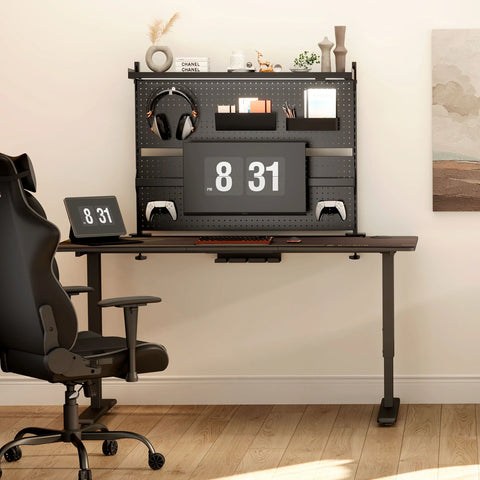
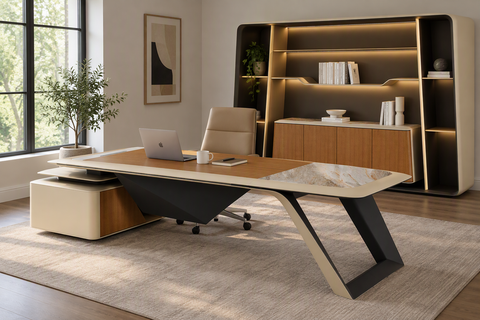
The work of a legal professional does not end at the file cabinet. Document review is a high-intensity task that often requires hours of seated or standing focus. The Opal Executive Standing Desk (66"x29") is designed to facilitate this transition. For legal document review, the optimal desk height is typically 1 to 2 inches below elbow height when seated. This specific adjustment reduces shoulder elevation and trapezius strain during extended periods of physical file examination.
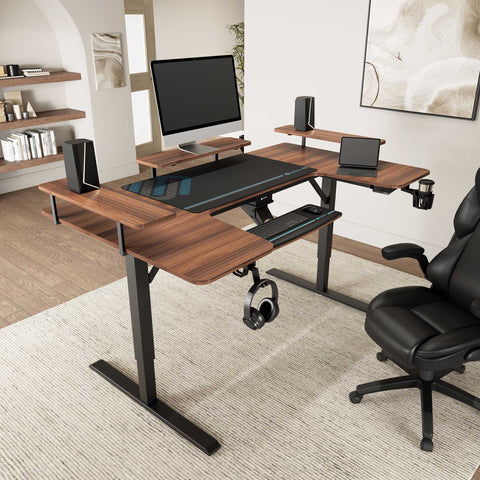
When transitioning to a standing position, the Ark Pro L-Shaped Standing Desk (Sintered Stone, 63"x23") provides the expansive surface area required for spreading out multi-volume case files. To maintain productivity and health, firms should implement a "45-minute transition" rule. According to a systematic review by Cochrane on workplace interventions, sit-stand desks can significantly reduce sitting time by over 100 minutes per day. However, standing for too long can be just as detrimental as sitting.
The World Health Organization (WHO) 2020 Guidelines emphasize that standing is not a substitute for exercise; rather, it is a method to interrupt sedentary behavior. For the legal professional, this means alternating between sitting and standing every 45 minutes, supported by anti-fatigue mats and adjustable monitor arms to maintain proper sight lines.
The Investment in Professional Organization
Managing a legal vault is an investment in the firm's long-term viability. High-density filing systems that meet BIFMA G1-2013 Ergonomics Guidelines ensure that the furniture accommodates the 5th to 95th percentile of the population, making the office inclusive for all staff members. By integrating sophisticated storage solutions with health-conscious desk designs, firms can mitigate the risks of MSDs while maintaining the rigorous standards of document security required in the legal field.
As noted in The 2026 Workstation White Paper: Converging Ergonomic Science and Sustainable Engineering, the future of the professional workspace lies in the seamless integration of storage, ergonomics, and aesthetics. When these elements are aligned, the "vault" becomes more than a storage room—it becomes a pillar of firm-wide productivity.
Disclaimer: This article is for informational purposes only and does not constitute professional legal, medical, or financial advice. The ergonomic recommendations provided are based on general industry standards and may not be suitable for individuals with pre-existing health conditions. Consult with a qualified professional before making significant changes to your office environment or work habits.
Sources
- BIFMA G1-2013 Ergonomics Guideline for Furniture
- OSHA: Ergonomics - Identify Problems
- Cochrane: Workplace interventions for reducing sitting at work
- NARA 1571, Archival Storage Standards - National Archives
- ISO 11226:2000 Evaluation of static working postures
- WHO 2020 Guidelines on Physical Activity & Sedentary Behaviour
- The 2026 Workstation White Paper: Converging Ergonomic Science and Sustainable Engineering




Leave a comment