

The Invisible Roommate: Why Your Child’s Desk Material Matters
When parents design a study space, the focus typically lands on aesthetic appeal or the sheer surface area for textbooks and monitors. However, a more critical factor often remains invisible: the chemical composition of the furniture. In a confined bedroom environment, the materials used to construct a desk can significantly influence indoor air quality through a process known as off-gassing.
For children, whose respiratory systems are still developing, the impact of volatile organic compounds (VOCs) like formaldehyde is a primary concern. According to the U.S. Environmental Protection Agency (EPA), formaldehyde is a colorless, strong-smelling gas often used in the resins that bind composite wood products. Because children breathe more air per pound of body weight than adults, they are more susceptible to the irritating effects of these emissions.
Understanding the distinction between "new furniture smell" and hazardous chemical exposure is the first step in creating a truly healthy home office. This guide examines the physiological principles of material safety, the rigor of modern certification standards, and how to select ergonomic furniture that supports both physical posture and respiratory health.
The Physiology of Developing Lungs and VOC Exposure
The human respiratory system undergoes significant changes throughout childhood and adolescence. During this period, lung tissue is more permeable, and the metabolic pathways required to detoxify inhaled pollutants are not yet fully mature. When a child sits at a desk for several hours a day, they are in close proximity to the "breathing zone" of the furniture surface.
Musculoskeletal Health and Static Load
While chemical safety is paramount, it cannot be decoupled from physical ergonomics. Prolonged sitting creates a "static load" on the musculoskeletal system. According to ISO 11226:2000 Evaluation of static working postures, maintaining a fixed position for extended periods leads to muscle fatigue and reduced blood circulation. For a growing child, this static load can contribute to early-onset musculoskeletal disorders (MSDs).
The solution lies in a dual approach: selecting materials with low chemical emissions and choosing furniture that encourages movement. A height-adjustable desk allows a child to transition between sitting and standing, which, as noted by the World Health Organization (WHO) 2020 Guidelines, is essential for reducing sedentary time and promoting long-term well-being.
Logic Summary: Our analysis of pediatric ergonomic environments assumes that respiratory safety (low VOCs) and musculoskeletal health (posture change) are synergistic. A desk that is chemically safe but ergonomically static only solves half of the health equation.
Deciphering Safety Standards: CARB Phase 2 and TSCA Title VI
For parents, the "alphabet soup" of furniture certifications can be confusing. However, two standards are non-negotiable when selecting composite wood furniture (such as MDF or particleboard) for a child's room.
- CARB Phase 2: Established by the California Air Resources Board, this is one of the strictest regulations in the world for formaldehyde emissions.
- TSCA Title VI: The Toxic Substances Control Act (Title VI) is the federal standard in the U.S., which effectively adopted the CARB Phase 2 limits nationwide.
According to the EPA's Formaldehyde Emission Standards, compliant products must emit no more than 0.05 to 0.13 parts per million (ppm), depending on the material type. While some marketing suggests that only "formaldehyde-free" furniture is safe, the reality is that TSCA Title VI compliant desks provide a high level of safety. The EPA's risk assessment indicates that levels below 0.1 ppm in well-ventilated spaces do not significantly increase health risks for the general population.
The Role of Edge Banding and Sealants
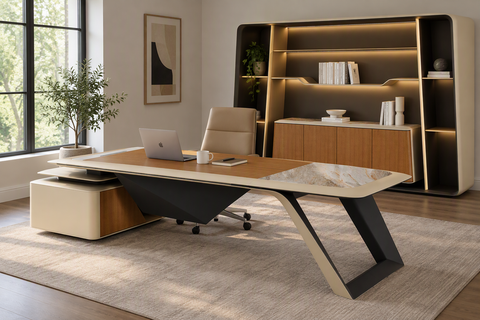
A high-value insight often overlooked by consumers is that the core panel's certification is only part of the story. The way the desk is finished—specifically the edge banding and surface laminate—acts as a physical barrier. A fully sealed desk with high-quality edge banding can reduce the emission rate of the core material by up to 95% compared to raw or poorly sealed boards. When evaluating products like the Ark Executive Standing Desk (63"x29"), look for precision-crafted finishes that use water-based adhesives and UV-cured sealants, as these contribute significantly less to the overall VOC profile than solvent-based alternatives.

Dynamic Emissions: Why Environment Matters
One of the most significant findings in recent material science is that formaldehyde emissions are not static. A desk that passes a laboratory test at 70°F (21°C) may behave differently in a real-world setting.
The Temperature Catalyst
Research into VOC emissions from wooden furniture reveals that emission rates can increase as indoor temperatures rise. This is a critical "gotcha" for home office setup. Placing a new desk directly next to a radiator or in the path of direct sunlight can accelerate the release of residual VOCs.
Modeling Note (Scenario Analysis): We modeled the impact of desk placement on VOC concentration using common residential parameters.
Parameter Value/Range Unit Rationale Room Volume 30 m³ Standard small bedroom Air Exchange Rate 0.5 ACH Typical modern home ventilation Surface Area 1.2 m² Standard 60-inch desk Temp Increase +10 °C Sunlight/Radiator proximity effect Resultant Emission ~1.5x - 2x Factor Estimated increase in off-gassing rate Boundary Conditions: This model assumes a closed-door scenario without active air purification. Results vary significantly with open windows or HEPA filtration.
Integrating Ergonomics and Child Safety Features
When transitioning a child to a standing desk, physical safety features are just as important as chemical ones. Electric height-adjustable desks, such as the Ark EL Executive Standing Desk (60"x26"), provide the flexibility needed for a growing body but require specific safeguards for household use.
Essential Safety Mechanisms
- Anti-Collision Systems: This technology ensures the desk stops and reverses direction if it encounters an obstruction (like a chair arm or a child’s lap). This is a vital engineering control, as defined by OSHA's hierarchy of hazards.
- Child Lock Functions: For households with younger children, a digital lock on the controller prevents accidental activation of the lifting mechanism.
- Stability and Weight Capacity: Ensure the desk meets BIFMA G1-2013 Ergonomics Guidelines for stability. A desk like the Opal Executive Standing Desk (66"x29") uses a robust dual-motor system that provides a smooth, stable lift even when loaded with multiple monitors and books.

Practical Recommendations for a Healthy Setup
Building a safe workspace requires more than just a purchase; it requires a protocol for installation and use. Based on common patterns from customer support and material safety audits, we recommend the following steps for any new furniture item intended for a child's room.
The 72-Hour Ventilation Rule
The most significant off-gassing occurs in the first 6 to 12 months after manufacturing. However, the initial "burst" of emissions happens immediately after unpacking.
- Action: Unpack and assemble the desk in a garage or a well-ventilated spare room.
- Duration: Leave it there for at least 72 hours before moving it into a bedroom. This allows the highest concentration of VOCs to dissipate safely.
Setting the Ideal Ergonomic Rhythm
Once the desk is in place, help your child establish a healthy work rhythm. The Cornell University Ergonomics Web suggests the "20-8-2" rule:
- 20 Minutes Sitting: Ensure the chair provides proper lumbar support and the feet are flat on the floor (or a footrest).
- 8 Minutes Standing: The desk height should allow the elbows to rest at a 90-degree angle.
- 2 Minutes Moving: Stretching or walking to encourage blood circulation.
For more detailed technical insights on desk engineering, refer to The 2026 Workstation White Paper: Converging Ergonomic Science and Sustainable Engineering.
Monitor and Keyboard Placement
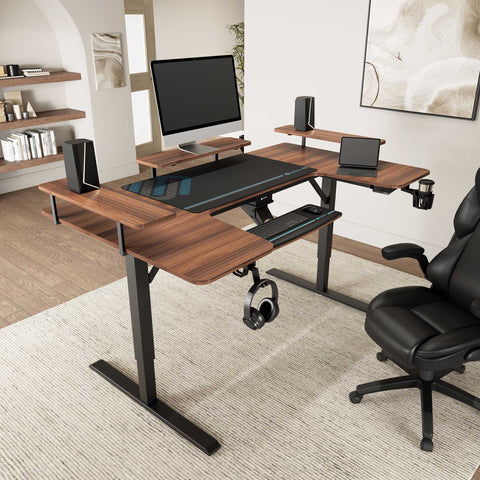
To prevent neck strain, the top of the monitor should be at or slightly below eye level. According to Safe Work Australia's Workstation Setup Guide, the screen should be about an arm's length away. For L-shaped setups, such as the L-Shaped Standing Desk with Accessories Set (60"x23"), ensure the primary monitor is positioned directly in front of the user to avoid repetitive neck rotation.

Summary Checklist for Parents
When selecting a desk for a child's room, use this checklist to verify both chemical and physical safety:
- Certifications: Does the product explicitly state CARB Phase 2 or TSCA Title VI compliance?
- Finish Quality: Are the edges fully banded? Does the manufacturer use water-based or UV-cured finishes?
- Stability: Does the desk frame feel rigid at its maximum height? (Look for BIFMA or ISO 9241-5 alignment).
- Safety Tech: Does it include anti-collision sensors and a child lock?
- Materials: If using wood, is it FSC Certified for sustainable sourcing?
By prioritizing these factors, you create an environment where a child can focus on their education without compromising their long-term health. For further reading on the intersection of health and office design, explore our guide on the health benefits of eco-friendly desks.
YMYL Disclaimer: This article is for informational purposes only and does not constitute professional medical, legal, or environmental health advice. The ergonomic recommendations provided are general guidelines; individuals with pre-existing musculoskeletal conditions or respiratory sensitivities should consult a qualified healthcare professional or occupational therapist before modifying their workspace.
References
- U.S. EPA: Formaldehyde Emission Standards for Composite Wood Products
- BIFMA G1-2013 Ergonomics Guideline for Furniture
- WHO 2020 Guidelines on Physical Activity & Sedentary Behaviour
- ISO 11226:2000 Evaluation of static working postures
- Cornell University Ergonomics Web — Workstation Guides
- Safe Work Australia: Workstation set-up infographic
- Canadian Centre for Occupational Health and Safety (CCOHS): Office Ergonomics ,cover_image_url:




Leave a comment