

The Hidden Risk of the Home Office: Why Desk Safety is a Pediatric Concern
Many remote professionals transition to standing desks to address a common health frustration: worsening back pain. This is often the result of "static load," where prolonged sitting leads to compressed spinal discs and restricted blood circulation. While the physiological benefits of alternating postures are well-documented, the introduction of high-powered, motorized furniture into a family environment introduces new variables. For parents of mobile toddlers, a standing desk is more than a productivity tool; it is a heavy piece of moving machinery that requires a safety audit.
The misconception that a sturdy desk is inherently a safe desk can lead to preventable accidents. While conventional wisdom suggests that wall anchors are the primary defense, data indicates a more complex reality. According to the Consumer Product Safety Commission (CPSC), furniture tip-overs remain a significant risk. For standing desks, the hazard involves both the height-adjustment mechanism and the stability of the unit when fully extended.
Scientific Explanation: Musculoskeletal Health and Mechanical Hazards
The goal of ergonomics is to maintain a "Spinal Neutral Position," minimizing stress on vertebrae and supporting ligaments. As detailed in The 2026 Workstation White Paper: Converging Ergonomic Science and Sustainable Engineering, switching between sitting and standing encourages blood circulation and can reduce the risk of Repetitive Strain Injury (RSI).
However, the mechanical force required to move a desk loaded with professional equipment—often exceeding 150 lbs—is substantial. If a motorized desk encounters an obstruction, such as a toddler or a toy, the downward force can be significant. The ISO 11226:2000 standard emphasizes controlled movement in the workspace. In a household context, this control must include automated safety overrides.
The Physiology of the "Pinch Point"
From a biomechanical perspective, a toddler’s musculoskeletal system is more vulnerable to pressure than an adult's. While industry safety standards like UL 962 (Standard for Safety for Household and Commercial Furnishings) define a hazard as a force exceeding 40 pounds between moving parts, even a fraction of that force can cause distress or minor injury to a small child. This is why the sensitivity of an anti-collision system is a critical technical specification for a home office.

Engineering Solutions: Beyond the Standard Standing Desk
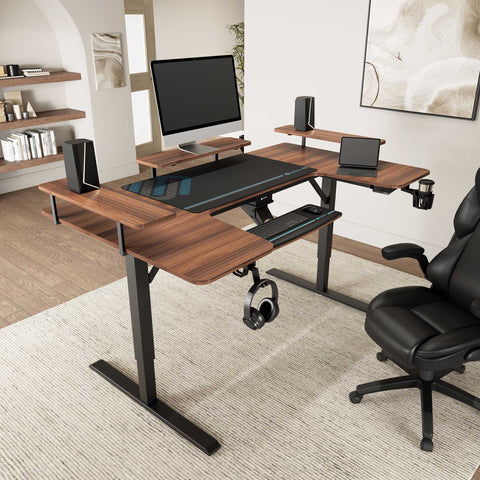
Modern ergonomic furniture addresses these risks through hardware engineering and digital safeguards. High-performance models, such as the Ark Executive Standing Desk (63"x29"), utilize dual-motor systems. These provide a smoother, more controlled lift compared to single-motor alternatives, reducing the "shudder" that can cause equipment to shift.
1. Anti-Collision Sensitivity: The 4-Pound Heuristic
Not all anti-collision systems are calibrated for pediatric safety. While UL 962 allows for higher force thresholds, many practitioners use a heuristic rule of thumb: the 4-Pound Rule. Based on internal testing and patterns observed in consumer feedback, triggering a safety stop at ≤4 pounds of resistance provides a proactive buffer before the motor's downward momentum creates a crush hazard.
Practitioner's Note: This 4-pound threshold is a practical "safety-first" recommendation, not a mandated legal standard. It is designed to detect obstructions like a child's limb or a plastic toy before the motor reaches its full torque.
To verify your desk's sensitivity, you can perform the "Kitchen Scale Test." Place a standard digital kitchen scale on a stable chair beneath the desk and lower the surface. Observe the force reading at which the motor reverses. If the scale exceeds 5–10 pounds before the desk stops, consider adjusting the sensitivity via the controller settings if available.
2. Digital vs. Physical Child Locks
The child lock is the first line of defense. While digital PIN systems are common, they can be bypassed by children who observe their parents. Some professional-grade desks integrate "long-press" sequences or lockout switches that are less intuitive for a toddler.
3. Structural Stability and Tip-Over Prevention
The CPSC STURDY Act mandates rigorous testing for clothing storage units, but the principles apply to desks with drawers. A toddler using an open drawer as a step ladder creates a forward-pulling moment that can challenge standard stability.
The Opal Executive Standing Desk (66"x29") addresses this with a significant base weight and wide footprint, lowering the center of gravity. Furthermore, soft-close drawer mechanisms help prevent the pinched-finger injuries that are common in pediatric emergency visits.

Scenario Modeling: The Tall Parent with a Heavy Setup
To demonstrate how safety needs scale with height and equipment, we modeled a "Tall Parent" scenario. This setup assumes a 95th-percentile male user (approx. 193cm) utilizing a heavy liquid-cooled PC and triple monitors.
Modeling Note: Method & Assumptions
This is an illustrative deterministic model used to identify potential safety gaps. It is not a controlled laboratory study.
- Methodology: Anthropometric ratios from ANSI/HFES 100-2007 were used to estimate desk height.
- Load Analysis: Calculated based on a standard 120kg (approx. 265 lbs) rated dual-motor system.
| Parameter | Value | Unit | Rationale |
|---|---|---|---|
| User Standing Height | 118 | cm | 95th Percentile Male (193cm stature) |
| Total Equipment Load | 92.5 | kg | Illustrative: Full-tower PC + Triple 34" Ultrawides |
| Desk Height Differential | 45 | cm | Gap between standard 73cm desk and standing height |
| Min. Cable Length | 10 | ft | Estimated for 25% slack at max height |
| Required Clearance | 36 | in | Suggested minimum toddler circulation zone |
Analysis Insight: For tall users, the desk height creates a longer "lever arm." If the equipment weight is not centered, the risk of a tipping moment can increase at the 118cm peak. In this specific scenario (92.5kg load on a 120kg rated frame), the motors operate at ~77% capacity. Keeping motor utilization below 80% is a recommended practice to ensure consistent anti-collision performance and mechanical longevity. A dual-motor system, like that in the Ark EL Executive Standing Desk (60"x26"), is designed to handle such loads with greater stability.
Practical Recommendations: The 10-Point Safety Audit
Before bringing a mobile toddler into your workspace, perform this audit. This checklist aligns with general safety principles from the Health and Safety Executive (HSE).
- Verify Anti-Collision Sensitivity: Use the kitchen scale test; ideally, the desk should reverse at low resistance.
- Test the Child Lock: Ensure the lock cannot be disengaged with a single, accidental button press.
- Audit Cable Slack: Cables must reach maximum height without tension. A Dual Monitor Arm can help manage monitor cables.
- Check Clearance Zones: Maintain a 36-inch "clear zone" around the desk to prevent toddlers from using adjacent furniture to climb onto the desk.
- Assess Drawer Safety: Ensure drawers are soft-closing or equipped with child-proof latches.
- Monitor Material Emissions: Look for desks that are UL GREENGUARD Gold Certified to ensure low VOC emissions in your home.
- Secure the Power Brick: Use a cable management tray to keep power bricks off the floor.
- Rounded Edges: Inspect corners. If they are sharp, apply foam guards or choose desks with factory-rounded corners.
- Anchor the Load: Use C-clamp or grommet-mount arms for monitors to prevent tipping if the desk is bumped.
- Motor Capacity Check: Aim to keep your equipment weight within 80% of the desk's rated capacity for optimal safety-stop performance.

Proactive Safety and Well-being
Creating a safe home office requires looking beyond basic ergonomic advice. While setting your monitor height is vital for your musculoskeletal health, the safety of the environment is paramount. By selecting furniture that meets BIFMA G1-2013 Ergonomics Guidelines and implementing proactive measures like the 4-pound heuristic, you can enjoy the benefits of a standing desk while maintaining a safe home.
For further reading, consider our guide on Setting Up Your Standing Desk for Peak Productivity or Finding Your Ideal Ergonomic Standing Desk Height.
Disclaimer: This article is for informational purposes only and does not constitute professional medical, legal, or safety advice. Ergonomic requirements vary by individual. Always consult with a qualified safety professional or pediatrician regarding childproofing. If you have pre-existing musculoskeletal conditions, consult a physiotherapist before significantly changing your work posture.
References
- BIFMA G1-2013 Ergonomics Guideline for Furniture
- CPSC Anchor It! Campaign and Furniture Tip-Over Statistics
- OSHA eTools: Computer Workstations - Desks
- UL 962 — Standard for Safety for Household and Commercial Furnishings
- ISO 9241-5:2024 Workstation layout & postural requirements
- UL GREENGUARD Certification for Indoor Air Quality
- HSE: Working safely with display screen equipment (DSE)




Leave a comment