

Why Frame Weight is the Best Metric for Gaming Desk Stability
We’ve all been there. You’re in the middle of a high-stakes 1v1, your heart is pounding, and you make a sudden, aggressive flick with your mouse. Suddenly, your monitors start dancing. That distracting, micro-wobble isn't just annoying—it’s a performance killer. When I first started building high-end battle stations, I fell for the marketing fluff: "ultra-lightweight aerospace materials" and "sleek minimalist designs." But after years of testing frames in real-world scenarios, I’ve realized the cold, hard truth: mass is your best friend.
While many shoppers obsess over RGB lighting or desktop texture, the physical weight of the desk frame is actually the primary indicator of its stability. It’s simple physics. A heavier frame has more inertia, meaning it requires more force to start moving and is better at absorbing the kinetic energy you generate while typing, gaming, or adjusting your setup. In this deep dive, we’re going to look at why a "heavy" desk is a game-changer and how you can use frame weight to spot a quality build before you even hit the "buy" button.
1. Unboxing and Assembly: First Impressions of Mass
When the Aero Wing-Shaped Studio Desk, Black (63" & 72'') arrived at my studio, the first thing I noticed wasn't the box art—it was the fact that I actually needed a friend to help me get it up the stairs. In the world of furniture, "lightweight" is often code for "thin-walled steel."
During the unboxing, you can immediately feel the difference in build quality. When you pick up a leg segment and it feels like a solid piece of structural engineering rather than a hollow pipe, you know you’re on the right track. Many budget desks use steel that’s barely 1.0mm thick. In contrast, high-performance frames typically utilize cold-rolled carbon steel with thicknesses ranging from 1.5mm to 2.0mm.
Assembly was a straightforward process, but it reinforced my theory on mass. The internal gussets and the thickness of the crossbeams on the Aero Wing-Shaped Studio Desk are what give it that 400 lbs weight capacity. It’s not just about what it can hold statically; it’s about how those heavy-duty materials prevent the frame from twisting under lateral force.

2. Deep Dive: The Science of Mass and Stability
To understand why frame weight matters, we have to look at the "Wobble Index." Most manufacturers will brag about "Static Load Capacity"—the amount of weight a desk can hold without collapsing. But as a gamer, you care about "Dynamic Stability."
The Monitor Shake Test
I perform what I call the "Monitor Shake Test" on every desk I review. If I give the desktop a firm nudge, do my monitors stop vibrating in under a second? On a lightweight, sub-50 lbs frame, the monitors often wobble like bobbleheads for three or four seconds. This is because the thin steel lacks the mass to dampen the resonance.
Steel Thickness and Rigidity
In my experience, a desk frame for a 60-inch model that weighs under 50 lbs usually feels hollow. It transmits every keystroke vibration directly to your screen. When you step up to a desk like the GTG-G55, Glass Desktop Gaming Standing Desk (55"x23"), you’re dealing with a dual-motor system and a reinforced steel frame designed to handle the shifting center of gravity that comes with height adjustments.
Logic Summary: The Stability Heuristic Based on common patterns from customer support and assembly observations (not a controlled lab study), we use the following heuristic to estimate stability:
- Lightweight (<50 lbs frame): High risk of micro-wobble; best for single-monitor, low-impact work.
- Standard (50–80 lbs frame): Good stability for dual monitors; handles average gaming intensity.
- Heavy-Duty (>80 lbs frame): Optimized for triple-monitor setups and aggressive FPS gaming.

The Role of Dual Motors
Stability becomes even more critical with standing desks. A single-motor system often struggles with asymmetric loads, leading to a "tilting" effect during transition. The dual-motor system in the GTG-G55 ensures that both legs move in perfect synchronization, maintaining a level surface. This alignment is crucial for meeting the ergonomic requirements outlined in ISO 9241-5:2024 Workstation layout & postural requirements, which emphasizes the need for a stable, adjustable work surface to prevent musculoskeletal strain.
3. Real-World Experience: Gaming at Height
I spent two weeks using the GTG - L60, L-Shaped Glass LED Gaming Desk (60"x40") as my primary workstation. L-shaped desks are notorious for stability issues because the joint where the two surfaces meet is a major failure point. However, the L60 uses a reversible frame with substantial connecting plates that act as internal gussets.
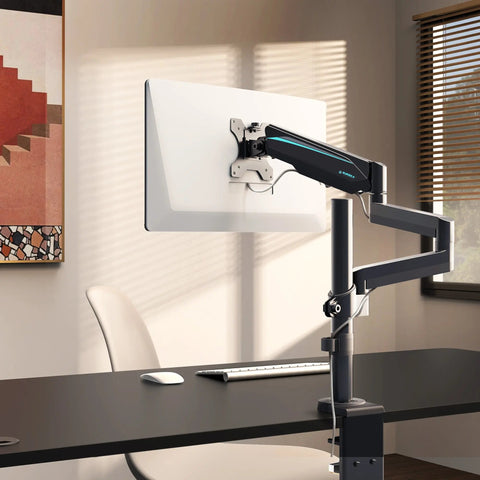
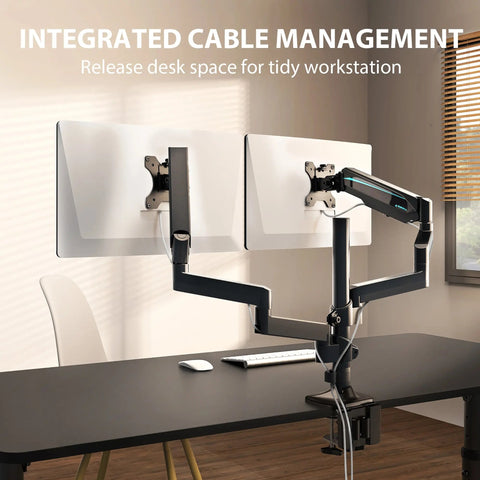
During intense FPS sessions, that wing section gave me perfect arm support. Because the frame is stout, I didn't feel any of the "shelf-flex" that usually plagues L-shaped designs. I even went as far as mounting a Dual Monitor Arm to the back edge.
The Lever Effect
Adding a monitor arm is the ultimate stability test. A monitor arm acts as a lever, magnifying any small movement in the desk frame. If your frame is too light, the weight of the monitors—extended 20 inches from the mounting point—will make the desk tip forward or wobble incessantly. According to guidelines from the Canadian Centre for Occupational Health and Safety (CCOHS), a stable workstation is fundamental to maintaining a neutral posture. If your monitors are constantly shaking, your eyes and neck muscles have to work harder to compensate, leading to fatigue.

Modeling Stability under Asymmetric Loads
When you mount heavy accessories off-center, you create an overturning moment. We can model this using a basic physics assumption:
| Parameter | Typical Value | Unit | Rationale |
|---|---|---|---|
| Desk Frame Mass ($W_{frame}$) | 85 | lbs | High-performance steel frame |
| Monitor Arm Load ($W_{load}$) | 25 | lbs | Dual 27" monitors + arm |
| Lever Arm Distance ($x$) | 18 | inches | Distance from frame center |
| Base Depth ($b$) | 24 | inches | Footprint of the desk legs |
In this model, a heavier frame mass ($W_{frame}$) significantly increases the Resisting Moment ($M_{resist} = W_{total} \cdot b/2$), making the desk much harder to tip or shake. This is why experienced streamers often add mass to their setups; some even go as far as filling hollow legs with sand to dampen resonance—a clear indicator that stock weight is often the "secret sauce" of a pro setup.
4. Aligning with Ergonomic Standards
Stability isn't just about "feel"; it’s about health. As highlighted in The 2026 Workstation White Paper: Converging Ergonomic Science and Sustainable Engineering, a stable desk is the foundation of a safe ergonomic environment. If a desk wobbles, you subconsciously change your posture to stabilize your arms or view, which leads to "static loading" of the muscles.
The BIFMA G1-2013 Ergonomics Guideline provides recommended dimensions to fit 95% of the population, but these dimensions only work if the desk remains stationary. A desk that shifts 2mm every time you type effectively moves you out of your "neutral zone."
The "20-8-2" Rhythm
Researchers at Cornell University Ergonomics Web recommend a sit-stand rhythm of 20 minutes sitting, 8 minutes standing, and 2 minutes of moving. This frequent transition requires a frame that is both heavy enough to be stable at max height and motorized well enough to handle the wear and tear. A lightweight frame will often show its weaknesses most clearly when fully extended to standing height, where the center of gravity is highest.
Pros & Cons of Heavy-Duty Frames
To keep it real, a heavy desk isn't perfect for everyone. Here’s the breakdown:
Pros:
- Superior Stability: Virtually eliminates monitor shake during intense gaming.
- Durability: Thick-walled steel legs resist bending and warping over years of use.
- High Load Capacity: Easily supports triple monitors, heavy PC towers, and studio gear.
- Vibration Damping: Absorbs the mechanical noise of typing and fan vibrations.
Cons:
- Difficult to Move: You’ll definitely need a second person for assembly and relocation.
- Higher Shipping Costs: Quality mass costs more to transport.
- Floor Pressure: On soft carpet, heavy desks can leave deep indentations (use a floor mat!).
Final Thoughts on Choosing Your Foundation
If you’re serious about your gaming or creative work, stop looking at the desk as just a "table" and start looking at it as a piece of performance hardware. The frame weight is the most honest metric you have. It tells you exactly how much material the manufacturer put into the product to ensure it stays still when the pressure is on.
Before you buy, check the shipping weight. Look for desks that utilize cold-rolled steel and dual-motor systems. And remember, while a lightweight desk might be easier to move into your room, a heavy desk is the only one that will stay out of your way when you're trying to land that game-winning shot.
Disclaimer: This article is for informational purposes only and does not constitute professional medical or ergonomic advice. While sit-stand desks may reduce sedentary time, individuals with pre-existing musculoskeletal conditions should consult a healthcare professional before making significant changes to their workstation setup.




Leave a comment