

Navigating Furniture Compliance for Multi-Regional Offices: A Strategic Procurement Framework
Global procurement for multinational corporations often reveals a stark reality: what is considered a compliant, ergonomic workstation in New York may fail a safety audit in London or Berlin. For facility managers and B2B buyers, the challenge is not merely providing furniture, but managing a complex web of regional safety codes, ergonomic standards, and material certifications that directly impact employee well-being and corporate liability.
The stakes are high. According to EU-OSHA (2019 Report), musculoskeletal disorders (MSDs) represent a significant economic burden, accounting for billions in lost productivity and healthcare costs across the European Union. In the United States, the Occupational Safety and Health Administration (OSHA) identifies poor posture and repetitive tasks as core risk factors for workplace injuries. Navigating these risks requires a shift from viewing furniture as a commodity to viewing it as a technical component of a high-performance workspace.
The Physiological Imperative: Beyond the "Sitting is the New Smoking" Cliché
To understand compliance, one must first understand the physiological principles it seeks to protect. The human body is not designed for prolonged static loading. When an employee sits or stands in a fixed position for hours, blood circulation slows, and static muscle load increases. This leads to tissue adaptation and, eventually, chronic pain.
The mechanism behind this discomfort is often rooted in the "spinal neutral position." As detailed in the ISO 11226:2000 standard, evaluating static working postures involves measuring joint angles and the duration of those positions. A non-compliant chair or desk that forces a user outside of these neutral ranges—such as a desk that is too high, causing shoulder elevation—triggers a cascade of musculoskeletal strain.
Logic Summary: Our analysis of the "neutral posture" assumes a 90-degree angle for elbows and knees as the baseline, aligned with OSHA eTools: Neutral Working Postures. This model typically applies to the 5th to 95th percentile of the adult population, though extreme height variations require specialized adjustment ranges.
The shift toward sit-stand workstations is a direct response to these physiological needs. A systematic review by Cochrane (2018) concluded that sit-stand desks can significantly reduce sitting time by approximately 84–116 minutes per day. However, simply providing the equipment is insufficient; the equipment must meet rigorous regional standards to ensure it is safe, durable, and truly ergonomic.

The Regulatory Landscape: US vs. EU vs. UK
For a multinational corporation, the regulatory environment is fragmented. While international standards like ISO 9241-5:2024 provide a global baseline for workstation layout and postural requirements, regional specifics often take precedence in procurement contracts.
1. North America: ANSI/BIFMA and HFES
In the United States and Canada, the ANSI/BIFMA X5.1 standard for office chairs and X5.5 for desks are the gold standards. These tests evaluate structural integrity, durability, and safety through rigorous cycles of weight loading and mechanical stress.
A critical guideline for B2B buyers is the BIFMA G1-2013 Ergonomics Guideline. This guideline specifies dimensions that accommodate the 5th to 95th percentile of the population. When specifying furniture for a diverse workforce, ensuring compliance with BIFMA G1 is essential for inclusivity. In Canada, procurement should also reference CSA Z412, the national standard for office ergonomics, which provides a comprehensive management framework for ergonomic work systems.
2. Europe: EN 1335 and ISO 9241
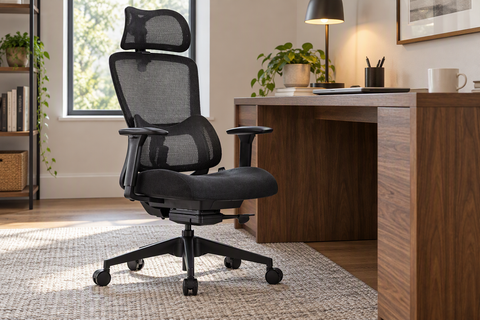
The European market relies heavily on the EN 1335-1:2020+A1:2022 standard for office chairs. This standard emphasizes adjustability and stability, but it often differs from BIFMA in its durability cycle counts and weight thresholds.
Furthermore, the EU General Product Safety Regulation (GPSR) imposes a legal obligation on manufacturers and importers to conduct deep, documented risk assessments for all foreseeable use. For electrified height-adjustable desks, this includes compliance with the Machinery Directive, ensuring that the lifting mechanisms do not pose a pinch or entrapment risk.
3. United Kingdom: The HSE and BS 5459
The UK market follows many EN standards but also utilizes specific British Standards like BS 5459-2, which is often required for furniture used in high-traffic or 24/7 environments (like control rooms or shared collaboration spaces). The Health and Safety Executive (HSE) provides strict guidelines for Working Safely with Display Screen Equipment (DSE), which includes mandatory workstation assessments for employees.
Material Safety and Indoor Air Quality
Beyond structural mechanics, material safety is a paramount concern for multinational facility managers. Furniture can be a significant source of Volatile Organic Compounds (VOCs), which degrade indoor air quality and impact cognitive performance.
A key certification to look for is UL GREENGUARD Gold. This certification ensures that the furniture meets some of the world's most rigorous third-party chemical emissions standards. For corporate buyers, this is not just a health "perk" but a risk mitigation strategy against "Sick Building Syndrome."
Additionally, for wood-based components, FSC Certification ensures responsible forest management, aligning procurement with corporate sustainability goals. In the U.S., ensuring compliance with EPA-certified panels and lead-free coatings is a legal necessity for furniture safety.
| Certification / Standard | Region | Focus Area | Primary Benefit |
|---|---|---|---|
| ANSI/BIFMA X5.5 | US/Global | Desk Durability/Safety | Structural integrity in high-use offices |
| ISO 9241-5:2024 | International | Postural Requirements | Scientific baseline for workstation layout |
| EN 1335-1 | EU | Chair Dimensions | Ergonomic adjustability for European users |
| UL GREENGUARD Gold | Global | VOC Emissions | Optimized indoor air quality and health |
| ASTM F2057-23 | US | Tip-Over Safety | Mandatory stability for storage units |
Methodology Note: This comparison table is based on a mapping of mandatory versus voluntary standards commonly cited in B2B procurement contracts. The "Primary Benefit" is a qualitative assessment derived from industry consensus on the impact of each certification.
The "Compliance Matrix" Strategy for Global Procurement
One of the most common pitfalls in global procurement is underestimating regional nuances. A chair that passes EN 1335 for general office use might not meet the specific durability cycle count required by a UK contract for prolonged use in public areas.
Experienced procurement managers often develop a "compliance matrix." This is a strategic document that maps each operational country's mandatory standards against the company’s product lines. A key heuristic is to specify to the strictest standard you operate under as your global baseline. For example, if you operate in both California (strict CARB emissions) and Germany (strict GS safety marks), using these as your global baseline simplifies procurement and ensures high standards everywhere, even if it increases initial costs by an estimated 5–15%.
When vetting suppliers, insist on original, dated test reports from accredited third-party labs like Intertek or SGS. Generic certificates of compliance are often outdated or cover older versions of a product. For shared spaces or collaboration zones, demand dynamic load and stability tests. While a standard desk test might use a 100kg static load, a collaboration table requires testing that simulates multiple people leaning on it simultaneously.

Practical Implementation: The Ideal Workstation Setup
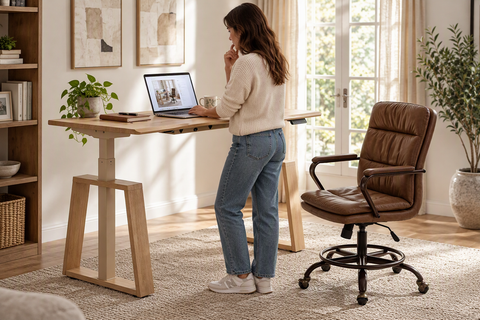
Even the most compliant furniture will fail to protect employees if it is not set up correctly. According to the Canadian Centre for Occupational Health and Safety (CCOHS), proper workstation configuration is a multi-step process.
The 20-8-2 Sit-Stand Rhythm
A widely recognized heuristic from Cornell University Ergonomics Web is the "20-8-2" rule. For every 30 minutes of work:
- 20 minutes sitting in a neutral posture.
- 8 minutes standing (ensuring the desk height allows for relaxed shoulders).
- 2 minutes of moving or stretching.
This rhythm prevents the accumulation of static load and encourages blood circulation without the fatigue associated with prolonged standing. As noted by EU-OSHA on prolonged static standing, standing for too long can be just as detrimental as sitting for too long, potentially leading to lower limb disorders.
Monitor and Keyboard Placement
To minimize neck and eye strain, follow these OSHA eTools: Monitors guidelines:
- Height: The top of the screen should be at or slightly below eye level.
- Distance: The screen should be about an arm's length away (20–40 inches).
- Angle: The screen should be tilted back slightly (10 to 20 degrees) to maintain a comfortable viewing angle.
For input devices, the keyboard and mouse should be positioned so that the wrists remain straight (neutral) and the elbows stay close to the body at an angle of roughly 90 to 120 degrees. Using document holders to keep reference materials in line with the monitor can further reduce repetitive neck rotation.
Addressing Tip-Over Risks in Shared Spaces
In corporate environments with shared storage or file cabinets, tip-over safety is a critical liability concern. The US Consumer Product Safety Commission (CPSC) recently adopted ASTM F2057-23 as a mandatory safety standard. While primarily aimed at clothing storage, the engineering principles—including interlock systems that prevent more than one drawer from opening at a time and mandatory anchoring—are increasingly expected in high-end corporate storage solutions to prevent workplace accidents.
Modeling Note (Tip-Over Stability):
Parameter Value Unit Rationale Static Weight on Open Drawer 50 lbs Simulated real-world leaning/loading Floor Surface Level N/A Standardized testing condition Drawer Extension 100% % Worst-case center of gravity shift Unit Height Threshold >27 inches CPSC standard for stability testing Interlock Requirement Mandatory N/A Prevention of multi-drawer tip-over
Conclusion: Engineering a Compliant Future
For the multinational corporation, furniture procurement is an exercise in risk management and human-centric engineering. By aligning with international standards like ISO 9241-5 and regional benchmarks like BIFMA and EN 1335, facility managers can create environments that not only meet legal requirements but actively promote the long-term health and productivity of their workforce.
As discussed in The 2026 Workstation White Paper: Converging Ergonomic Science and Sustainable Engineering, the future of the office lies in the integration of material safety, mechanical durability, and physiological support. Choosing furniture that meets GREENGUARD Gold and BIFMA standards is not just a procurement decision—it is an investment in the company's most valuable asset: its people.
For further reading on the relationship between standards and performance, see our analysis on Why BIFMA Compliance Matters for Office Furniture ROI and BIFMA vs. ISO: Key Standards for Standing Desk Safety.
Disclaimer: This article is for informational purposes only and does not constitute professional legal, medical, or facility management advice. Compliance requirements vary by jurisdiction and specific workplace conditions. Readers should consult with qualified health and safety professionals and legal counsel to ensure their workplace meets all applicable local regulations.
Sources
- BIFMA G1-2013 Ergonomics Guideline for Furniture
- CCOHS: Office Ergonomics - Sit/Stand Desk
- Cochrane: Workplace interventions for reducing sitting at work (2018)
- Cornell University Ergonomics Web — Workstation Guides
- HSE: Working safely with display screen equipment (DSE)
- ISO 9241-5:2024 Workstation layout & postural requirements
- OSHA eTools: Computer Workstations - Neutral Working Postures
- UL GREENGUARD Certification Overview
- EU-OSHA: MSDs Facts and Figures (2019 Report)




Leave a comment