

The Afternoon Ache: Why Gaming Marathons Strain Your Spine
For many dedicated gamers and home office professionals, the workday or gaming session follows a predictable physical arc. It begins with focus and energy, but as the hours pass, a subtle shift occurs. Shoulders begin to round, the neck juts forward, and a dull ache develops in the lower back. By late afternoon, this discomfort often becomes the primary distraction, outcompeting the task at hand or the intensity of the game.
This phenomenon is rarely the result of a single "bad" movement. Instead, it is the cumulative effect of static loading on the musculoskeletal system. When the body remains in a fixed position for extended periods, blood circulation slows, and muscles must work harder to maintain stability against gravity. This is particularly true for the lumbar region—the five vertebrae of the lower spine (L1 through L5)—which bears the majority of the upper body's weight.
The core issue often lies in a widespread misconception: that sitting "upright" is a natural state for the human body. In reality, the spine is designed for movement. Prolonged sitting, especially without proper support, leads to the flattening of the natural inward curve of the lower back, a condition known as lumbar kyphosis. Understanding the physiological principles behind this strain is the first step toward reclaiming both comfort and performance.
The Biomechanics of the Lumbar Curve: Understanding Lordosis
To address back pain effectively, one must understand the anatomy of the spinal neutral position. The human spine possesses four natural curves. The lumbar region features an inward curve called "lordosis." Maintaining this curve is essential because it ensures that the intervertebral discs are loaded evenly, preventing localized pressure that can lead to long-term Musculoskeletal Disorders (MSDs).
According to the U.S. National Institute for Occupational Safety and Health (NIOSH), MSDs are often caused by risk factors such as repetitive tasks and poor posture. When you "slouch," the lumbar spine moves from a lordotic (inward) curve to a kyphotic (outward) curve. This shift increases the pressure on the front of the spinal discs and stretches the ligaments and muscles in the back, leading to fatigue and pain.
Biomechanical research highlights the importance of the L4 and L5 vertebrae, which sit at the base of the spine near the belt line. Supporting this specific area reduces the activation required by the paraspinal muscles, effectively delaying the onset of fatigue during long sessions.
Logic Summary: Our analysis of lumbar positioning assumes that the primary goal of support is the maintenance of the natural lordotic curve. This model is based on standard biomechanical principles where supporting the L4–L5 region minimizes intradiscal pressure and muscular effort.
| Parameter | Value or Range | Unit | Rationale / Source Category |
|---|---|---|---|
| Lumbar Support Height | 160–220 | mm | L3–L4 vertebral level (BIFMA G1) |
| Support Thickness | 30–50 | mm | Optimal lordotic fill (Industry Heuristic) |
| Vertical Adjustability | 40–60 | mm | 5th to 95th percentile coverage (ISO 9241-5) |
| Seat Pan Depth Gap | 2–3 | fingers | Popliteal clearance (Two-finger rule) |
| Tilt Tension | Variable | N/m | Dynamic micro-movement support |

Correcting the "Gamer Slouch": The Role of Adjustable Lumbar Support
While many chairs marketed to gamers prioritize aesthetics, true performance is found in how a chair interacts with the user's anatomy. High-performance ergonomic furniture is designed to provide "engineering controls"—physical changes to the environment that reduce hazards. As noted by OSHA's eTools on Computer Workstations, engineering controls are more effective than administrative controls (like simply trying to remember to sit up straight).
A common mistake observed in gaming setups is the use of oversized, non-adjustable lumbar pillows. These often push the entire spine forward, creating a gap between the upper back and the chair, which actually increases neck strain. Instead, an integrated, adjustable lumbar system is preferred. These systems allow users to fine-tune the height and depth of the support to match their unique spinal profile.
For those using hybrid mesh chairs, there is a unique "gotcha": breathability. While mesh keeps the user cool, it can sometimes lack the necessary firmness for sustained support. In these cases, a medium-firm lumbar setting is typically more effective than the softest option, as it provides a stable "anchor" for the pelvis.
As detailed in The 2026 Workstation White Paper: Converging Ergonomic Science and Sustainable Engineering, the integration of advanced materials and responsive geometry is essential for long-term musculoskeletal health. Modern ergonomic systems are increasingly moving toward "dynamic" support, which responds to the user's micro-movements throughout the day.
The Precision Setup: How to Calibrate Your Chair
Achieving the "neutral position" requires a systematic approach to adjustment. It is not enough to have an ergonomic chair; it must be calibrated to your specific body dimensions.
1. The Belt-Line Rule (Height Adjustment)
Most users set their lumbar support too high, placing pressure on the mid-back (thoracic spine) rather than the lower back. The optimal position is often lower than expected. Aim to align the peak of the lumbar support with the natural inward curve of your back, which usually sits right at or slightly above your belt line (the iliac crest). According to BIFMA G1-2013 Ergonomics Guidelines, the support should typically be centered between 16 and 22 cm above the seat pan for most adults.
2. The Hand-Gap Test (Depth Adjustment)
The depth of the lumbar support should fill the hollow of your back without forcing your pelvis forward. A useful heuristic is the "Hand-Gap Test": when sitting back fully, you should be able to slide a flat hand between your spine and the lumbar support with slight resistance. If you can fit a fist, the support is too shallow; if you cannot fit your hand at all, the support is likely too deep and may be causing "pelvic tilt."
3. The Two-Finger Rule (Seat Depth)
Proper lumbar support is impossible if the seat pan is too deep. If the seat hits the back of your knees, you will naturally slide forward to avoid discomfort, losing all contact with the lumbar support. Ensure there is a 2-3 finger gap between the edge of the seat and the back of your calves. This is aligned with ISO 9241-5:2024 standards for workstation layout.

Integrating the Full Workstation: Desks, Monitors, and Movement
Lumbar support does not exist in a vacuum. Your posture is a result of how your entire body interacts with every component of your workstation.
The Desk Height Interaction
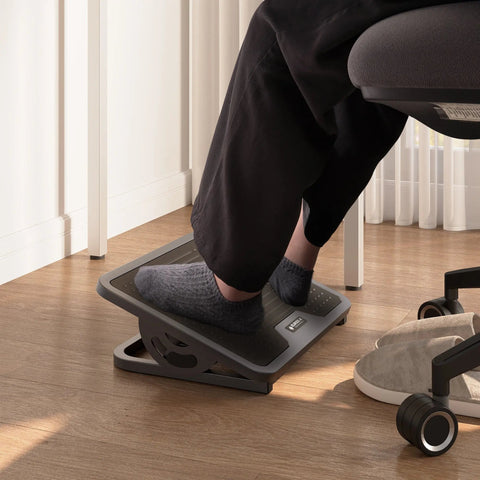
One of the most critical "hidden" factors in back pain is desk height. If your desk is set too high, your shoulders will shrug, and you will likely hunch forward to reach your peripherals. This "forward lean" completely negates even the most advanced lumbar support. To fix this, adjust your chair height first so your feet are flat on the floor (or a footrest), then adjust your desk height so your elbows are at a 90-degree angle.
According to the Canadian Centre for Occupational Health and Safety (CCOHS), using a sit-stand desk can significantly reduce sedentary time. However, the transition must be managed. A common error is standing for too long without a break, which can lead to lower limb MSDs.
Monitor Alignment and Neck Strain
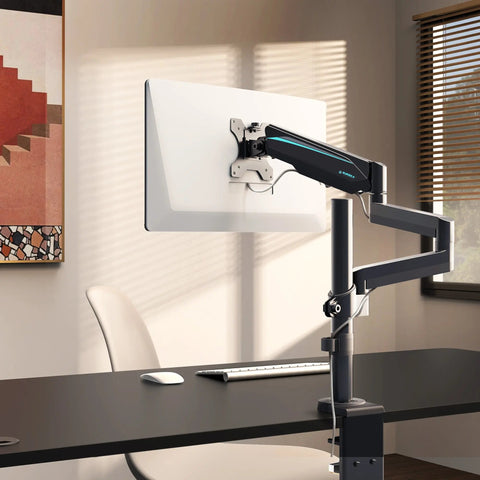
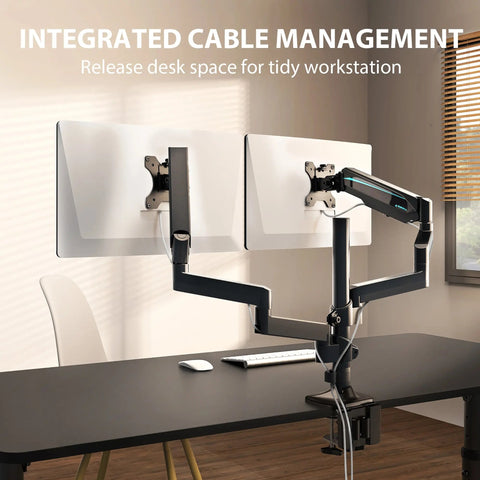
The position of your screen dictates the position of your head, which in turn affects your spine. If your monitor is too low, you will develop "tech neck," pulling your upper spine out of alignment. OSHA's guidelines for monitors recommend placing the top of the screen at or slightly below eye level. Using a dual monitor arm can provide the necessary adjustability to keep your neck in a neutral position, supporting the work done by your lumbar system.
The 20-8-2 Rhythm
No matter how "perfect" your chair settings are, the human body requires movement. Cornell University’s Ergonomics Web recommends the "20-8-2" rule:
- 20 minutes of sitting in a neutral posture.
- 8 minutes of standing.
- 2 minutes of moving or stretching.
This rhythm helps maintain blood circulation and prevents the static load that leads to tissue adaptation and chronic pain.

Beyond Passive Support: The Importance of Active Core Engagement
While ergonomic furniture provides essential passive support, it is only half of the equation. Relying solely on a chair can lead to muscle atrophy over time. Emerging research suggests that "active" core engagement is just as important as "passive" support.
A study on neuromotor adaptation indicates that core stability training can reduce back pain by over 60%. For gamers, this means that while a high-quality chair is a necessary tool, it should be supplemented with micro-movements and core-strengthening exercises.
If your chair features an adaptive system—such as a 4D gyro-tech backrest—avoid the temptation to tighten every adjustment to its maximum. These systems are designed to "float" and respond to your body's subtle shifts. Allowing the chair to move with you promotes dynamic loading, which research suggests can reduce the continuous static load on the spinal discs.
Modeling Note (Reproducible Parameters): This guide's recommendations are based on a "Standard User Model" with the following parameters. Results may vary for users outside these ranges.
Parameter Value Unit Unit Category User Height 165–185 cm Anthropometric Range Session Duration 4–8 hours Exposure Variable Ambient Temp 20–24 °C Environmental Control Surface Friction Medium Coeff. Seat Fabric Assumption Task Type High-Focus N/A Cognitive/Postural Load Boundary Conditions: This model may not apply to individuals with acute spinal injuries, scoliosis, or those significantly outside the 5th–95th percentile of height (below 150cm or above 195cm).
Optimizing for the Long Game
True ergonomic success is found in the details. It is the 1-inch adjustment to the lumbar height and the 5-degree tilt of the monitor that collectively prevent the "afternoon ache." By applying the principles of spinal neutrality and adhering to industry standards like BIFMA and ISO, you can transform your gaming or work setup from a source of strain into a tool for peak performance.
Remember that ergonomics is a process, not a one-time event. As your tasks change—from intense competitive gaming to relaxed content consumption—your setup should adapt. Use the checklists provided by authoritative bodies like the UK Health and Safety Executive (HSE) to periodically audit your workstation.
By prioritizing your musculoskeletal health today, you ensure that your focus remains where it belongs: on the game, the project, and the goals ahead.
Disclaimer: This article is for informational purposes only and does not constitute professional medical advice. If you experience chronic pain or have a pre-existing musculoskeletal condition, please consult a qualified healthcare professional or physiotherapist before making significant changes to your workstation or exercise routine.
Sources
- BIFMA G1-2013 Ergonomics Guideline for Furniture
- ISO 9241-5:2024 Workstation layout & postural requirements
- OSHA eTools: Computer Workstations - Neutral Working Postures
- Cornell University Ergonomics Web — Workstation Guides
- Canadian Centre for Occupational Health and Safety (CCOHS): Office Ergonomics
- WHO 2020 Guidelines on Physical Activity & Sedentary Behaviour
- The 2026 Workstation White Paper: Converging Ergonomic Science and Sustainable Engineering




Leave a comment