

Designing an L-Shaped Creator Hub for Multi-Tasking Workflows
Imagine a home office that sparks your limitless creativity—a sanctuary where the friction of a cluttered desk vanishes, replaced by an elegant, high-performance command center. For the modern content creator, a workspace isn't just a place to sit; it’s a stage for performance, a lab for editing, and a sanctuary for deep thought. Here is how a day of deep work begins once you say goodbye to the chaos of mismatched gear and cramped surfaces.
We have spent years observing the evolution of the "Creator Hub." In our experience working with professional streamers and editors, the most common frustration isn't a lack of space—it's the inefficient use of it. Many creators choose an L-shaped desk for its expansive surface, only to find themselves trapped in a cycle of constant swiveling and neck strain. By applying the principles found in the 2026 Workstation White Paper: Converging Ergonomic Science and Sustainable Engineering, we can transform that corner into a balanced "Workspace Sanctuary" that separates the intensity of a live stream from the precision of a high-end edit.
The Two-Wing Philosophy: Zone Partitioning for Focus
The secret to a high-functioning L-shaped setup lies in "Zone Partitioning." In practice, we often see creators make the mistake of using both wings of the desk for active tasks simultaneously. This leads to what we call "Context Chaos." Instead, we recommend a strict division of labor between the two desk wings.
Wing A: The Deep Work Zone
This is your "Execution Mode" area. Typically situated on your dominant-hand side, this wing is dedicated to high-focus tasks like video editing, color grading, or coding. According to the Canadian Centre for Occupational Health and Safety (CCOHS), maintaining a neutral posture is critical during these long, static sessions.
- Setup: Your primary monitor should be centered directly in front of you.
- Aesthetic: Keep this area "Decluttered." Only the essentials—keyboard, mouse, and perhaps a dedicated macro pad—should live here.
- Benefit: By isolating this zone, you signal to your brain that it is time for "Deep Work," reducing the urge to check stream chats or social feeds.
Wing B: The Interaction Zone
This is your "Engagement Mode" area. This wing houses your streaming hardware, audio interfaces, and secondary monitors for chat or reference materials.
- Setup: Use this space for your Aegispeg Board, which allows you to mount peripherals vertically. This keeps the desktop clear while keeping gear within a tight, accessible arc.
- Aesthetic: This is where your "Personal Branding" shines. Use synchronized RGB lighting to create a "Workflow Ambiance" that looks professional on camera.
Ergonomic Precision: Modeling the Ideal Fit
Creating an inspired environment requires more than just good looks; it requires scientific grounding. We modeled a scenario for a "Tall Professional Creator" (190cm / 6'3") to understand how standard furniture often fails high-performance users.
Modeling Note (Reproducible Parameters): Our analysis uses a deterministic parameterized model based on ANSI/HFES 100-2007 anthropometric ratios. This is a scenario model, not a controlled lab study.
Parameter Value Unit Rationale User Stature 190 cm 95th percentile male height Monitor Size 34 in Ultrawide 4K standard Equipment Load 92.5 kg PC, 3 monitors, audio gear Target FOV 60 deg Immersive editing/gaming Desk Depth 24 in Standard L-shape depth
The Desk Height Gap
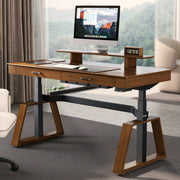
For a creator of this stature, the sitting desk height should be approximately 78.5cm (30.9 inches). Most standard fixed desks are 29 inches high, creating a deficit that forces the user into a slouched position. This misalignment is a primary driver of musculoskeletal disorders (MSDs). To combat this, we lean on the BIFMA G1-2013 Ergonomics Guideline, which suggests that height-adjustable desks are essential to accommodate the 5th to 95th percentile of the population.
The Depth Deficit and Visual Acuity
Our modeling of a 34-inch ultrawide monitor reveals a "Depth Deficit." To achieve a 60-degree field of view (ideal for immersion), the recommended viewing distance is ~27 inches. However, a standard 24-inch desk depth leaves the creator 3 inches too close. This often results in eye fatigue and neck strain as the user "hunts" for a comfortable focal point.

Space Transformation: Tools for the Sanctuary
To bridge the gap between "Before" (a chaotic corner) and "After" (a streamlined hub), you need tools that link functionality with emotion.
1. Reclaim the Surface with Monitor Arms
We strongly advise investing in a Dual Monitor Arm before you populate your desk surface. Retrofitting arms after your gear is laid out is a common "gotcha" that leads to cable tangles and weight distribution issues.
By lifting your screens, you align with OSHA’s guidelines for monitor placement, which recommend the top of the screen be at or slightly below eye level. This doesn't just save your neck; it opens up the "Aesthetic" of your desk, making the workspace feel larger and more inviting. For your Interaction Zone, a Single Monitor Arm allows you to swivel your chat monitor toward you during a stream and away when you need to focus on your "Deep Work" wing.
2. The Foundation: Ergonomic Seating
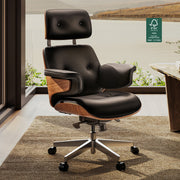
Your chair is the most critical piece of "Infrastructure" in your sanctuary. The Exis, Ergonomic Office Chair is designed to support the "Thinking" and "Execution" modes we discussed. With its 4-level adjustable lumbar support and 90°–145° recline, it allows you to shift from an upright, focused posture for editing to a relaxed, slightly reclined position for community engagement or brainstorming.
3. Vertical Organization: The Pegboard Advantage
The Aegispeg Board is more than just storage; it’s a "Mindfulness" tool. By moving headphones, controllers, and cables off the desk and onto a desk-mounted panel, you remove visual noise. A tidy desk helps reduce distractions and maintain focus, which is essential for "Deep Work."
Mastering the Flow: Workflow Tips & Tricks
A beautiful sanctuary only stays that way if you have a system to maintain it. Here are the practical "Expert Insights" we’ve gathered from the streaming community.
The "20-8-2" Rhythm
Even with the best L-shaped standing desk, standing all day is not the goal. Aligned with Cornell University’s Ergonomics Web, we recommend the 20-8-2 rule:
- 20 Minutes Sitting: For precise editing or writing.
- 8 Minutes Standing: For streaming or active interaction.
- 2 Minutes Moving: A quick stretch or walk to reset your "Mindfulness."
Professional Cable Management
Experienced creators run all permanent cables (power, Ethernet, primary monitor DP) through the desk's built-in channels first. Then, use velcro ties for device-specific cables (USB for mics, controllers) that need to be swapped frequently. This creates a maintainable system instead of a one-time, impossible-to-update bundle. Never use permanent zip ties; they are the enemy of a modular, evolving setup.
Lighting and Ambiance
To avoid the "Visual Disconnect" that beginners often face, sync all RGB elements—desk, backlight, and pegboard—to a single software controller. The World Health Organization (WHO) emphasizes the importance of a healthy work environment; while they focus on physical activity, we believe "Visual Harmony" is just as important for mental well-being during 10-hour editing marathons.
Summary of Technical Requirements for Heavy-Duty Setups
When building a "Creator Hub," the mechanical limits of your furniture are just as important as the specs of your PC. Our "Battlestation Load Analysis" shows why "Professional" grade matters.
| Component | Weight (Est.) | Requirement |
|---|---|---|
| Full Tower PC (Liquid Cooled) | 25 kg | High-stability surface |
| 3x 34" Ultrawide Monitors | 24 kg | Triple/Dual Monitor Arms |
| Desk Tabletop (L-Shape) | 25 kg | Reinforced frame |
| Peripherals (Mic, Camera, etc.) | 8 kg | Organized mounting |
| Total System Load | ~92.5 kg | Dual-Motor System Mandatory |
Logic Summary: A single-motor desk typically has a capacity of ~80kg. At 92.5kg, a single-motor system would operate at ~116% capacity, risking motor burnout and jerky movement. A dual-motor system, rated for ~120kg, operates at a healthy ~77% utilization, ensuring longevity and smooth transitions between sitting and standing modes.
A Sanctuary for Your Best Work
Transformation isn't just about buying new furniture; it’s about "Vision Casting" a space that respects your body and your craft. When you align your workstation with industry standards like ISO 9241-5 and personalize it with tools like the Exis, Ergonomic Office Chair, you aren't just "Decluttering"—you are building a platform for your future success.
Imagine your next stream: your monitors are at the perfect height, your gear is neatly organized on your Aegispeg Board, and your mind is free to focus on your audience. This is the power of a well-designed Creator Hub. It’s time to stop fighting your desk and start letting it work for you.
YMYL Disclaimer: This article is for informational purposes only and does not constitute professional medical, legal, or ergonomic advice. While the recommendations are based on industry standards and scenario modeling, individual physical needs vary. If you have pre-existing musculoskeletal conditions or chronic pain, please consult with a qualified physical therapist or occupational health professional before making significant changes to your workstation or activity levels.
Sources
- BIFMA G1-2013 Ergonomics Guideline for Furniture
- CCOHS: Office Ergonomics - Sit/Stand Desk
- Cornell University Ergonomics Web — Workstation Guides
- ISO 9241-5:2024 Workstation layout & postural requirements
- OSHA eTools: Computer Workstations
- WHO 2020 Guidelines on Physical Activity & Sedentary Behaviour
- The 2026 Workstation White Paper: Converging Ergonomic Science and Sustainable Engineering

Leave a comment