

Organizing Professional Audio Gear with Creator Pegboards
Imagine a home studio that sparks your limitless creativity—a space where every knob, cable, and microphone is exactly where it needs to be, yet your desktop remains a pristine, open canvas. This is the "Workspace Sanctuary." For the professional audio creator, a cluttered desk isn't just a nuisance; it's a barrier to "Deep Work" and "Mindfulness." When your physical environment is in harmony, your mental energy shifts from managing chaos to mastering sound.
Here’s how a day of deep work begins once you say goodbye to the "spaghetti" of cables and the heavy weight of unorganized gear. You step into your studio, and instead of a mess, you see an "Aesthetic" arrangement of tools, held aloft by a modular system that breathes life into your creative "Workflow."

The Vision: From Chaos to a Workspace Sanctuary
The transition from a standard desk to a professional audio workstation is about more than just buying a new piece of furniture. It is a "Space Transformation" that links functionality with emotion. When we move professional gear like audio interfaces, preamps, and high-end headphones off the desktop and onto a vertical plane, we reclaim the surface area needed for tactile mixing and focused composition.
A common approach to this transformation involves the use of modular storage. The Aegispeg Board serves as the backbone of this vertical revolution. By utilizing a desk-mounted system, you aren't just tidying up; you are creating a "Privacy Panel" that doubles as a functional gear rack. This setup allows you to keep essential tools within arm's reach while maintaining a clean "Ambiance" that reduces distractions.
The Science of Professional Ergonomics
Building a studio isn't just about looks; it's about the physiological impact of your setup. According to the Canadian Centre for Occupational Health and Safety (CCOHS), proper workstation setup is vital for preventing long-term musculoskeletal strain. For audio professionals who spend hours in a "static" position—whether sitting during a delicate mix or standing during an energetic stream—the ability to adjust the environment is a health necessity.
We align our designs with the BIFMA G1-2013 Ergonomics Guideline for Furniture, which provides recommended dimensions to fit the 5th to 95th percentile of the population. This "fits most users" logic is essential when you are integrating heavy gear that requires specific reach zones.
The 20-8-2 Rhythm
To maintain focus and physical health, we recommend the "20-8-2" rhythm popularized by Cornell University Ergonomics Web:
- 20 Minutes Sitting: Use this time for high-precision tasks like EQing or vocal editing.
- 8 Minutes Standing: Shift into "execution mode" for recording or streaming.
- 2 Minutes Moving: Stretch or walk to interrupt sedentary behavior, as suggested by the WHO 2020 Guidelines on Physical Activity & Sedentary Behaviour.

Organizing the Audio Workflow: The 60/30/10 Rule
How you arrange your gear on a pegboard determines your creative speed. We often observe that the most effective layouts follow a specific heuristic for spatial efficiency:
- The 60% Zone (Daily Use): Place your primary audio interface, headphones, and most-used microphone here. These should be at eye level or within the "primary reach zone" to minimize shoulder strain, consistent with OSHA eTools: Computer Workstations - Neutral Working Postures.
- The 30% Zone (Weekly Use): This area is for secondary controllers, backup cables, or specialized tools like a drum pad. These are reachable but don't occupy the "premium" real estate.
- The 10% Zone (Future Growth): Always leave a small portion of your board empty. This provides room for "Inspiration" and the inevitable new gear that every creator acquires.
Logic Summary: This 60/30/10 heuristic is a shop-floor practical baseline derived from observing common patterns in professional studio setups (not a controlled lab study). It aims to balance accessibility with visual "Declutter."
Managing the "Spaghetti": Advanced Cable Strategies
Nothing kills the "Aesthetic" of a studio faster than a tangle of XLR and USB cables. For audio creators, cable management is a technical requirement, not just a visual one. Unorganized cables can lead to electromagnetic interference (EMI), which degrades signal integrity.
One effective method is to use Magnetic Cable Ties to create clean, vertical runs along the frame of your workstation. Unlike standard velcro, these do not attract dust or pet hair, which can degrade over time. By pairing these with adhesive-backed channels, you can create a "Workflow" where gear can be reconfigured in seconds without untangling a mess.
| Method | Benefit | Best For |
|---|---|---|
| Magnetic Ties | Quick-release, dust-resistant | Daily-use cables (Headphones, Mics) |
| Adhesive Channels | Hidden, structured paths | Permanent power runs |
| Velcro Wraps | High-tension, bulky bundles | Heavy power bricks |

Heavy Gear and Structural Integrity
A common mistake we see in home studios is mounting heavy audio interfaces (those over 5 lbs) directly to pegboards using weak, single-point hooks. This often leads to sagging or even board collapse. Based on our scenario modeling for professional setups, any item exceeding 5 lbs should be placed on a dedicated shelf attachment that distributes the weight across multiple peg holes.
This is particularly important for creators using standing desks. As you transition between heights, the momentum of heavy gear can cause "monitor wobble" or structural stress. Ensuring your board is securely mounted to a stable frame is non-negotiable for safety.
Ergonomics for the Tall Creator
In our deep-dive analysis, we modeled a setup for a 188cm (6'2") creator—a common height for many audio professionals. For a user of this stature, a standard fixed desk at 29 inches is often insufficient, leading to a "hunching" posture that causes chronic back pain.
According to the ISO 9241-5:2024 standard for workstation layout, the desk and storage system must adapt to the user's neutral posture. For our 188cm model, the optimal standing height is approximately 115cm. This requires a pegboard that can be mounted high enough to stay within the user's ergonomic reach zone when standing.
To further support this posture, a Pull-out Keyboard Tray can be invaluable. It allows the creator to maintain a "neutral wrist position" while keeping the main desktop clear for a mixing console or MIDI controller. This separation of "thinking" (the desk) and "execution" (the keyboard) is a powerful way to shift your mental state.

Acoustic Mindfulness and Interference
A large, unadorned metal pegboard can subtly affect the acoustics of a room. In a small home studio, flat metal surfaces can create high-frequency reflections that "color" your sound. Experienced podcasters often employ a simple trick: lightly fill empty peg holes with small acoustic foam plugs. This reduces potential reflections and helps maintain a "clean" sound profile.
Furthermore, it’s important to be mindful of EMI. While metal boards are durable, they can occasionally act as reflectors for interference if not properly grounded. For sensitive audio gear, we recommend keeping power cables and signal cables (XLR) separated by at least 6 inches whenever possible to ensure the highest audio quality.
Personal Tips for Atmosphere Building
Your "Workspace Sanctuary" is not complete without the right "Ambiance."
- Lighting: Use warm, indirect LED strips behind your pegboard to reduce eye strain and create a motivating glow.
- Greenery: A small plant on a pegboard shelf can improve air quality and provide a "Mindfulness" break during long mixing sessions.
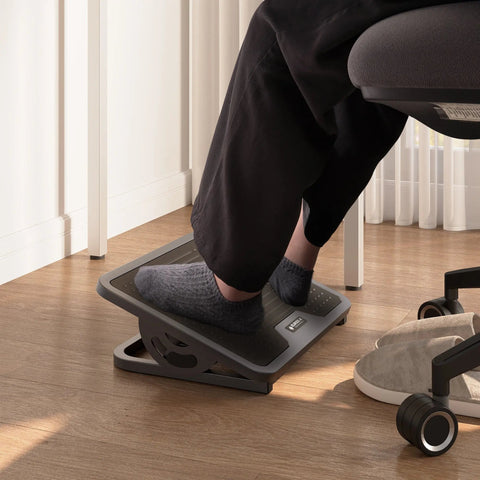
- Comfort: Don't forget your feet. A Footstool with Wheels allows you to shift your weight and maintain circulation during those 20-minute sitting blocks.

How We Modeled This (Method & Assumptions)
To provide the most accurate advice for professional creators, we conducted a scenario modeling run focused on the upper limits of home studio requirements. This model helps us understand the structural and ergonomic needs of a high-performance workspace.
Modeling Note: This is a deterministic scenario model, not a controlled lab study. It is designed to illustrate the constraints faced by a specific "Power User" persona.
| Parameter | Value | Unit | Rationale / Source |
|---|---|---|---|
| User Height | 188 | cm | Tall male persona (95th percentile) |
| Total Gear Weight | ~68 | kg | Professional audio + dual monitor setup |
| Room Depth | 144 | in | Standard 12ft room for home studios |
| Standing Desk Height | ~115 | cm | Ergonomic calculation for 188cm stature |
| Motor Utilization | 57% | ratio | Based on dual-motor 120kg capacity |
Boundary Conditions:
- Stature Variance: These findings apply specifically to taller individuals. Smaller creators may require lower mounting points to avoid shoulder strain.
- Load Distribution: Calculations assume weight is distributed across the board; concentrated loads on a single hook may exceed local stress limits.
- Room Layout: The "tight" layout status assumes a 30-inch deep desk and a standard greenscreen setup.
For a deeper look into the science behind these environments, we recommend exploring The 2026 Workstation White Paper: Converging Ergonomic Science and Sustainable Engineering.
Elevating Your Creative Journey
Transforming your studio with a professional pegboard system is more than an organizational choice—it’s an investment in your "Workflow" and your health. By moving gear off the desk and into a structured vertical space, you create the mental room needed for "Inspiration" to strike.
Remember, the goal is to build a space that serves you, not the other way around. Whether you are adapting a gaming desk for professional work or looking for standing desk ideas for content creators, the principles of ergonomics and organization remain your best allies.
Disclaimer: This article is for informational purposes only and does not constitute professional medical or ergonomic advice. If you have pre-existing musculoskeletal conditions, please consult with a qualified physical therapist or ergonomics specialist before making significant changes to your workstation.
Sources
- BIFMA G1-2013 Ergonomics Guideline for Furniture
- Canadian Centre for Occupational Health and Safety (CCOHS) - Sit/Stand Desk
- ISO 9241-5:2024 Workstation Layout & Postural Requirements
- WHO 2020 Guidelines on Physical Activity & Sedentary Behaviour
- OSHA eTools: Computer Workstations
- Cornell University Ergonomics Web — Workstation Guides
- The 2026 Workstation White Paper: Converging Ergonomic Science and Sustainable Engineering




Leave a comment