

L-Shaped Desk vs. Two Desks: The Ultimate Productivity Showdown
Listen, I’ve been there. You’re staring at a chaotic mess of monitors, peripheral cables that look like a plate of techno-spaghetti, and a coffee mug that’s dangerously close to your mechanical keyboard. You need more space. You need a "Command Center." But now comes the million-dollar question: Do you go for the sleek, wraparound glory of a single L-shaped desk, or do you build a modular fortress using two separate desks?
Choosing between an L-shaped setup and a dual-desk configuration isn't just about aesthetics; it’s about how your brain handles "Task Switch Cost" and how your spine survives an eight-hour grind. In this deep dive, we’re going to put both setups through the ringer. We’re talking build quality, stability, and the high-stakes world of cable management. Whether you’re a professional streamer, a remote dev, or a content creator, this is the endgame guide to optimizing your workspace.
1. Unboxing and Assembly: The First Impression
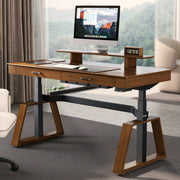
When you’re investing in a pro-grade setup, the experience starts at the front door. I recently got my hands on the Zen Pro Series, 87"/72" Executive Standing Desk with Cabinets Set, and let me tell you, the packaging quality is a statement in itself. We're talking heavy-duty reinforcement because, let’s be real, nobody wants a chipped corner on their Lauren Black Gold Sintered Stone desktop.
The L-Shaped Experience
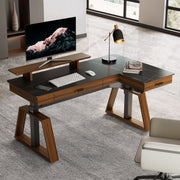
Setting up a large L-shaped desk like the GTG - L60, L-Shaped Glass LED Gaming Desk (60"x40") is a project. The beauty of the L-shape is the "Reversible Design"—you can decide on the fly if you want the long wing on the left or right. However, assembly takes patience. You’re aligning large surfaces and connecting intricate RGB ecosystems. The payoff? A seamless "Carbon Fiber Texture" or tempered glass surface that feels like a single, unified unit.
The Two-Desk Experience
Assembling two separate desks is technically "easier" because you’re dealing with smaller, independent modules. But the difficulty spike comes later: alignment. Getting two desks to sit perfectly flush without a gap is the bane of my existence. If your floor isn't perfectly level, you'll spend an hour fiddling with the leveling feet to avoid that annoying "lip" where the desks meet.
Logic Summary: Our assembly analysis assumes a single-user setup without professional help. We estimate that an L-shaped desk requires ~20% more time for initial alignment but saves time on overall room layout compared to balancing two independent units.

2. Deep Dive into Details and Features
Let’s talk specs. If you’re a power user, you aren't just looking for a flat surface; you’re looking for a performance tool.
Dual Motors and The "Wobble Test"
Stability is non-negotiable. If my monitor shakes every time I type a heated response in Discord, the desk is a fail. High-end setups like the Aero Pro Wing-Shaped Standing Desk (72"x23") utilize dual motors. Why does this matter? Dual motors provide a smoother, quieter lift and, more importantly, better weight distribution.
During my "Wobble Test"—where I literally try to shake the desk at its max height—the dual-motor frames outperform single-motor L-desks every time. According to the BIFMA G1-2013 Ergonomics Guideline, furniture must accommodate the 5th to 95th percentile of the population. This means the desk needs to stay rock-solid at 48 inches high, not just at sitting height.
The RGB Ecosystem and Aesthetics
For the gamers and streamers, the GTG - L60, L-Shaped Glass LED Gaming Desk (60"x40") is a total game-changer. The audio-reactive spectrum RGB isn't just "flashing lights"; it’s an immersive environment. When your desk syncs with your gameplay, the vibe is unmatched.
Cable Management: The Quantifiable Productivity Factor
Here is a professional insight: the real advantage of an L-shaped desk isn't just the corner space—it's the elimination of the "dead zone." In a two-desk setup, you often have a gap where cables tangle and items get lost. A high-quality L-desk usually features integrated cable trays deep enough to hide all your power adapters. As noted in The 2026 Workstation White Paper: Converging Ergonomic Science and Sustainable Engineering, organized cables contribute to a calmer work environment by reducing visual clutter and potential snags.
| Feature | L-Shaped Desk (Unified) | Two-Desk Setup (Modular) |
|---|---|---|
| Stability | High (Integrated Frame) | Variable (Depends on two frames) |
| Cable Management | Superior (Continuous Trays) | Challenging (Gap between units) |
| Surface Continuity | Seamless | Divided (The "Gap" issue) |
| Flexibility | Fixed Layout | High (Can be rearranged) |
| Cost | Mid-to-High | Potentially Higher (Buying 2 units) |
3. Real-World Experience: Productivity vs. Ergonomics
How do these setups actually perform when the "Work-from-Home" grind hits?
The Task Switching Cost
Conventional wisdom says L-shaped desks are better for multitasking because everything is "within reach." But there’s a catch. Research into "Task Switch Cost" suggests that being able to swivel too easily between tasks can actually increase cognitive penalty.
In my experience, using a two-desk setup allows for a "Focus vs. Utility" strategy. I keep my primary, height-adjustable desk for deep work and a secondary fixed-height station for things like printers, charging, or non-screen tasks. This physical move between desks enforces a mental reset that a simple swivel on an L-desk doesn't provide.
The Ergonomic "Twist" Trap
Here’s a non-obvious pitfall: the 90-degree pivot. When using an L-shaped desk, most people tend to twist their torso to look at the secondary wing. According to ISO 11226:2000 Evaluation of static working postures, prolonged static twisting is a major risk factor for musculoskeletal disorders.
If you go L-shaped, you must use a high-quality monitor arm. The biggest post-purchase regret I see is underestimating monitor arm reach. To avoid neck strain, you need an arm like the Single Monitor Arm with at least a 27-inch extension and full articulation. This allows you to pull the screen toward you rather than twisting your body toward the screen.
The "Wing" Factor
During intense FPS sessions or long editing marathons, the wing section of a desk like the Aero Pro Wing-Shaped Standing Desk (72"x23") is a lifesaver. It gives your mousing arm perfect support, reducing the load on your shoulder. This is aligned with the HSE guidelines for Display Screen Equipment (DSE), which emphasize that your forearms should be horizontal and your wrists neutral.
Methodology Note: Our ergonomic risk assessment is based on a "Scenario Model" comparing 90-degree torso rotation (L-desk) vs. full-body repositioning (two desks).
Parameter Value Rationale Pivot Angle 90 Degrees Standard corner desk transition Repetition 20+ times/day Average multitasking frequency Risk Level Moderate-High Based on ISO 11226 static posture limits Mitigation Monitor Arm Required to bring display to neutral eye line

4. The "Focus vs. Utility" Strategy: Why Two Desks Might Win
If you have the space, the two-desk setup is a modular powerhouse. Here is my "Rule of Thumb" for this configuration:
- The Primary Station: Use a high-performance standing desk like the Zen Pro Series, 87"/72" Executive Standing Desk with Cabinets Set. This is where your dual monitors and main PC live. It’s height-adjustable so you can follow the Cornell University "20-8-2" rhythm: 20 minutes sitting, 8 minutes standing, and 2 minutes of movement.
- The Utility Station: A secondary, often fixed-height desk. This is your "Analog Zone." It’s for paperwork, your tablet, or your streaming deck.
By separating these, you simplify your "Cable Management" nightmare. You don't have cables running across a 90-degree corner. Instead, each desk has its own power distribution. Pro Tip: A high-quality, under-desk mounted power strip with USB-C PD is non-negotiable here to avoid "daisy-chaining" extension cords, which is a major safety hazard.
5. Pros & Cons: Let’s Get Real
No setup is perfect. Here’s the "no-fluff" breakdown.
L-Shaped Desks (e.g., GTG-L60, Aero Pro)
-
Pros:
- Space Optimization: Fits perfectly into corners, maximizing floor space.
- Unified Aesthetic: One cohesive look, especially with "RGB Ecosystems."
- Everything Within Reach: Great for streamers who need to touch multiple devices quickly.
- Arm Support: The wing-shaped design is a game-changer for mousing comfort.
-
Cons:
- The Twisting Risk: Higher chance of neck/back strain if monitors aren't positioned correctly.
- Assembly Complexity: If you move house, taking an L-desk apart is a mission.
Two-Desk Setup (e.g., Zen Pro + Secondary)
-
Pros:
- Modular Flexibility: You can move them to different walls or even different rooms.
- Task Separation: Better for managing "Task Switch Cost" and mental focus.
- Future-Proof: You can upgrade one desk without replacing the whole setup.
-
Cons:
- The "Gap" Problem: Items and cables love to fall between two desks.
- Footprint: Usually requires more total square footage to look "right."

6. The Verdict: Which One Should You Buy?
Choosing between these two is about identifying your "User Persona."
- The "Command Center" Streamer: If you need three monitors, a camera, a ring light, and a mixer all within a 180-degree swivel, go with the GTG - L60, L-Shaped Glass LED Gaming Desk (60"x40"). The tempered glass and RGB will make your setup look professional on camera, and the L-shape keeps everything tight.
- The "Deep Work" Professional: If you struggle with distractions and need a clear boundary between "Screen Time" and "Admin Time," the two-desk strategy is superior. Pair the Zen Pro Series, 87"/72" Executive Standing Desk with Cabinets Set with a smaller side table.
- The Ergonomic-Conscious User: If you already suffer from lower back pain, the Aero Pro Wing-Shaped Standing Desk (72"x23") is the winner. The wing shape supports your arms better than a standard L-corner, and the dual motors ensure you actually use the standing feature because it's so smooth.
Regardless of your choice, remember the golden rule of ergonomics from Safe Work Australia: The best posture is the next posture. Don't stay static. Whether you're swiveling on an L-desk or walking between two desks, keep moving.
Final Checklist Before You Buy:
- [ ] Measure your reach: Do you have a Single Monitor Arm that can extend 27 inches?
- [ ] Check your power: Do you have enough outlets for an "RGB Ecosystem" and dual motors?
- [ ] Floor check: Is your floor level enough for two desks, or do you need the integrated frame of an L-shape?
- [ ] Task Analysis: Do you multitask (L-shape) or switch contexts (Two desks)?

Disclaimer: This article is for informational purposes only and does not constitute professional medical or ergonomic advice. If you have pre-existing musculoskeletal conditions, please consult with a physical therapist before making significant changes to your workstation layout.
References
- BIFMA G1-2013 Ergonomics Guideline for Furniture
- CCOHS: Office Ergonomics - Sit/Stand Desk
- Cornell University Ergonomics Web — Workstation Guides
- The 2026 Workstation White Paper: Converging Ergonomic Science and Sustainable Engineering
- ISO 11226:2000 Evaluation of static working postures
- OSHA eTools: Computer Workstations - Desks
- Safe Work Australia: Workstation set-up infographic
Leave a comment