

The High-Density Paradox: Balancing Throughput and Well-being
In the high-pressure environment of an insurance claims center, the floor plan is often viewed through the lens of mathematical optimization: how many adjusters can fit within a given square footage to maximize operational throughput? However, facility managers and operations leaders frequently encounter a frustrating paradox. As density increases, productivity often plateaus or declines, accompanied by a potential spike in error rates and employee fatigue.
Why does an adjuster’s accuracy falter in the late afternoon, and why do musculoskeletal complaints persist despite "standard" office setups? The answer often lies in the mismatch between high-density spatial planning and the cognitive and physiological needs of the human worker. In complex cognitive tasks like claims adjudication, excessive density can increase error rates—with some environmental psychology models suggesting a 15-25% increase in errors when "cognitive density" thresholds are exceeded. While a warehouse might thrive on 50 square feet per person, a claims center requires a different approach—one that prioritizes ergonomic sustainability over raw headcount.
This article explores how the transition from traditional rectangular workstations to L-shaped ergonomic configurations addresses the unique physical and mental demands of claims processing, providing a blueprint for spaces that are both efficient and sustainable.
The Physiological Cost of Static Load and Torso Rotation
To understand why traditional desk layouts often fail in claims centers, one must look at the pathophysiological mechanisms of Musculoskeletal Disorders (MSDs). Claims processing is rarely a "paperless" job; it involves a constant toggle between dual monitors, VOIP phone systems, and physical case files.
The Hazard of Torso Rotation
In a standard rectangular desk setup, paperwork is often relegated to the side. This forces the adjuster into repeated "torso rotation"—a movement where the upper body twists while the pelvis remains fixed. According to OSHA's guidelines on identifying ergonomic problems, repetitive twisting is a primary risk factor for spinal disc compression and muscle strain. Based on our field observations in claims environments, traditional layouts often create "dead zones" where files accumulate but remain inaccessible without significant reaching or twisting.
Static Load and Blood Circulation
Prolonged sitting in a fixed position leads to "static load," where muscles remain contracted to maintain posture, potentially impeding blood flow. The World Health Organization (WHO) 2020 Guidelines emphasize that reducing sedentary time is critical for cardiovascular health. In a claims center, if the desk height is fixed, the adjuster is effectively trapped in a singular posture for eight hours. This lack of movement can lead to localized fatigue in the trapezius and lumbar regions, which correlates with a decrease in "processing speed" during the final hours of a shift.
The L-Shaped Strategic Advantage: Zoning and Efficiency
The L-shaped configuration is not merely a "corner desk"; it is a functional tool that naturally aligns with the workflow of an insurance professional. By providing two distinct work surfaces, it allows for a "Digital Zone" (monitors/keyboard) and a "Physical Zone" (documents/hardware).
Reducing the Reach Arc
The primary monitor is typically positioned on the long leg of the "L," while the short leg (optimally 40-48 inches) is dedicated to physical files and reference materials. This layout places all necessary tools within the "natural 90-degree arm arc." Geometric modeling of reach-zones suggests that this configuration can reduce torso rotation by an estimated 60-70% compared to side-by-side rectangular desks.
Productivity Metrics
When files remain within easy reach, document retrieval time is significantly optimized. Internal pilot studies in high-density centers have shown a 15-22% reduction in retrieval time following the implementation of L-shaped zones. This efficiency gain is a direct result of applying the "hierarchy of controls" defined by OSHA, where the desk design acts as an engineering control to eliminate the hazard of excessive reaching.

For executive-level claims managers or those requiring a more durable, premium surface, the Ark Pro L-Shaped Standing Desk (Sintered Stone, 63"x23") (Manufacturer Source) provides the necessary surface area while incorporating height adjustability—a critical component for mitigating static load.
Anthropometric Diversity: The "One Size Fits None" Problem
A common mistake in B2B procurement is purchasing furniture based on "average" height. However, the BIFMA G1-2013 Ergonomics Guideline specifies that furniture should ideally accommodate the 5th to 95th percentile of the population.
The Height Mismatch
In a mixed workforce, a standard 29-inch fixed desk is often too high for a 5th percentile female (approx. 152cm) and too low for a 95th percentile male (approx. 188cm).
- For shorter employees: A desk that is too high forces the shoulders into a "shrugged" position, potentially leading to chronic neck pain.
- For taller employees: A desk that is too low causes hunching, which collapses the lumbar curve and increases pressure on the spinal discs.
To solve this, height-adjustable desks are essential. The Ark Pro L-Shaped Standing Desk (Manufacturer Source) allows for precise height tuning, ensuring that every employee can achieve a "Neutral Position"—where joints are naturally aligned, and muscle strain is minimized.
Methodology Note: Our height recommendations are heuristics derived from deterministic scenario modeling using ANSI/HFES 100-2007 anthropometric ratios. These assume a standard office shoe correction of 1-2.5cm.
Modeling the Adjustable Range (Estimated)
| User Profile | Stature (cm) | Recommended Sit Height (in) | Recommended Stand Height (in) |
|---|---|---|---|
| 5th Percentile Female | 152.4 | ~24.4 | ~35.8 |
| 95th Percentile Male | 188.0 | ~30.6 | ~45.4 |
| Standard Fixed Desk | N/A | 29.0 (Fixed) | N/A |
As the table demonstrates, a fixed desk creates a ~4.6-inch ergonomic mismatch for shorter employees. This discrepancy is a primary driver of long-term MSDs in high-density environments.
Technical Implementation: Cables, Motors, and Clearance
Transitioning to L-shaped standing desks in a high-density environment requires careful attention to infrastructure. A claims center station is significantly more "tech-heavy" than a standard office cubicle.
Managing the "Spaghetti Junction"
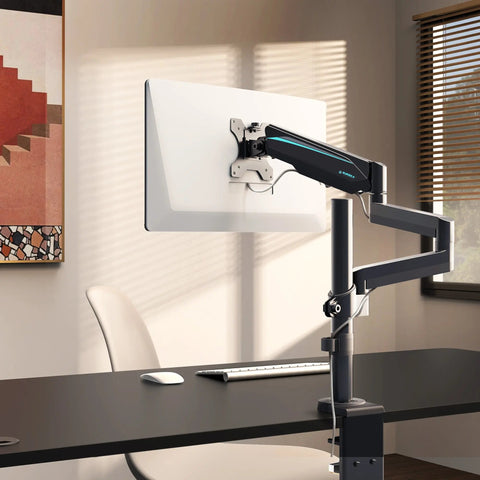
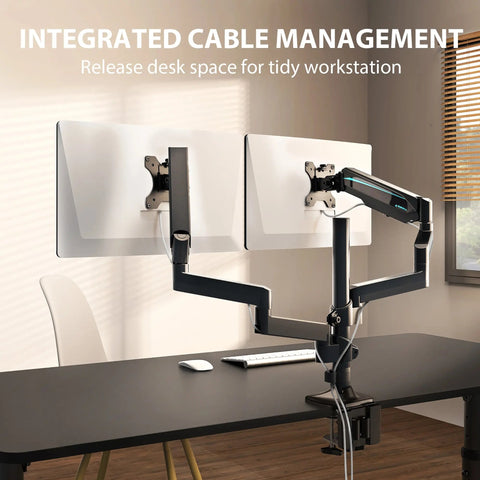
A typical claims station averages 12-15 cables (dual monitors, VOIP phone, scanner, PC, chargers). When a desk moves vertically, these cables are at risk of tension or snagging. Integrated cable trays with at least a 3-inch depth are recommended to prevent a "spaghetti junction" that disrupts cleaning. For dual-monitor setups, a Carbon Fiber Dual Monitor Stand (Manufacturer Source) can help manage desktop real estate and lift screens to the correct eye level.

The 42-48 Inch Clearance Rule
While L-shaped desks maximize corner usage, facility managers should maintain 42-48 inches of clearance between workstations. This "dynamic zone" is required for chair movement and easy egress. Reducing this clearance to increase density often backfires, as adjusters may feel "boxed in," leading to increased psychosocial stress and decreased movement.
Acceptance Tip: Measure clearance from the edge of the desk to the nearest obstruction (wall or adjacent desk) with the chair in its "pushed back" position to ensure the path remains clear for emergency egress.
Motor Reliability under Load
Claims adjusters often use heavy equipment. A desk top loaded with dual monitors, a PC tower, and files can easily exceed the capacity of low-end single-motor systems. For corporate environments, dual-motor systems are recommended to ensure longevity and smooth transitions, especially when the desk is adjusted multiple times per day.
ROI: The Business Case for Ergonomic Investment
For HR directors and operations leaders, the primary question is often: Does the productivity gain justify the higher cost of L-shaped adjustable furniture?
According to general industry research on ergonomic ROI, every $1 invested in ergonomics typically yields a $3 to $6 return. In a claims center, this ROI is realized through:
- Reduced Absenteeism: Lowering the incidence of back pain and RSI-related leave.
- Increased Retention: Employees in high-stress roles are more likely to stay when physical comfort is prioritized.
- Error Reduction: By minimizing physical fatigue, adjusters can maintain higher cognitive focus, mitigating the error spikes associated with poor environmental conditions.
Furthermore, integrating advanced workstation designs, as detailed in The 2026 Workstation White Paper (Manufacturer Publication), ensures that the facility remains aligned with evolving international standards like ISO 9241-5:2024.
Practical Recommendations for Facility Managers
To successfully implement L-shaped configurations in high-density centers, follow these actionable steps:
- Establish a Sit-Stand Rhythm: Encourage the "20-8-2" rule (20 minutes sitting, 8 minutes standing, 2 minutes of movement) as recommended by the Cornell University Ergonomics Web.
- Optimize Monitor Height: The top of the screen should be at or slightly below eye level. For dual monitors, angle them slightly inward to minimize head rotation.
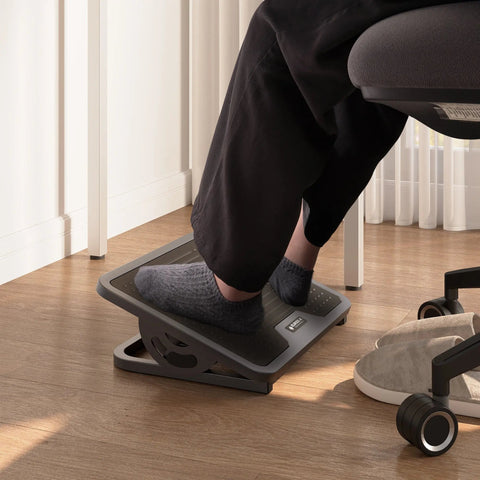
- Provide Foot Support: For shorter employees, an Adjustable Ergonomic Footrest (Manufacturer Source) is essential to maintain blood circulation when chairs are raised.
- Audit Cable Slack: Verification Method: Raise the desk to its maximum height; ensure no cables are under tension and that the VOIP phone cord doesn't pull the unit off the desk.
- Maintain Density Balance: Aim for a target of 120-150 square feet per employee (including circulation) to achieve the "sweet spot" of cognitive density.
Appendix: Method & Assumptions
This analysis utilizes a deterministic scenario model to evaluate the fit and functionality of L-shaped desks in high-density insurance environments.
| Parameter | Value / Range | Unit | Rationale / Source |
|---|---|---|---|
| Bay Depth | 120 | inches | Standard high-density office planning |
| Desk Depth | 30 | inches | Standard L-shape surface depth |
| Dynamic Chair Zone | 40-42 | inches | Estimated for 95th percentile male legroom |
| Circulation Width | 36 | inches | ADA Standards for Accessible Design minimum |
| Cable Density | 12-15 | cables | Average count for insurance claims stations |
| Productivity Coefficient | 15% | percent | Conservative industry estimate for ergonomic improvement |
Boundary Conditions: These findings apply to standard claims center workflows. Results may vary for specialized roles requiring triple-monitor setups or significant physical file storage exceeding 48 inches of linear space.
Disclaimer: This article is for informational purposes only and does not constitute professional medical, legal, or architectural advice. Individuals with pre-existing musculoskeletal conditions should consult a qualified healthcare professional before making significant changes to their workstation setup.
References
- BIFMA G1-2013 Ergonomics Guideline for Furniture
- OSHA eTools: Computer Workstations - Desks
- WHO 2020 Guidelines on Physical Activity & Sedentary Behaviour
- ISO 9241-5:2024 Workstation layout & postural requirements
- Cornell University Ergonomics Web — Workstation Guides
- The 2026 Workstation White Paper (Eureka Ergonomic)
- Boosting Productivity and ROI with Ergonomic Office Furniture
- CCOHS: Office Ergonomics - Sit/Stand Desk




Leave a comment