

The Physiological Imperative of Multi-Monitor Ergonomics
The modern professional often experiences a specific, localized fatigue by mid-afternoon: a dull ache at the base of the skull, tension across the trapezius, and a persistent "dry" sensation in the eyes. While often dismissed as the cost of a productive workday, these symptoms can be physiological signals of Musculoskeletal Disorders (MSDs) in development. According to the U.S. Occupational Safety and Health Administration (OSHA), core risk factors for these conditions include repetitive tasks, awkward postures, and sustained static loads.
When a workspace expands from a single screen to a multi-monitor array, the ergonomic complexity increases. The primary challenge is no longer just height; it is the management of the horizontal viewing arc. In a dual or triple monitor setup, the neck (cervical spine) is frequently subjected to repeated rotation beyond its neutral range. This movement, when sustained over an eight-hour shift, can create a "static load" on the musculature, potentially restricting blood circulation and leading to the buildup of metabolic byproducts that cause pain.
The choice between a straight-line desk and an L-shaped configuration significantly influences the fundamental geometry of one's interaction with digital information. As explored in the Eureka Ergonomic 2026 Workstation White Paper (a company technical report), the convergence of physical furniture design and digital workflow efficiency is a critical frontier for professional well-being.
The Straight Desk: Linear Constraints and Focal Depth
The traditional straight desk is the baseline for office design. Its primary ergonomic advantage lies in its simplicity and the ability to maintain a consistent focal distance—provided the monitors are arranged in a specific arc. However, straight desks often present a "linear constraint" that users must actively manage.
In a triple-monitor configuration on a straight desk, users frequently align the screens in a flat, parallel line. This is a common ergonomic pitfall. According to the ISO 9241-5:2024 standard for workstation layout, the viewing distance should remain relatively constant to prevent the eyes from constantly refocusing (accommodation). A flat line of three monitors means the outer edges are significantly further from the eyes than the center, forcing the ocular muscles to work harder and the neck to rotate further to maintain clarity.
Geometric Modeling & Heuristics: To illustrate the "linear constraint," consider a user sitting 60cm from a center monitor. If two additional 24" monitors (approx. 53cm wide each) are placed in a perfectly flat line, the distance from the user's eye to the outer edge of a side monitor increases to approximately 80cm (calculated via $ \sqrt{60^2 + 53^2} $).
- Result: This creates a ~33% increase in focal distance.
- Practical Rule: We recommend a "viewing arc" heuristic where side monitors are angled so that the distance from the pupil to any point on the screen varies by no more than 10–15%.
To mitigate this on a straight desk, a Carbon Fiber Dual Monitor Stand or a robust monitor arm system is highly recommended. These tools allow the user to "toe-in" the side monitors, creating a semi-circular arc that keeps all pixels at a roughly equidistant range from the user’s pupils.

The L-Shaped Desk: Solving the "Corner Conflict"
The L-shaped desk is frequently marketed as a solution for multi-taskers. By providing two distinct work surfaces, it theoretically allows for a more immersive environment. However, based on internal customer support feedback and setup data from Eureka Ergonomic users, the "corner" itself is the most misunderstood ergonomic zone.
A frequent mistake is placing the primary monitor directly in the 90-degree vertex (the corner). This often creates an excessive viewing distance because the user cannot get close enough to the screen without the desk's "wings" hitting their torso. Furthermore, if the keyboard is placed deep in the corner, it can lead to shoulder "shrugging" if the desk height is not perfectly calibrated to the user's elbow height.
The optimal configuration for an L-shaped setup involves using one "leg" of the L for the primary workstation and the adjacent leg for secondary tasks or additional screens. This allows for a 30°–45° "splay angle" for the secondary surface.
Methodology Note: The recommendation for a 30°–45° splay angle is a practical heuristic derived from the horizontal field of comfortable vision (typically 30 degrees from center) and the reach envelope of the 5th to 95th percentile population, as referenced in the BIFMA G1-2013 Ergonomics Guideline.
For professionals requiring significant surface area and height flexibility, the L-Shaped Standing Desk with Accessories Set (60"x23") addresses these issues through mechanical engineering. The dual-motor system ensures that the entire L-shaped surface rises uniformly, maintaining the relative height of multiple monitors during transitions.
Comparative Analysis: Workflow vs. Geometry
The choice between these two shapes should be dictated by the user's specific workflow pattern.
| Feature | Straight Desk | L-Shaped Desk |
|---|---|---|
| Primary Use Case | Linear focus, single-stream tasks | Multi-tasking, separate "modes" of work |
| Monitor Capacity | Best for 1-2 monitors (3 with arms) | Optimized for 3+ monitors or mixed media |
| Neck Strain Risk | High if screens are flat; Low if arched | Low if splayed correctly; High if corner-seated |
| Space Efficiency | High (fits against any wall) | High (utilizes corners), but requires more floor area |
| Stability | High (standard 4-leg or T-leg design) | High (integrated corner support prevents wobble) |
For gamers or creative professionals who may use a single, large primary monitor, a compact straight desk like the GTG - I43, LED Glass Desktop Gaming Desk (43"x23") provides a focused environment. The 43-inch width is sized to fit a high-performance single monitor setup, helping to prevent the "visual clutter" that can lead to cognitive fatigue.

The Role of Movement: The 20-8-2 Rhythm
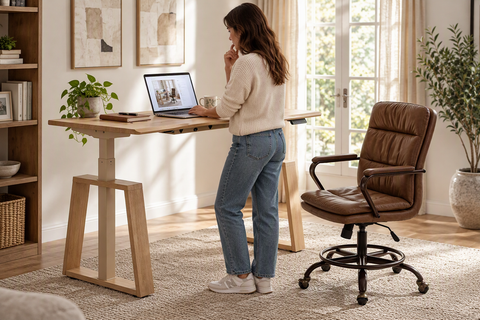
Regardless of desk shape, a significant risk factor for musculoskeletal health is "prolonged static sitting." A systematic review by Cochrane (2018) concluded that sit-stand desks can reduce sitting time by approximately 84–116 minutes per day in a work environment. However, standing is not a substitute for movement.
Cornell University’s Ergonomics Web recommends the "20-8-2" rhythm:
- 20 Minutes Sitting: In a neutral, supported posture.
- 8 Minutes Standing: To engage different muscle groups and improve circulation.
- 2 Minutes Moving: Stretching or walking to reset the metabolic state of the tissues.
To support this rhythm, the use of an Adjustable Ergonomic Footrest is recommended. When sitting, a footrest helps ensure the hips are positioned correctly relative to the knees. When standing, it can be used to alternate weight between feet, reducing the static load on the lower back—a principle supported by EU-OSHA research on lower limb disorders.
Strategic Implementation: How to Set Up Your Multi-Monitor Array
To achieve a balanced ergonomic setup, follow these step-by-step practical recommendations derived from HSE DSE guidelines:
- Determine the Primary Monitor: If you spend the majority of your time on one screen, place it directly in front of you. If you use two monitors equally, place them in a "V" shape with the seam directly in front of your nose.
- Calibrate Eye Level: The top third of the screen should generally be at eye level. This encourages a slight downward gaze (15–20 degrees), which is considered a natural position for the eyes. For more on this, see Solving 'Tech Neck': Monitor Height Strategies for Multi-Screen Devs.
- Manage Viewing Distance: As a rule of thumb, extend your arm; your middle finger should roughly touch the screen (approx. 50–70cm).
- The "Splay" for L-Shapes: If using an L-shaped desk, ensure your secondary monitor is tilted inward toward your face. Avoid placing it parallel to the desk edge if that edge is at a 90-degree angle to your primary seating position.
- Keyboard and Mouse Placement: Keep these on the same level, with the elbows at approximately a 90-degree angle. If the desk is too high, use an Adjustable Ergonomic Footrest to allow you to raise your chair to the correct height without leaving your feet dangling.

Future-Proofing the Workstation
The transition to multi-monitor setups is a consistent shift in professional and gaming environments. While increased screen real estate is associated with significant productivity gains—estimated at up to 42% in industry studies by Jon Peddie Research—those gains can be undermined if the user experiences discomfort or injury.
An effective desk is one that facilitates movement while supporting a neutral posture. For many, the L-shaped standing desk represents a versatile engineering solution, providing the surface area for complex workflows and the mechanical flexibility to support the 20-8-2 rhythm. However, for those in smaller spaces, a straight desk augmented with high-quality monitor arms provides a comparable level of protection.
By aligning your workstation setup with international standards like ISO 9241-5 and industry guidelines from BIFMA, you transform your desk from a piece of furniture into a tool for long-term health and performance.
Disclaimer: This article is for informational purposes only and does not constitute professional medical advice. Individuals with pre-existing musculoskeletal conditions or chronic pain should consult a qualified healthcare professional or ergonomic specialist before making significant changes to their workstation setup.
References
- BIFMA G1-2013 Ergonomics Guideline for Furniture
- ISO 9241-5:2024 Workstation layout & postural requirements
- OSHA eTools: Computer Workstations - Neutral Working Postures
- Cornell University Ergonomics Web — Workstation Guides
- Cochrane: Workplace interventions for reducing sitting at work
- The 2026 Workstation White Paper: Eureka Ergonomic Technical Report
- Jon Peddie Research: Multiple Displays Can Improve Productivity




Leave a comment