

30-Second Fix: The "Gamer Lean" Checklist
If you are currently feeling back or neck strain, use this rapid checklist to reset your posture immediately. These steps are based on general ergonomic principles and can be performed at any workstation.
- Footing: Feet flat on the floor or a solid footrest. Knees at roughly 90–120 degrees.
- The "Small" of the Back: Adjust your chair's lumbar support so it sits in the curve of your lower spine (just above the beltline).
- Eye Level: Raise your monitor so the top third of the screen is at eye level.
- The "Arm's Length": Push your monitor back until it is about one arm's length away.
- Elbow Rule: Adjust armrests so your shoulders remain relaxed and elbows are at a 90–100 degree angle while typing.
The "Gamer Lean" and the Hidden Cost of Immersion
We have all been there: the match is tied, the boss’s health bar is at 5%, and without realizing it, you are inches away from your screen, shoulders up to your ears, and your spine curved like a question mark. This phenomenon, often called the "gamer lean," is a subconscious reaction to intense focus. While it feels like you are getting closer to the action, you are actually subjecting your body to significant physical stress.
Based on our observations in customer support and ergonomic testing, this forward lean is often a mechanical failure of the workstation to support the user during high-cognitive-load sessions. When we lean forward, we abandon the backrest—the primary source of spinal support. This shifts the weight of the upper body onto the lower back and neck muscles. Over time, this "static load"—a term used by the Occupational Safety and Health Administration (OSHA) to describe holding a position for a long period—can lead to fatigue and reduced blood circulation.
To build a sustainable gaming or streaming career, the battlestation should be treated as a high-performance tool. As highlighted in The 2026 Workstation White Paper, the convergence of ergonomic science and engineering is essential for maintaining performance during marathon sessions.
The Physiology of Posture: Why Static Sitting Fails
The human body is not designed for prolonged static positions. When you sit in a fixed forward-leaning posture, your muscles remain in a state of constant contraction. This can reduce blood flow, which may prevent oxygen from reaching tissues and allow metabolic waste products to accumulate.
Musculoskeletal Disorders (MSDs) and Tissue Adaptation
Prolonged static sitting is a documented risk factor for Musculoskeletal Disorders (MSDs). According to the European Agency for Safety and Health at Work (EU-OSHA), static postures can contribute to "tissue adaptation," where ligaments and tendons may change over time, making it more difficult to return to a neutral position.
The "spinal neutral position" is the goal. This is the posture where the spine's natural S-curve is maintained. In a neutral position, the load is distributed more evenly across the vertebrae and discs.
The Visual Pull
One of the most overlooked triggers for the forward lean is "visual pull." If your monitor is too low, too far away, or the resolution is too high for the screen size, your brain subconsciously moves your head closer to the screen. This creates a "forward head posture." Biomechanical models suggest that while a head weighs ~12 pounds in a neutral position, a 60-degree forward tilt can increase the effective load on the cervical spine to an equivalent of 60 pounds.

Engineering the Solution: The Role of the Ergonomic Chair
An effective ergonomic chair acts as an external skeleton. It should move with you, providing support whether you are in a "focus" mode or "relaxed" mode.
The Recline Heuristic: Why 90 Degrees is Obsolete
A common misconception is that sitting at a rigid 90-degree angle is "perfect" posture. However, many ergonomic guidelines suggest that a slight recline—between 100 and 110 degrees—is often superior for long-duration tasks. This angle allows the chair’s backrest to support a portion of your upper body weight.
We recommend adjusting your chair's tilt tension so that you can recline naturally. For streamers who need to stay upright for the camera, a chair like the Flex, Dual-Backrests Ergonomic Office Chair (Manufacturer Example) is designed for this. Its dual backrest design moves independently, providing support to the lower back even as you shift your weight.
Lumbar Support: Finding the "Small of the Back"
A frequent mistake in chair setup is placing the lumbar support too high. It should sit firmly in the "small" of your back—the inward curve just above your beltline. Proper placement helps ensure the pelvis is tilted slightly forward, which naturally maintains the lumbar curve.
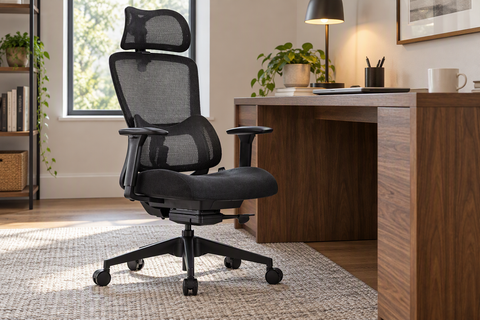
For those starting their ergonomic journey, the Onyx, Ergonomic Office Chair (Manufacturer Example) offers a reliable entry point. Its mesh back provides consistent lumbar tension while facilitating airflow.

Beyond the Chair: Optimizing the Visual Zone
The Canadian Centre for Occupational Health and Safety (CCOHS) emphasizes that screen placement is vital for preventing neck and shoulder strain.
The Eye-Level Rule
The top third of your primary monitor should be at or slightly below eye level. This ensures that your gaze is naturally slightly downward (about 15-20 degrees), which is generally the most comfortable position for the eyes and neck.
Using a tool like the Carbon Fiber Dual Monitor Stand (Manufacturer Example) allows you to elevate your screens to the correct height. This is critical for streamers using multiple monitors; the secondary screen should ideally be at the same height as the primary to avoid repetitive neck rotation.

Viewing Distance and the "Arm's Length" Heuristic
A common rule of thumb for monitor distance is one arm’s length (roughly 20-30 inches). According to THX viewing distance standards, a 40-degree field of view is ideal for immersion. If you sit too close to a large screen, you may find yourself moving your head excessively, which can increase cervical fatigue.
Scenario Analysis: Standard Setup vs. The Tall Professional
To demonstrate how ergonomics must be personalized, let’s look at two distinct scenarios based on our modeling data.
Scenario A: The Standard Case
For a user of average height (approx. 5'6" to 5'10"), a standard 29-inch desk height is typically acceptable, provided the chair can be raised high enough to keep the elbows at a 90-120 degree angle. In this case, the primary challenge is often "foot dangle," which can be corrected with a footrest.
Scenario B: The 95th Percentile Tall Streamer (Modeling Analysis)
Our scenario modeling for a 193cm (6'4") gamer reveals a significant "ergonomic gap." A standard 29-inch desk is often too low for this user when seated, which can encourage a permanent hunch.
Methodology & Calculation Note: The following values are estimates based on standard anthropometric ratios (ANSI/HFES 100-2007).
- Sitting Desk Height Calculation: (Sitting Elbow Height) + (1-2 cm clearance). For a 193cm user, this typically results in a ~79.7 cm requirement.
- Standing Desk Height Calculation: Measured from floor to the underside of the forearm when elbows are at 90 degrees.
Parameter Value (Estimate) Unit Source/Rationale User Height 193 cm 95th percentile male stature Sitting Desk Height (Rec) 79.7 cm Calculated based on elbow height Standing Desk Height (Rec) 118.3 cm Calculated based on elbow-to-floor Example Equipment Load 95 kg Full-tower PC + 49" Ultrawide + Peripherals Room Depth Required 132 in Includes chair clearance + greenscreen
For this "Scenario B" user, a motorized sit-stand desk with a dual-motor system is strongly recommended. This provides the necessary height range and ensures structural stability under heavy equipment loads (often reaching ~79% of a standard 120kg dual-motor capacity).
Behavioral Interventions: The 20-8-2 Rule
Movement is a critical ergonomic solution. Cornell University’s Ergonomics Web recommends the 20-8-2 rhythm:
- 20 minutes of sitting in a neutral posture.
- 8 minutes of standing (using a sit-stand desk).
- 2 minutes of moving or stretching.
Integrating Micro-breaks into Gameplay
You can utilize "micro-breaks" during natural lulls in gameplay. A 2025 study on therapeutic micro-exercises suggests that even 20-30 seconds of stretching can help manage musculoskeletal discomfort.
- Loading Screens: Do a "chest opener" stretch to reverse the forward shoulder roll.
- Death Timers: Perform seated leg extensions to promote blood flow.
- Lulls in Action: Use the Adjustable Ergonomic Footrest (Manufacturer Example) to shift your ankle angle. A tilt of 10-15 degrees is often more effective for circulation than a flat surface.
The "Racing Chair" vs. Ergonomic Office Chair Debate
There is a common misconception that "racing-style" gaming chairs are the pinnacle of comfort. However, some studies have suggested that while users may like the aesthetic, discomfort levels can increase after several hours of use compared to highly adjustable ergonomic office chairs.
The rigid, bucket-seat design of many racing chairs often lacks a sliding seat pan. If the seat is too deep, it can create pressure behind the knees, forcing the user to sit on the edge of the chair—abandoning the backrest and triggering the forward lean. A professional-grade chair like the Flex Dual-Backrest (Manufacturer Example) focuses on intuitive ergonomics to mitigate these risks.

Summary of Practical Recommendations
- Adjust the Chair First: Set the height so your feet are flat and your knees are at ~90–120 degrees. Position the lumbar support in the small of your back.
- Set the Tilt Tension: Allow for a 100-110 degree recline that feels supported.
- Fix the Monitor: Bring the top of the screen to eye level and keep it roughly an arm's length away.
- Manage the Visual Pull: Ensure your font size and resolution do not force you to lean forward to read text.
- Move Constantly: Use micro-breaks during every lull in gameplay to reset your posture.
For more detailed guides, explore our resources on how to adjust your ergonomic chair correctly or breaking bad gaming posture habits.
YMYL Disclaimer: This article is for informational purposes only and does not constitute professional medical advice. Ergonomic needs vary significantly based on individual physical conditions. If you have pre-existing back, neck, or joint issues, please consult a qualified physical therapist or occupational health professional before making significant changes to your workstation setup.
References
- BIFMA G1-2013 Ergonomics Guideline for Furniture
- OSHA eTools: Computer Workstations - Neutral Working Postures
- Cornell University Ergonomics Web — Workstation Guides
- CCOHS: Office Ergonomics - Sit/Stand Desk
- ISO 9241-5:2024 Workstation layout & postural requirements
- WHO 2020 Guidelines on Physical Activity & Sedentary Behaviour
- Cochrane: Workplace interventions for reducing sitting at work (2018)




Leave a comment