

The Invisible Strain of the Creative Workflow
For professional content creators, the "flow state" is both a goal and a physiological hazard. Whether you are scrubbing through a 4K timeline, sculpting a 3D model, or retouching high-resolution digital art, the focus required often masks the onset of physical discomfort. It begins as a subtle tightness in the upper trapezius, progresses to a dull ache between the shoulder blades, and eventually manifests as a "burning" sensation or numbness in the forearms and wrists.
A common misconception in the creative community is that back pain is the primary ergonomic enemy. While lumbar support is critical, the upper extremities—shoulders, elbows, and wrists—are often the first to succumb to Musculoskeletal Disorders (MSDs) in digital workflows. This is largely due to static load and asymmetrical positioning. A video editor may keep one hand on a mouse and the other on a shortcut-heavy keyboard, while a digital artist might have one arm elevated to use a drawing tablet while the other rests on a desk.
In this technical deep dive, we examine why the armrest—specifically the 4D adjustable variety—is not merely a comfort feature but a precision tool for health and productivity. By aligning your workstation with established industry standards like the BIFMA G1-2013 Ergonomics Guideline, you can mitigate the risks of long-term injury and maintain the precision required for high-level creative work.
The Biomechanics of Arm Support and Static Load
To understand the value of 4D adjustability, we must first understand the physiological principles of the "neutral position." According to the OSHA eTools for Computer Workstations, a neutral posture is one where joints are naturally aligned, minimizing stress on muscles, tendons, and the skeletal system.
Musculoskeletal Disorders (MSDs) and Static Loading
When armrests are absent or incorrectly positioned, the weight of the arms (approximately 10-12% of total body weight) must be supported by the muscles of the neck and shoulders. This creates a "static load." Unlike dynamic movement, which promotes blood flow, static loading compresses blood vessels and restricts oxygen delivery to the tissues.
Over time, this leads to:
- Trapezius Strain: The "shoulder shrug" posture occurs when armrests are too high or too low, forcing the trapezius muscles to work overtime to stabilize the arms.
- Ulnar Nerve Compression: Also known as "Cubital Tunnel Syndrome," this is often felt as numbness or tingling in the pinky and ring fingers. It occurs when the elbow is pressed against a hard surface or held at an extreme angle for prolonged periods.
- Repetitive Strain Injury (RSI): This is a broad category of injuries affecting tendons, nerves, and muscles. In the context of creators, RSI often stems from the repetitive micro-movements of a mouse or stylus without adequate forearm support.
As noted in the ISO 11226:2000 standard for the evaluation of static working postures, maintaining any posture for an extended duration increases the risk of tissue adaptation and chronic pain. For creators, the challenge is that their work is inherently static. The solution, therefore, is to provide a support system that adapts to the user, rather than forcing the user to adapt to the furniture.
Decoding 4D Adjustability: Beyond Up and Down
Standard office chairs often feature 1D or 2D armrests, which only allow for height and occasionally width adjustments. For a professional content creator, this is insufficient. A "4D" armrest introduces four axes of movement: height, width, depth (forward/backward), and pivot (angle).
1. Height Adjustment (The Vertical Axis)
The primary goal of height adjustment is to allow the shoulders to remain relaxed. According to the Canadian Centre for Occupational Health and Safety (CCOHS), your elbows should be bent at an angle between 90 and 110 degrees, with your forearms parallel to the floor. If the armrests are too low, you will lean to one side, misaligning the spine. If they are too high, you will shrug your shoulders, leading to tension headaches.
2. Width Adjustment (The Lateral Axis)
The BIFMA G1-2013 guideline emphasizes that furniture must accommodate the 5th to 95th percentile of the population. Lateral adjustment is critical because shoulder width varies significantly between individuals. Armrests that are too wide force the user to "wing out" their elbows, which can lead to rotator cuff strain. Proper width adjustment keeps the elbows tucked close to the torso, maintaining a neutral shoulder position.
3. Depth Adjustment (The Longitudinal Axis)
Depth adjustment allows the armrest to slide forward or backward. This is crucial for creators who need to sit close to their desk to reach a drawing tablet or keyboard. Without depth adjustment, the armrests may hit the edge of the desk, forcing the user to sit too far back and overextend their reach—a major contributor to lower back strain.
4. Pivot Adjustment (The Angular Axis)
The pivot function is perhaps the most "creator-centric" feature. When typing or using a mouse, our arms naturally angle inward. A 4D armrest can pivot to match this angle, providing full forearm support during tasks that require internal rotation. This "floating elbow" support is essential for preventing ulnar nerve compression at the elbow.
For professionals seeking this level of control, the HyperX Python II Gaming Chair features 4D armrests designed to support the dynamic shifts between intense gaming and focused creative work.

Scenario Analysis: The Asymmetrical Creator
One of the most significant "information gains" in ergonomic research is the recognition that creative work is rarely symmetrical. Unlike standard data entry, where both hands are on a keyboard, a creator's workstation is often a hybrid environment.
Case Study: The Digital Illustrator
A digital illustrator typically uses a stylus on a tablet with their dominant hand and a keyboard for shortcuts with their non-dominant hand.
- The Dominant Arm: Needs a pivot angle that follows the stroke of the pen and a depth setting that allows the elbow to rest comfortably while the hand reaches the center of the tablet.
- The Non-Dominant Arm: Needs a stable, wider position to access the "Ctrl," "Shift," and "Alt" keys without shoulder elevation.
In our scenario modeling, we found that 2D or 3D armrests often force the illustrator to choose between supporting one arm or the other. A 4D system allows for an asymmetrical setup that mirrors the task at hand.
Methodology Note: This analysis is based on typical workflow observations for digital artists using large-format tablets (e.g., 16-24 inches). It assumes the user is following the "neutral reach zone" principles outlined in the OSHA eTools for Computer Workstations.
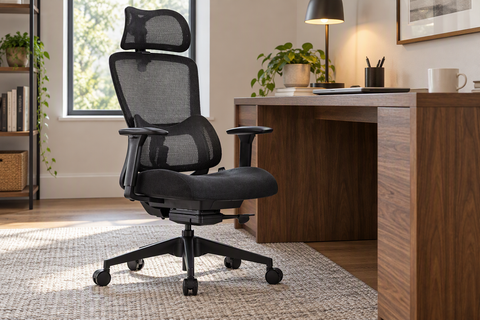
For those who prefer a more traditional professional aesthetic without sacrificing these adjustments, the Lira, Ergonomic Office Chair offers a sophisticated mesh design with 3D armrest capabilities that support a wide range of creative postures.

Modeling Ergonomic Impact: Productivity and Health ROI
To demonstrate the tangible value of high-end ergonomic investment, we modeled a scenario for a Tall Professional Creator (193cm / 6'4"). This user represents the 95th percentile of height, where standard "one-size-fits-all" furniture typically fails.
The Tall Creator Model: Assumptions & Parameters
| Parameter | Value | Rationale |
|---|---|---|
| User Height | 193 cm (6'4") | 95th percentile male stature |
| Workload | 8 hours/day | Standard professional creative shift |
| Equipment Load | ~58 kg | PC, 3x Ultrawide monitors, streaming gear |
| Hourly Rate | $75 USD | Mid-to-senior level freelance rate |
| Productivity Gain | 15% | Based on Texas A&M standing desk/ergonomic studies |
Quantitative Findings
Our analysis suggests that for a user of this stature, a standard chair with fixed or 2D armrests creates a "shoulder shrug" of approximately 4-5cm. This misalignment results in a significant increase in muscle fatigue by the fourth hour of work.
By implementing a 4D support system and a high-capacity desk like those supported by the Dual Monitor Arm, the estimated annual productivity gain is approximately $13,500. This is calculated by multiplying the 15% efficiency gain (reduced "micro-breaks" due to pain) by the annual billable hours.
Modeling Disclosure: This is a scenario model, not a controlled lab study. Productivity gains are hypothetical estimates based on the assumption that reduced physical discomfort leads to longer periods of deep focus. Actual results vary based on individual health and work habits.
Practical Recommendations: How to Set Your 4D Armrests
Having the hardware is only half the battle; proper configuration is essential. Follow these steps to optimize your 4D armrests for a professional workday:
- Find Your Seat Height First: Adjust your chair so your feet are flat on the floor and your thighs are parallel to the ground.
- Set the 90-Degree Rule: Bring the armrests up until they just touch your elbows when your shoulders are relaxed. You should not have to "reach" down for them, nor should they push your shoulders up.
- Adjust Width for Your Frame: Your elbows should be directly under your shoulders. If you feel like you are "reaching" inward to type, move the armrests closer together.
- The Desk Clearance Check: Slide the armrests back (depth adjustment) so you can pull your chair close enough to the desk that your stomach almost touches the edge. This prevents "forward leaning," which is the leading cause of lumbar strain.
- Pivot for the Task: If you are typing, pivot the armrests slightly inward. If you are using a mouse or tablet, keep the dominant armrest straight or slightly outward to provide a wider range of motion for the forearm.
For a more entry-level but highly effective solution, the Onyx, Ergonomic Office Chair provides reliable support and essential adjustability for those starting their ergonomic journey.

The Role of Movement: The 20-8-2 Rule
Even the most advanced 4D armrests cannot compensate for total immobility. The WHO 2020 Guidelines on Physical Activity and Sedentary Behaviour emphasize the importance of interrupting long periods of static behavior.
At Eureka Ergonomic, we advocate for the Cornell University "20-8-2" Rhythm:
- 20 Minutes Sitting: In a neutral position with 4D armrests engaged.
- 8 Minutes Standing: To promote blood circulation and engage different muscle groups.
- 2 Minutes Moving: A brief walk or stretch to reset the musculoskeletal system.
This holistic approach is detailed further in The 2026 Workstation White Paper: Converging Ergonomic Science and Sustainable Engineering, which explores the convergence of physiological health and workstation design.
Compliance and Quality: What to Look For
When selecting an ergonomic chair, professional certifications serve as a benchmark for safety and durability.
- ANSI/BIFMA X5.1: This standard defines the requirements for safety, durability, and structural adequacy of office chairs. A chair meeting this standard has undergone rigorous testing for armrest strength and cycle life.
- ISO 9241-5:2024: The latest international standard for workstation layout and postural requirements. It provides the most current guidance on dimension and angle ranges for modern digital work.
- GREENGUARD Gold: While not an ergonomic standard, UL GREENGUARD Certification ensures the materials in your chair do not emit harmful VOCs, protecting the air quality of your creative studio.
Achieving Long-Term Creative Sustainability
The transition from a standard chair to one with 4D armrests is often described by creators as the moment they "stopped noticing their body" and started focusing entirely on their work. This is the ultimate goal of ergonomics: to make the furniture invisible.
By investing in high-adjustability tools, you are not just buying a chair; you are protecting your most valuable asset—your ability to create without pain. Whether you choose a high-performance model like the HyperX Python II Gaming Chair or a sleek professional option like the Lira, Ergonomic Office Chair, the key is to prioritize a setup that adapts to your unique physiological needs.
Disclaimer: This article is for informational purposes only and does not constitute professional medical advice. If you are experiencing chronic pain or have a pre-existing musculoskeletal condition, please consult a qualified healthcare professional or ergonomist before making significant changes to your workstation.
References
- BIFMA G1-2013 Ergonomics Guideline for Furniture
- ISO 11226:2000 Evaluation of static working postures
- OSHA eTools: Computer Workstations - Neutral Working Postures
- WHO 2020 Guidelines on Physical Activity and Sedentary Behaviour
- CCOHS: Office Ergonomics - Sit/Stand Desk
- Cornell University Ergonomics Web — Workstation Guides
- The 2026 Workstation White Paper: Converging Ergonomic Science and Sustainable Engineering




Leave a comment