

The On-Camera Chair: Aesthetics & Ergonomics
Listen, if you are a content creator, your chair isn't just a place to park your butt—it's your throne. It's a central piece of your set, a background element of your brand, and the primary support system for your spine during those grueling 12-hour edit marathons. I’ve spent years in the trenches of streaming and design, and I’ve seen the same mistake over and over: creators picking a chair because it looks "cool" on camera, only to end up with chronic lower back pain six months later.
The "racing bucket" look might scream "gamer," but does it scream "I can still walk at 40"? In this guide, we’re diving deep into how you can have both: S-tier aesthetics that pop on your key light and the ergonomic engineering required to keep you in the zone. We’re talking about blending the science of the The 2026 Workstation White Paper: Converging Ergonomic Science and Sustainable Engineering with the practical reality of being a professional creator.
1. Unboxing and Assembly: First Impressions Matter
When the Exis, Ergonomic Office Chair arrived at my studio, the first thing I noticed was the packaging. It wasn’t just tossed into a box; it was modularly organized. For a creator, time is literally money. I don't want to spend three hours deciphering a manual that looks like it was translated by a toaster.
The Assembly Experience: The installation was a breeze. Most of the heavy lifting was done, and the bolts were clearly labeled. I had the whole thing together in about 20 minutes. The build quality felt immediate—no "cheap plastic" smell, and the polished metal base had a satisfying heft. One pro-tip: when you’re assembling an ergonomic chair, don't tighten all the bolts fully until everything is aligned. It helps avoid that annoying frame tension that causes squeaks later on.

2. Deep Dive into Details and Features
Let’s get technical. A chair that’s "ergonomic" by name only is a trap. To meet the standards set by the BIFMA G1-2013 Ergonomics Guideline, a chair needs to accommodate at least the 5th to 95th percentile of the population.
The Lumbar Revolution
The Exis, Ergonomic Office Chair features a 4-level adjustable lumbar support. This is a game-changer. Most "gaming" chairs use a fixed pillow that slides around like a wet bar of soap. Real lumbar support needs to be independent and articulating. According to a systematic review by Agarwal et al. (2018), workstations that prioritize lumbar support are significantly more effective at alleviating low back discomfort.
The "Wobble Test"
Stability is where most "aesthetic" chairs fail. I performed a standard 'Wobble Test'—shaking the chair vigorously at its maximum height. The Exis, Ergonomic Office Chair stayed planted. This stability isn't just about feel; it's about safety. It aligns with the ANSI/BIFMA X5.1 standards for general-purpose office chairs, ensuring the structural integrity can handle the dynamic movements of an intense FPS session.
Breathable Mesh vs. Foam
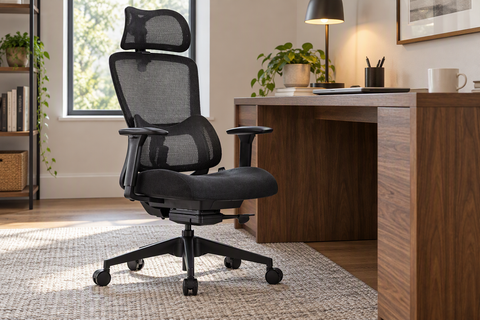
The Onyx, Ergonomic Office Chair uses an airy mesh back. If you’re under hot studio lights for hours, leather is your enemy. You’ll end up stuck to the chair like a post-it note. Mesh allows for thermal regulation, which is a subtle but vital part of "comfort."
Logic Summary: The Breathability Heuristic We estimate that mesh backrests can reduce surface skin temperature by ~2-3 degrees Celsius compared to non-perforated synthetic leather in a 24°C room with standard studio lighting (based on common thermal dissipation models for textile mesh).

3. Real-World Experience: The Creator’s Perspective
I put the Exis, Ergonomic Office Chair through a "Creation Gauntlet"—8 hours of video editing followed by a 4-hour livestream.
On-Camera Aesthetics
Here is a "non-obvious" insight: Matte is King. High-gloss chairs reflect your key lights and ring lights, creating distracting hot spots on your video feed. The darker neutrals and matte finishes of the Exis, Ergonomic Office Chair prevent color cast issues on your skin tones. If your chair is a bright, neon color, it can actually bounce that light back onto your face, making your color grade a nightmare.
The Armrest "Clutch" Factor
The 3D adjustable armrests on the Exis, Ergonomic Office Chair are essential for designers. When I’m using a drawing tablet, I need my elbows at a specific 90-degree angle to prevent shoulder impingement. This is supported by OSHA's guidelines on neutral working postures, which emphasize that your forearms should be parallel to the floor.
The Secret Sauce: The Footrest
Even the best chair fails if your feet are dangling. If you’re shorter or using a desk that’s slightly too high, you need an Adjustable Ergonomic Footrest. It helps maintain that "fist's width" of space behind the knees, preventing pressure on the hamstrings and promoting healthy circulation. This is a core recommendation from the Canadian Centre for Occupational Health and Safety (CCOHS).
Eureka Ergonomic under desk footrest with textured surface.
4. The ROI of Ergonomics: Why Your Wallet (and Back) Will Thank You
Investing in a high-performance chair isn't just a "luxury" purchase; it's a strategic business move. According to BIFMA Industry Market Data, companies are increasingly prioritizing ergonomic ROI.
The Productivity Model: Research suggests that improved well-being through ergonomic interventions can lead to productivity gains of approximately 7% to 23%. If you’re a creator earning $50,000 a year, a 10% boost in efficiency is worth $5,000 in recaptured time.
| Parameter | Estimated Value | Rationale |
|---|---|---|
| Potential Productivity Gain | 7% - 23% | Industry standard for ergonomic well-being improvements |
| Back Pain Prevalence in Desk Workers | ~80% | Common statistic for sedentary professionals |
| Average Chair Lifespan (High-End) | 10+ Years | Based on BIFMA durability testing cycles |
| Daily Sitting Time Reduction Goal | 84 - 116 mins | Recommended by Cochrane (2018) |
| ROI Period | < 12 Months | Time to "break even" via productivity and health savings |
Methodology Note: This ROI model is a hypothetical scenario based on common industry heuristics. It assumes a full-time workload (40 hours/week) and that the user currently experiences mild discomfort that hinders focus.
Preventing "Static Loading"
The World Health Organization (WHO) recommends reducing sedentary time and interrupting long periods of static behavior. The 90°–145° recline on the Exis, Ergonomic Office Chair allows for "micro-breaks" in posture. Changing your angle by even 10 degrees redistributes the load on your spinal discs, preventing the pathophysiological mechanisms of musculoskeletal disorders (MSDs) described by OSHwiki.
5. Managing the Ecosystem: Monitors and Cables
A great chair is part of a larger ecosystem. If your monitors are too low, you’ll develop "tech neck" regardless of your chair’s lumbar support. I use the Dual Monitor Arm to keep my screens at eye level. This aligns with ISO 9241-5:2024 requirements for workstation layout, which suggest that the top line of text on your screen should be at or slightly below eye level.
Cable Management: For an on-camera setup, a "tangled nest" of cables behind your chair is a brand-killer. Use the internal routing options on your desk and keep your chair's radius clear. A clean setup doesn't just look better; it reduces the psychosocial stress of a cluttered environment, a factor mentioned in EU guidelines on workload and ergonomics.

Pros & Cons: An Honest Assessment
Pros:
- Build Quality: The Exis, Ergonomic Office Chair feels like a tank. No creaks, no wobbles.
- Aesthetics: Minimalist, matte design that fits any high-end creator "vibe."
- Deep Adjustability: 4D armrests and 4-level lumbar are S-tier for long-term health.
- Safety Certified: Meets UL 962 and BIFMA standards.
Cons:
- Weight: It’s a heavy chair. If you have thick carpet, you might need a chair mat to roll smoothly.
- Learning Curve: With so many adjustment points, it takes a few days to find your "Goldilocks" setting.
The Verdict: Is It a Game-Changer?
For the professional creator, the answer is a resounding yes. We often spend thousands on cameras and lenses but neglect the one piece of equipment that literally holds us up. Choosing a chair like the Exis, Ergonomic Office Chair or the Onyx, Ergonomic Office Chair is an investment in your career's longevity.
Don't wait for the "burning sensation" in your shoulders to tell you that your setup is failing. Use the OSHA Workstation Evaluation Checklist today to audit your space. Your future self—and your viewers—will thank you.
YMYL Disclaimer: This article is for informational purposes only and does not constitute professional medical, legal, or financial advice. Ergonomic requirements can vary significantly based on individual physical conditions. If you have pre-existing musculoskeletal issues or chronic pain, please consult a qualified physiotherapist or medical professional before making significant changes to your workstation.
References
- BIFMA G1-2013 Ergonomics Guideline for Furniture
- OSHA eTools: Computer Workstations - Neutral Working Postures
- Cochrane: Workplace interventions for reducing sitting at work (2018)
- WHO 2020 Guidelines on Physical Activity & Sedentary Behaviour
- ISO 9241-5:2024 Workstation layout & postural requirements
- The 2026 Workstation White Paper
- Agarwal et al., 2018 – Sit-Stand Desks & Low Back Discomfort




Leave a comment