

For professionals in the 95th percentile of height and weight, the standard office chair often represents a significant point of failure—both ergonomically and structurally. While a standard chair may suffice for the average user, big and tall executives subject their seating to unique stresses that accelerate material fatigue and compromise musculoskeletal health. The choice between premium leather and high-tensile reinforced mesh is not merely an aesthetic preference; it is a critical engineering decision that dictates long-term durability, thermal comfort, and spinal alignment.
Selecting the wrong material under high-load conditions often leads to a "sinking" sensation, where the seat pan loses its ability to distribute pressure, or "bottoming out," where the user's weight exceeds the cushion's compression resistance. Understanding the physiological and physical principles behind these materials is essential for maintaining a neutral spinal position and preventing Repetitive Strain Injury (RSI).
The Physics of Support: Compression vs. Suspension
The fundamental difference between leather and mesh lies in how they manage a user's weight. Leather executive chairs typically rely on a multi-layer foam system for support, whereas mesh chairs utilize a suspension system.
Leather: The Mechanism of "Molding"
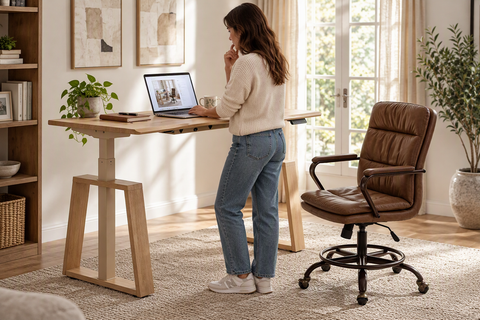
High-quality full-grain or Napa leather, such as that found in the Mathias, Napa Leather Executive Office Chair, offers a unique break-in period. Over approximately 60 to 90 days of regular use, the leather and underlying high-density foam mold to the user's specific anatomy. This creates a personalized support cradle that can significantly reduce localized pressure points.
However, for heavy users, this molding process carries a risk known as "compression set." If the foam density is insufficient, the material may fail to return to its original shape, leading to a permanent "dish" in the seat. According to the ISO 11226:2000 standard for evaluating static working postures, maintaining a posture that minimizes static load is vital. If a leather chair's seat depth is too short for a tall user's thighs, the molding process can actually compromise lower back support by forcing the pelvis into a posterior tilt.
Reinforced Mesh: The Tensile Strength Factor
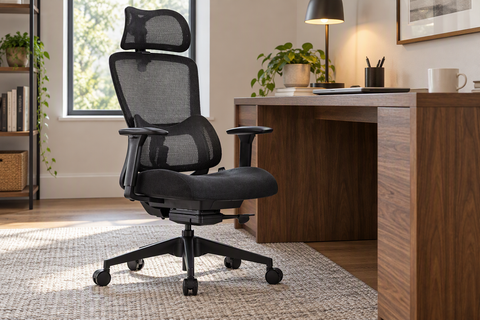
Reinforced mesh uses high-tensile polyester or elastomeric fibers to suspend the user. This material is highly resistant to "tensile creep"—the tendency of a solid material to move slowly or deform permanently under the influence of persistent mechanical stresses. For a user weighing 250 lbs or more, the mesh distributes weight across the entire suspension system rather than compressing a single point of foam.
A critical maintenance point for mesh is the tension. In environments with significant humidity swings, polyester fibers can relax slightly. Professionals recommend an annual tension check to ensure the mesh hasn't lost its structural integrity. If the chair design allows for retensioning, it can prevent a subtle but impactful loss of lumbar support.

Comparative Performance for Heavy-Duty Use
To understand the long-term implications of material choice, we must look at how these surfaces perform under sustained high-pressure use. The following table outlines the estimated performance ranges based on industry standards and typical observations for big and tall users.
| Performance Metric | Premium Leather (e.g., Napa/Microfiber) | High-Tensile Reinforced Mesh |
|---|---|---|
| Primary Support Mechanism | Compression (Foam-based) | Suspension (Tensile-based) |
| Break-in Period | 60–90 Days (Personalized Molding) | Immediate (Static Tension) |
| Thermal Management | Heat Retention (Insulative) | High Airflow (Conductive) |
| Durability (Cyclic Fatigue) | High (Resistance to tearing/cracking) | Moderate to High (Requires tension checks) |
| Maintenance Need | Conditioning (Prevent cracking) | Cleaning (Dust accumulation in mesh) |
| Failure Mode | Peeling, Cracking, or Foam Sagging | Tensile Creep or Perimeter Detachment |
Note: Values and comparisons are estimated based on common industry observations and material science principles.
Thermal Regulation and the Airflow Paradox
A common misconception is that mesh is universally cooler than leather. While mesh generally offers superior breathability, users above 250 lbs may experience the "airflow paradox." Because a heavier user creates more surface contact with the mesh, the increased pressure can actually restrict the very gaps designed for airflow.
In these scenarios, a hybrid design—such as a mesh back for spinal cooling combined with a solid, high-density seat—is often more effective. This allows for the thermal benefits of mesh where the skin is most sensitive to heat (the back) while providing the robust pressure distribution of a solid seat. For those who prefer a full-leather feel but worry about heat, perforated options like the Royal, Microfiber Leather Executive Office Chair use micro-perforations to enhance air circulation, mitigating the insulative properties of the material.
According to the HSE guidelines on working with display screen equipment, environmental comfort, including temperature regulation, is a key component of a safe workstation. Excessive heat can lead to increased fatigue and reduced productivity.
Structural Integrity: Beyond the "300 lb" Label
When selecting a chair for heavy-duty use, many users look for a "300 lb weight capacity" label. However, the ANSI/BIFMA X5.1 standard defines tests that often simulate single, severe impacts. It does not always replicate the cyclic fatigue of a user sitting and rising thousands of times over several years.
For big and tall professionals, the frame material is as important as the upholstery. An aluminum alloy frame, like the one used in the Forma, Ergonomic Executive Office Chair, provides a rigid foundation that prevents the "flex" often found in plastic-framed chairs. This rigidity ensures that the lumbar support remains exactly where it was intended, even when the user reclines or shifts weight.

Ergonomic Setup for Taller Professionals
Taller users (6'2" and above) often face a "suboptimal posture gap." Standard desks are typically 29 inches high, which is often too low for tall individuals, forcing them to hunch forward. This posture increases the load on the front of the chair seat, exactly where leather is most prone to cracking and mesh is most prone to perimeter detachment.
To address this, we recommend the following setup parameters based on the Cornell University Ergonomics "20-8-2" rule:
- Seat Height: Adjust the chair so your feet are flat on the floor and your knees are at a 90-degree angle. For a 6'4" user, this often requires a seat height of approximately 20–22 inches.
- Monitor Alignment: According to the OSHA eTools for Monitors, the top line of text should be at or slightly below eye level. Taller users almost always require a monitor arm or riser to achieve this.
- Sit-Stand Rhythm: Aim for 20 minutes of sitting, 8 minutes of standing, and 2 minutes of moving/stretching. A systematic review by Cochrane (2018) suggests that sit-stand workstations can reduce daily sitting time by up to 116 minutes, which is crucial for reducing static load on heavy-duty materials.
The Economic Case for Premium Materials
Investing in a high-capacity executive chair is not just a health decision; it is a financial one. While the initial cost of a chair like the Alto, Silicone Leather Executive Office Chair may be higher, the total cost of ownership is often lower than replacing multiple low-grade chairs.
Theoretical ROI Calculation: If a standard $200 chair fails every 18 months due to material fatigue, a user will spend $1,000 over 7.5 years. In contrast, a premium executive chair built to BIFMA G1-2013 standards may last 10 years or more. Furthermore, considering a conservative 15% productivity uplift through reduced discomfort and fatigue, the "payback period" for a high-end ergonomic investment is often measured in months, not years.
Scenario-Based Selection Guide
Scenario A: The High-Stature Executive (6'4"+, 250 lbs+)
For users in this category, structural rigidity is paramount. A chair with an integrated aluminum frame and high-density foam or reinforced mesh is recommended. The Forma, Ergonomic Executive Office Chair is an ideal candidate due to its self-adapting headrest and adjustable seat depth, which accommodates longer femurs without compromising the lumbar position.
Scenario B: The Home Office Professional (Focus on Aesthetics and Comfort)
If the chair must blend into a residential environment while providing executive-level support, microfiber or silicone leather offers a softer touch and easier maintenance than traditional animal hides. The Alto, Silicone Leather Executive Office Chair provides a minimalist aesthetic while maintaining the structural integrity required for long workdays.

Maintaining Your Investment
Regardless of the material chosen, longevity is dictated by care.
- For Leather: Apply a high-quality leather conditioner every 6 months to maintain elasticity and prevent the cracks that often form under high-pressure loads.
- For Mesh: Use a vacuum with a brush attachment monthly to remove dust and skin cells that can act as abrasives between the fibers, leading to premature tensile failure.
- For Both: Periodically check all bolts and the gas lift cylinder. Heavy users exert significant lateral force when sitting or standing, which can loosen hardware over time.
By choosing a material that aligns with your specific physiological needs and maintaining it through regular checks, you ensure that your executive chair remains a tool for productivity rather than a source of physical strain.
YMYL Disclaimer: This article is for informational purposes only and does not constitute professional medical advice. Individuals with pre-existing musculoskeletal conditions or chronic back pain should consult a qualified healthcare professional or physiotherapist before making significant changes to their workstation setup or selecting new ergonomic furniture.




Leave a comment