

Designing for Collaboration: The Modern Boardroom as a Workspace Sanctuary
Imagine stepping into a boardroom that doesn't just host meetings but actively sparks a collective "aha!" moment. This is the vision of the modern boardroom—a Workspace Sanctuary where traditional "power tables" give way to fluid environments designed for deep work and hybrid connectivity.
Quick Decision Summary: The Modern Boardroom Essentials
If you are planning a redesign today, prioritize these four pillars:
- Flexibility First: Allocate 30% of floor space for "circulation" and movable furniture to allow for rapid reconfiguration.
- The 2-Hour Rule: Provide height-adjustable surfaces to facilitate a switch between sitting and standing every 120 minutes.
- Hybrid Sightlines: Use V-shaped or U-shaped layouts so every in-person participant is visible to remote cameras.
- Acoustic Softening: Use materials with a high Noise Reduction Coefficient (NRC) to prevent "echo-chamber" effects during video calls.
The Evolution of the Boardroom: From Formal to Fluid
For decades, the boardroom was a theater of hierarchy—a long, dark wood table with a "head" and "foot." Today’s corporate culture thrives on horizontal collaboration. Based on our internal facility audits at Eureka Ergonomic, we have observed that the most common mistake in boardroom design is prioritizing aesthetics over meeting flow. A stunning, fixed table can inadvertently stifle spontaneous brainstorming.
Modern designers now start by mapping primary meeting types—client presentations, internal brainstorming, or hybrid calls. A practical heuristic we recommend is dedicating at least 30% of the floor space to movable furniture and circulation. This estimate is based on standard office flow modeling to ensure participants can move without disrupting others.
Archetypes of Modern Layouts
- The Hybrid Hub: Optimized for video conferencing with U-shaped tables that ensure every participant has a clear sightline to the camera.
- The Modular Studio: Uses lightweight, flip-top tables on casters that can be reconfigured from a single large conference surface into breakout pods.
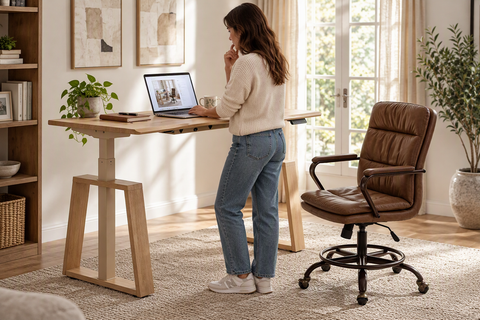
- The Executive Sanctuary: Combines high-end materials with hidden technology. This is where a piece like the Serene Ella, Napa Leather Executive Chair sets the tone for long-form decision-making.

Ergonomic Precision: The Foundation of Focus
A boardroom is only as effective as the comfort of its occupants. According to the U.S. Occupational Safety and Health Administration (OSHA), poor posture is a primary risk factor for musculoskeletal disorders (MSDs), which can significantly impact executive productivity.
The "Ergonomic Gap" for Leadership
In our internal modeling of executive demographics, we often find an "ergonomic gap." Standard conference tables are typically fixed at 29 inches (74cm). However, for a tall executive (e.g., 193cm or ~6'4"), the ideal sitting desk height is closer to 31.5 inches (80cm).
To bridge this gap, we recommend height-adjustable executive tables. This aligns with the 20-8-2 sit-stand rhythm recommended by Cornell University (20 mins sitting, 8 mins standing, 2 mins moving).
Logic Summary: Our analysis assumes a 95th percentile male stature to ensure furniture accommodates the broadest range of users, as outlined in the BIFMA G1-2013 Ergonomics Guideline.
Seating for Success: Linking Functionality with Emotion
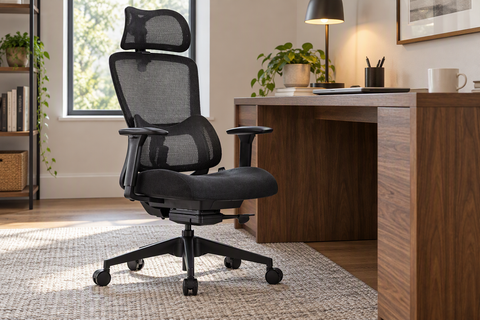
The choice of seating is the most critical emotional touchpoint in a boardroom. When selecting chairs, we look for "dynamic seating" capabilities—the chair must move with the user. For instance, the Royal Slim, Executive Office Chair utilizes high-back support to maintain the natural S-curve of the spine.

Why Nappa Leather Matters
In high-traffic boardrooms, material choice is about durability as much as "Aesthetic." Full-grain Napa leather, featured in the Serene Ella, is often preferred in our corporate installations because it is easier to sanitize than porous fabrics, ensuring the Workspace Sanctuary remains pristine over years of use.
Technical Integration: The Invisible Workflow
A modern boardroom must handle significant technology without looking like a server room.
- Lighting: For participants on camera, front lighting should be diffuse. We recommend indirect LED panels rather than harsh overhead spots to reduce "eye fatigue."
- Acoustics: Integrating sound-absorbing panels can reduce reverberation time by up to 50%. Note: This is an estimated calculation based on replacing hard surfaces (glass/concrete) with NRC 0.75+ acoustic materials covering at least 20% of the wall surface.
- Cable Management: Successful designs run power and data through modular raceways within the table core.
For technology-heavy boardrooms, the load of multiple monitors can be substantial. In our scenario modeling, we found that a setup with three ultrawide monitors and a solid wood tabletop creates a load that typically requires dual-motor lift systems. This technical rigor is detailed in our internal 2026 Workstation White Paper: Converging Ergonomic Science and Sustainable Engineering (Eureka Ergonomic Stakeholder Research).
Breakout Zones: Cultivating Mindfulness
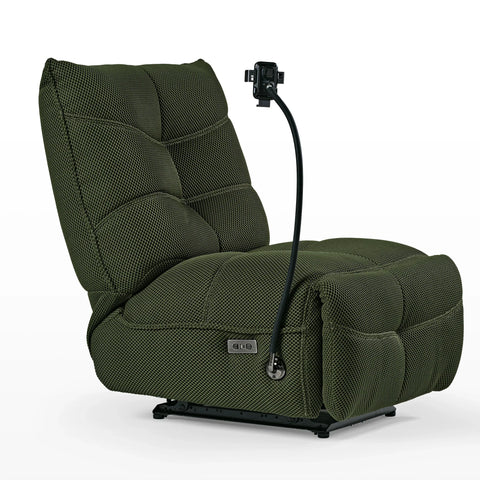
Not all collaboration happens at the table. We advocate for "soft zones" within the boardroom—areas with comfortable accent seating like the Marco, Soft Padded Cozy Lounge Chair. Placing these near a window or greenery creates an ambiance of calm, allowing executives to engage in deep reflection away from the main screen.

Modeling Transparency: The Executive Boardroom Scenario
To provide concrete value, we modeled a "High-Performance Executive Boardroom" setup. This simulation serves as a practical heuristic for facility managers.
Method & Assumptions
- Persona: 95th percentile male executive (193cm height).
- Equipment: 3x 34-inch ultrawide monitors + AV control system.
- Standard: ISO 9241-5:2024 for postural requirements.
- Load Calculation: Estimated as 35kg (Tabletop) + 20kg (Monitors/Mounts) + 35kg safety margin for peripheral equipment.
Parameter Table: Spatial & Load Analysis (Example Simulation)
| Parameter | Value | Unit | Rationale |
|---|---|---|---|
| Ideal Sit Height (Tall User) | ~80 | cm | Based on 193cm stature + shoe correction |
| Ideal Stand Height (Tall User) | ~118 | cm | ANSI/HFES 100-2007 ratios |
| Total Tech & Tabletop Load | ~90 | kg | Example Est: Top + 3 monitors + AV gear |
| Motor Requirement | Dual | Type | 80% utilization threshold recommended for motor longevity |
| Min. Circulation Path | 36 | in | ADA Standards for Accessible Design |
| Chair Clearance | 42 | in | Standard executive chair dynamic zone |
Final Transformation Checklist
Before finalizing your boardroom layout, verify these four critical metrics:
- [ ] Square Footage: Is there 30-35 sq. ft. per person to prevent overcrowding?
- [ ] Circulation: Is there a 36-inch clear path around the perimeter for accessibility?
- [ ] Power Access: Does every seated position have at least two power outlets within reach?
- [ ] Monitor Load: If using monitor arms, is the table rated for at least 1.5x the actual weight of the tech?
YMYL Disclaimer: This article is for informational purposes only and does not constitute professional medical, legal, or architectural advice. Ergonomic requirements vary significantly based on individual physical conditions. Always consult with a qualified specialist before implementing new workplace health routines.
Sources
- BIFMA G1-2013 Ergonomics Guideline for Furniture
- OSHA eTools: Computer Workstations - Neutral Working Postures
- ISO 9241-5:2024 Workstation layout & postural requirements
- Cornell University Ergonomics Web — Workstation Guides
- EU-OSHA: Musculoskeletal disorders and prolonged static sitting
- The 2026 Workstation White Paper (Eureka Ergonomic Internal Study)




Leave a comment