

Why does your lower back ache by 2:00 PM, even though you are sitting in a chair labeled "ergonomic"? For users under 5'4", the answer often lies in a fundamental design mismatch. Most office furniture is engineered to accommodate the 50th to 95th percentile of the population, leaving petite individuals in a "no-man's land" of ergonomics. When a chair is too deep, a desk is too high, or a lumbar support sits at the shoulder blades, the body compensates through poor posture, leading to a cascade of musculoskeletal issues.
The struggle for petite users is not merely about comfort; it is a matter of long-term physiological health. In this technical guide, we examine the biomechanical requirements of smaller statures and explain how fully adjustable ergonomic solutions serve as the essential bridge between standard manufacturing and personalized well-being.
The Physiology of the "Petite Gap"
To understand why a standard chair fails a petite user, one must look at the mechanics of the human frame. According to the BIFMA G1-2013 Ergonomics Guideline for Furniture, furniture dimensions should ideally cover the 5th to 95th percentile of the population. However, in practice, many "adjustable" chairs have a minimum seat height of 18 inches. For a user with a shorter popliteal height (the distance from the underside of the foot to the back of the knee), this height prevents the feet from resting flat on the floor.
When feet dangle, the weight of the legs pulls on the front edge of the seat pan. This creates high pressure in the popliteal crease, which can compress the femoral artery and restrict blood circulation. Over time, this contributes to "static load"—a condition where muscles remain in a state of constant tension to stabilize the body. As noted in the ISO 11226:2000 standard for the evaluation of static working postures, prolonged static positions are a primary risk factor for the development of Musculoskeletal Disorders (MSDs).
Furthermore, a seat pan that is too deep prevents the user from reaching the backrest. If you cannot sit all the way back, you lose the benefit of lumbar support. This forces the spine into a kyphotic (slouched) curve, putting excessive pressure on the intervertebral discs and the ligaments of the lower back. For petite users, the "ergonomic gap" is often a three-to-four-inch discrepancy that leads to chronic neck, shoulder, and lumbar pain.
The Science of Personalized Adjustability
A truly ergonomic setup for a petite professional requires a "bottom-up" approach. The goal is to achieve a neutral spinal position, where the natural curves of the neck, upper back, and lower back are maintained with minimal muscular effort.
1. Seat Height and the Floor Connection
The first point of contact is the floor. If the chair cannot lower enough to allow the feet to be flat while the thighs are parallel to the ground, the entire kinetic chain is disrupted. In scenarios where a desk is at a fixed height that is too tall, the user is often forced to raise the chair to reach the keyboard. This is where a high-quality footrest becomes non-negotiable.
The Footstool with Wheels provides a stable platform that effectively "raises the floor," allowing the user to maintain a 90-degree angle at the knees and hips even when the chair is elevated. This prevents the pelvis from rolling backward, a common error that negates the effectiveness of any lumbar support.

2. Seat Depth and the "Two-Finger" Rule
Seat depth is perhaps the most overlooked metric for petite users. According to the GSA Ergonomic Seating Adjustment Guide, there should be approximately two inches of clearance between the front edge of the seat and the back of the user's knees.
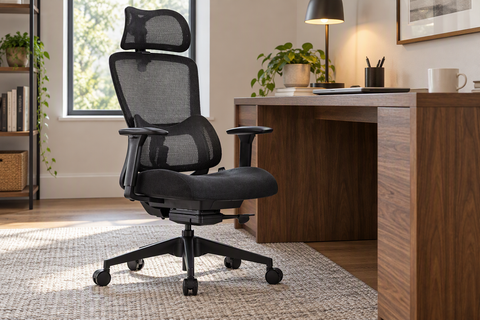
For many, a fixed seat pan is simply too long, making it impossible to utilize the chair's backrest without the seat edge digging into the calves. The Lira, Ergonomic Office Chair addresses this with an integrated seat slider mechanism. By allowing the user to pull the seat pan forward or push it back, it creates a custom depth that supports the thighs without restricting circulation.
3. Dynamic Lumbar Support
For a petite individual, the inward curve of the lower back (the lumbar lordosis) is situated lower than on a taller person. If the lumbar support is fixed too high, it pushes against the thoracic spine (the rib cage area), causing the user to lean forward and lose all support.
As discussed in The 2026 Workstation White Paper: Converging Ergonomic Science and Sustainable Engineering, modern ergonomic design is moving toward dynamic, self-adjusting systems. A chair with a vertically adjustable or flexible lumbar frame ensures the support hits the specific vertebrae of the lower back, regardless of the user’s torso length.
Technical Deep Dive: The 150cm Persona Experiment
To quantify the challenges faced by petite users, we analyzed the requirements of a 150cm (approx. 4'11") professional—representing the 5th percentile of female stature. We compared their ideal dimensions against standard industry furniture.
| Ergonomic Metric | Petite User (150cm) | Standard Fixed Furniture | The Ergonomic Gap |
|---|---|---|---|
| Ideal Seated Desk Height | 62.5 cm (24.6") | 73.7 cm (29") | 11.2 cm (4.4") too high |
| Ideal Seat Height | 38.0 cm (15.0") | 45.7 cm (18") | 7.7 cm (3.0") too high |
| Ideal Seat Depth | 35.5 cm (14.0") | 43.2 cm (17") | 7.7 cm (3.0") too deep |
| Elbow-to-Floor Height | 58.4 cm (23.0") | N/A | Requires low-range arms |
Values estimated based on ANSI/HFES 100-2007 anthropometric ratios.
This data highlights a critical "Triple Constraint" for petite users:
- Vertical Mismatch: Standard desks are nearly 4.5 inches too high, forcing the user to shrug their shoulders (trapezius strain) or raise the chair (thigh compression).
- Horizontal Depth: Standard seats are 3 inches too deep, preventing backrest contact.
- Spatial Footprint: In compact home offices, the need for footrests and monitor arms adds complexity to the workspace layout.
Beyond the Chair: The Workspace Ecosystem
While the chair is the foundation, a game-changing setup for petite users requires addressing the desk and monitor height as well.
The Role of Monitor Arms
When a petite user adjusts their chair or adds a footrest, their eye level changes relative to the desk. Relying on a stack of books to raise a monitor is an unstable and non-ergonomic solution. The Dual Monitor Arm allows for precise vertical and tilt adjustments. According to the OSHA eTools for Computer Workstations, the top line of text on a monitor should be at or slightly below eye level to minimize neck extension. A gas-spring arm allows the user to pull the screens closer or push them back, accommodating the shorter reach of a petite frame.

The Importance of Armrest Adjustability
Petite users often have narrower shoulders. Standard fixed armrests are often set too wide, forcing the user to "wing" their elbows outward to reach them. This causes abduction of the shoulder joint and can lead to rotator cuff strain.
Look for "4D" armrests that offer height, depth, width, and pivot adjustments. Pivoting the armrests inward allows the forearms to be supported while keeping the elbows tucked close to the torso in a neutral position. This is essential for preventing Repetitive Strain Injuries (RSI) in the wrists and forearms.
Practical Recommendations: A 5-Step Setup Guide
For petite users, follow this specific sequence to ensure a custom fit:
- Adjust the Seat Height First: Sit in your chair and lower the seat until your feet are flat on the floor. If your desk is too high at this level, use the Adjustable Ergonomic Footrest to bring the floor up to your feet.
- Set the Seat Depth: Use the seat slider to ensure there is a 1-2 inch gap between the front of the seat and the back of your knees. You should feel the backrest firmly supporting your spine.
- Position the Lumbar Support: Move the lumbar pad (if adjustable) until it fits into the smallest part of your back. It should feel like a gentle "nudge" forward, not a hard pressure point.
- Align the Armrests: Adjust the height so your shoulders are relaxed and your elbows are at a 90-degree angle. Pivot the pads inward so your forearms are fully supported while typing.
- Calibrate the Monitors: Use your monitor arm to bring the screens to eye level. Ensure the distance is approximately an arm's length away to prevent eye strain.

Addressing Common Pitfalls
A common mistake is assuming that a "small" chair is the same as an "ergonomic" chair. Many small chairs lack the robust adjustment mechanisms found in professional-grade furniture. For example, a chair might have a small seat but no seat slider, or it might be low but have a weak gas lift.
Another "gotcha" is the tension of the tilt mechanism. Petite users often weigh less than the average user, meaning a standard tilt tension might be too stiff, making it difficult to recline. Always choose a chair with adjustable tilt tension or a weight-sensitive mechanism that adapts to the user's body mass.
Summary of Benefits
Investing in a fully adjustable system provides more than just comfort; it offers a measurable impact on productivity and health. By eliminating the "ergonomic gap," petite users can reduce the risk of chronic MSDs, improve blood circulation, and maintain higher energy levels throughout the workday.
As the modern workforce continues to embrace remote and hybrid models, the need for furniture that adapts to the individual—rather than forcing the individual to adapt to the furniture—has never been greater. For the petite professional, adjustability is not a luxury; it is the foundation of a sustainable career.
YMYL Disclaimer: This article is for informational purposes only and does not constitute professional medical advice. Individuals with pre-existing musculoskeletal conditions or chronic pain should consult a qualified physiotherapist or occupational therapist before making significant changes to their workstation setup.
References
- BIFMA G1-2013 Ergonomics Guideline for Furniture
- CCOHS: Office Ergonomics - Sit/Stand Desk
- ISO 11226:2000 Evaluation of static working postures
- OSHA eTools: Computer Workstations - Monitors
- GSA Ergonomic Seating Adjustment Guide
- The 2026 Workstation White Paper: Converging Ergonomic Science and Sustainable Engineering




Leave a comment