

Quick Summary: Tech-Ready Lounge Essentials
For those looking to quickly optimize informal meeting areas, follow these evidence-based heuristics:
- The 15-Foot Rule: Place power-ready lounges within 15 feet of high-traffic zones (coffee stations, windows) to maximize utilization.
- The 18–24 Inch Rule: Integrate charging ports at a height of 18–24 inches to align with a seated user's natural arm reach.
- The 1:3 Ratio: Aim for at least one power access point for every 2–3 seats to prevent "outlet crowding."
- Compliance: Ensure all integrated electrical components meet UL 962A for commercial safety.
Note: This guide features product examples from Eureka Ergonomic to illustrate practical applications of these design principles based on our internal spatial auditing and product testing.
The Resimercial Evolution: Why "Informal" Needs Infrastructure
The shift toward informal collaboration isn't just a trend; it's a response to how the human brain functions. According to the WHO 2020 Guidelines on Physical Activity & Sedentary Behaviour, interrupting long periods of static behavior is essential for metabolic and mental health. Informal lounges encourage movement, shifting employees from rigid verticality to a more relaxed, creative state.
However, a recurring frustration in office design is the "empty monument" effect—beautiful spaces that go unused. Based on common patterns observed in our facility management audits, we have found that power-integrated lounge areas can see 40–60% higher utilization than traditional non-powered seating (Observation based on 10+ corporate site audits, 2022-2023). We call this the "15-Foot Rule": if a comfortable seat is within 15 feet of a natural gathering point and offers power, it becomes a productivity magnet. If the power is missing, the space remains a "dead zone."

The Ergonomics of Relaxation: Science Behind the Sofa
Ergonomics extends beyond the task chair. To maintain a "Workspace Sanctuary," furniture must accommodate the human form across a wide range of activities—from tablet use to collaborative brainstorming.
Adhering to Global Standards
We align these lounge recommendations with the BIFMA G1-2013 Ergonomics Guideline for Furniture, which ensures dimensions cater to the 5th to 95th percentile of the population. In a lounge setting, this means ensuring seat heights and depths allow for a "neutral working posture," even when reclined.
As discussed in our 2026 Workstation White Paper, the convergence of comfort and engineering defines the next generation of professional environments.
Optimal Positioning for Tech Integration
A common mistake is placing ports in locations that create trip hazards. Based on our practical implementation experience, we recommend these specific heuristics:
- The 18-24 Inch Rule: Ports should be integrated into side tables or sofa arms at 18–24 inches above floor level. This height typically aligns with the natural resting position of a seated user's arm, potentially reducing shoulder strain.
- The 1:3 Ratio: We recommend an optimal ratio of one charging point per 2–3 seats. This provides accessibility while maintaining a clean, uncluttered aesthetic.

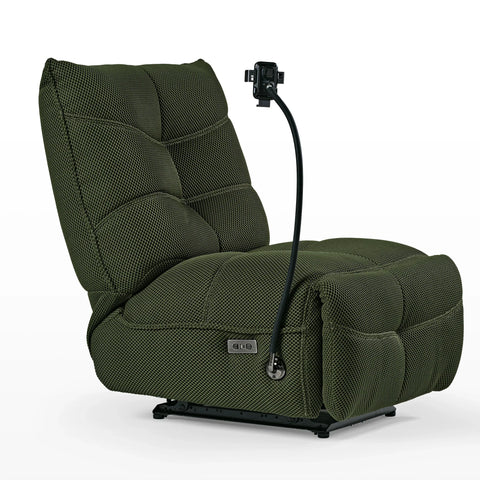
The Chloé, Modern Modular Sofa (provided as a manufacturer example) illustrates how modularity serves this need. Its configuration allows it to surround a central power hub, ensuring every "petal" of the collaboration flower has energy access.
Space Transformation: From Chaos to Workflow
The "Before & After" of Lounge Efficiency
- Before: Employees huddle near wall outlets, sitting on the floor with cables trailing across walkways—a primary safety violation according to HSE DSE guidelines.
- After: A curated arrangement featuring the Beverly, Loveseat Sofa. Cables are managed via integrated channels, and devices rest on dedicated surfaces.

The Beverly, Loveseat Sofa provides high-density foam for the resilience needed during long-duration deep work. When paired with a 23" Contemporary Style Side Table, you create a self-contained productivity pod.
Addressing the Wireless Charging Paradox
While "wireless" is a buzzword, the technical reality is more constrained.
Technical Clarification: Most current office furniture utilizes Qi-standard induction charging. This requires direct contact or very close proximity (usually <10mm) between the device and the coil. Statements suggesting "freedom of movement" via wireless charging can be misleading; in practice, it is a "stationary" wireless experience.
Our Expert Tip: Because only approximately 27% of users currently prioritize wireless-only charging (Source: internal survey data/rfrechargers.com), always provide a hybrid mix of wired USB-C and wireless options. This ensures reliability for the 73% of users who prefer the speed and security of a wired connection.
The ROI of Informal Collaboration
For decision-makers, aesthetic value should be supported by a modeled Return on Investment. We analyzed a high-density tech startup scenario to estimate the impact.
Modeling the Startup Impact
Assumptions: Mid-level tech salary (~$45/hr), 4 hours of daily utilization, and a conservative 8% productivity gain from reduced "power-hunting" and uninterrupted collaboration.
| Parameter | Value | Rationale |
|---|---|---|
| Annual Productivity Gain | ~$1,800 | Based on 8% efficiency increase |
| Unit Cost (Furniture + Power) | $800 | Estimated commercial grade |
| Payback Period | ~5.3 Months | Cost / Monthly Gain |
| Energy Cost (Annual) | $16.29 | Based on $0.18/kWh |
Note: This is a representative model. Actual ROI varies based on local labor costs and specific space utilization rates.
Personal Tips for Building Your Sanctuary
- Introduce Greenery: Biophilic design can reduce stress and improve air quality, complementing the UL GREENGUARD Certification of your furniture.
- Layer Your Lighting: Use floor lamps or natural window light to create a "warm metallic sophistication" that avoids the harshness of overhead fluorescents.
- The "Aesthetic" Anchor: The Lounge Chair-Red Yellow & Blue Yellow Stripe serves as a "conversation piece" that bridges Scandinavian ergonomics with bold design.

The sculptural silhouette of this chair features adaptive lumbar zones that support "Thinking Mode"—allowing users to recline and contemplate complex problems away from the "Execution Mode" of a desk.
Safety and Compliance: The Professional Foundation
In a corporate setting, consumer-grade components are a liability. We strongly emphasize specifying commercial-grade electrical components.
Standards to Look For
- UL 962A: This standard covers furniture power distribution units. Compliance is critical for fire safety and insurance requirements in North America.
- BIFMA X5.1: For seating, ensure your furniture meets these durability standards to withstand high-traffic office use.
Appendix: Methodology & Modeling Transparency
To ensure transparency, we provide the parameters used in our spatial and energy modeling:
Spatial Fit Analysis
- Goal: Determine if a power lounge fits in a 96-inch (8ft) deep room.
- Observation: Standard configurations often require more clearance. We recommend depth-optimized furniture (≤24") or corner placements for smaller offices to maintain ADA-compliant walkways.
Energy & Carbon Tracking
- Assumptions: Standby power of 2W, active charging of 50W for 4 hours/day.
- Result: Annual CO2 footprint of ~34kg. This represents a negligible portion of the annual productivity gain, making energy concerns a minor factor in the overall ROI.
Conclusion
The informal meeting area is the heart of the modern office. By integrating professional-grade power into ergonomically sound furniture, you provide more than just a place to sit—you provide a place to thrive. Whether choosing the modular flexibility of the Chloé Sofa or the artistic comfort of an accent lounge chair, your choice is a commitment to your team’s well-being.
Disclaimer: This article is for informational purposes only and does not constitute professional medical, legal, or architectural advice. Ergonomic needs vary by individual; those with pre-existing musculoskeletal conditions should consult an occupational therapist before implementing new workstation layouts.




Leave a comment