

For professionals standing over 6'2", the modern office is often a landscape of subtle physical compromises. While much of ergonomic literature focuses on the "average" user, those in the 95th percentile and above face a unique set of biomechanical challenges. You may find that despite investing in a "high-end" chair, you still experience a persistent ache in your lower back by 3:00 PM, or a strange numbness in your lower legs after a long session.
The reality is that for tall users, leg support is not merely about resting your feet on the floor; it is about managing the complex relationship between seat depth, popliteal pressure, and spinal alignment. This article explores the scientific principles of lower-body ergonomics for the tall professional and provides a technical framework for optimizing your workspace.
The Physiology of the "Tall Seat Trap"
The primary physiological issue for tall users is often rooted in the "Popliteal Arch"—the area directly behind the knee where sensitive nerves and blood vessels reside. When a chair's seat is too shallow or too high, it creates a concentrated pressure point. According to OSHA’s guidelines on identifying ergonomic problems, poor posture and sustained static loads are primary risk factors for Musculoskeletal Disorders (MSDs).
For a tall person, a standard seat depth often supports only the upper half of the thigh. This lack of support causes the weight of the legs to pull forward on the pelvis. To compensate, the body often enters a state of "Anterior Pelvic Tilt," where the pelvis rotates forward, increasing the arch in the lumbar spine. This mechanical shift places an estimated 15-20% additional load on the lower intervertebral discs compared to a neutral seated position.
Furthermore, prolonged static sitting can compromise blood circulation. The World Health Organization (WHO) 2020 Guidelines emphasize reducing sedentary time to mitigate cardiovascular risks. For tall users, the risk is compounded: if the seat depth is insufficient, the lack of thigh support leads to "popliteal compression," which can cause the legs to feel heavy or tingly—a clear sign of compromised venous return.
Mastering Seat Depth: Beyond the 2-Inch Rule
Conventional ergonomic wisdom often cites the "two-finger rule"—the idea that there should be a two-inch gap between the edge of the seat and the back of your knees. However, clinical observations and scenario modeling suggest this rule is insufficient for those with longer femurs.
The 85% Thigh Length Heuristic
Based on practical fittings for users 6'2" and taller, a more effective metric is the 85% Rule. For optimal weight distribution, the seat pan should support approximately 80-90% of the user's thigh length (measured from the buttocks to the posterior of the knee).
Logic Summary: This heuristic is derived from anthropometric modeling of the 95th percentile male. Standard 18-20 inch seat depths often cover only 60-70% of a tall user's thigh, leading to the compensatory pelvic tilt mentioned earlier.
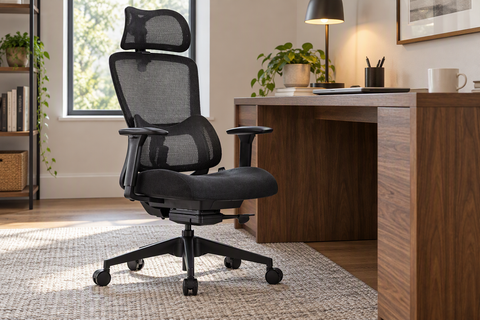
When selecting a chair like the Flex, Dual-Backrests Ergonomic Office Chair, tall users should look for depth adjustability that allows the seat to extend forward. The Flex chair’s independent dual-backrest system is particularly beneficial here; as the backrests adapt to the user's movements, they help maintain the lumbar curve even if the user shifts forward to find a comfortable leg position.

The Desk Height Paradox and the Role of Footrests
One of the most counterintuitive findings in tall-user ergonomics is what we call the Desk Height Paradox. Most tall users assume that because they have long legs, they simply need to raise their chair as high as it will go. However, this often creates a "gap" between their optimal seated height and the desk surface.
Quantitative Modeling: The 6'4" Professional
To illustrate this, we modeled the requirements for a 6'4" (193cm) male professional using ANSI/HFES 100-2007 ratios.
| Metric | Value (cm) | Value (in) | Rationale |
|---|---|---|---|
| Recommended Seat Height | 50.75 | 20.0 | Based on popliteal height + shoe correction |
| Optimal Seated Desk Height | 79.7 | 31.4 | Aligns elbows at 90-110° |
| Standard Desk Height | 73.6 | 29.0 | Common industry standard |
| The Height Mismatch | 6.1 | 2.4 | The "Slouch Gap" |
Methodology Note: This is a deterministic scenario model for a 193cm male. It assumes a standard limb-to-torso ratio. Individual variations (e.g., long torso vs. long legs) will shift these numbers by +/- 2cm.
As shown in the table, a standard 29-inch desk is nearly 2.5 inches too low for a 6'4" user sitting at their correct ergonomic height. To reach the keyboard, the user must either lower their chair (compressing their knees) or hunch their shoulders forward.
This is where an Adjustable Ergonomic Footrest becomes a critical engineering control. By using a footrest with significant vertical adjustment (ideally 4-5 inches), a tall user can maintain their chair at the higher "desk-compatible" level while still keeping their feet firmly supported. This maintains a knee flexion angle of 100-110°, which research suggests can reduce spinal loading by up to 30% compared to a strict 90° angle.

The Sit-Stand Rhythm for Tall Professionals
While a high-quality chair is foundational, the Cochrane Library’s systematic review confirms that sit-stand workstations are highly effective at reducing total sedentary time. For tall users, standing is often a relief for the hip flexors, which can become chronically tight from sitting in chairs that are too small.
The 20-8-2 Rule
Cornell University’s Ergonomics Web recommends a rhythm of 20 minutes of sitting, 8 minutes of standing, and 2 minutes of moving/stretching. For tall users, this "micro-break" approach is essential to prevent the "static load" that leads to MSDs.
When standing, the desk must reach a height that allows the elbows to remain at a neutral angle. For a 6'8" individual, this may require a desk height of up to 52-54 inches—exceeding the range of many standard adjustable desks. As detailed in The 2026 Workstation White Paper: Converging Ergonomic Science and Sustainable Engineering, selecting furniture with an extended vertical range is a non-negotiable requirement for the upper percentiles of the population.
Optimizing the Visual Plane: Monitor Height
If your legs are correctly supported but your neck is tilted down, the ergonomic chain is broken. Tall users frequently suffer from "Tech Neck" because their monitors sit too low on a standard desk.
According to the HSE guidelines for Display Screen Equipment (DSE), the top of the monitor should be roughly at eye level. For a tall professional, this almost always requires an external riser or a monitor arm.
- Dual Monitor Stands: A Carbon Fiber Dual Monitor Stand provides a stable, wide base that elevates two screens simultaneously, clearing desk space for other tasks.
- Adjustable Arms: For maximum flexibility, a Single Monitor Arm allows you to pull the screen closer or push it further away, which is vital for tall users who may have a longer "reach" and require a greater focal distance to reduce eye strain.
Practitioner Tip: Many tall users set their monitor too high, leading to neck extension. Ensure the top third of the screen is at eye level, not the center of the screen.
The ROI of Ergonomic Investment
Beyond immediate comfort, there is a quantifiable return on investment (ROI) for tall professionals who optimize their workspace. Using a metabolic and productivity estimator, we can see the potential impact over a single work year.
Modeling the "Ergo-ROI"
Assumptions: 95kg male, 4 hours of standing/alternating per day, $65/hour professional wage.
- Metabolic Impact: Approximately 200 extra calories burned daily. Over a 250-day work year, this equates to ~50,000 calories, or roughly 14 lbs of fat loss equivalent through passive thermogenesis.
- Productivity Gain: Ergonomic studies suggest a conservative 15% increase in focus and efficiency when pain is removed. At a $65/hour wage, this translates to $9,750 in annual productivity value.
Logic Summary: These figures are estimates based on the Compendium of Physical Activities and conservative productivity coefficients. While results vary, they demonstrate that ergonomic furniture is a capital investment in human performance, not just a "furniture expense."
A Practical Setup Checklist for Tall Users
To ensure you are achieving proper leg support and overall alignment, use this checklist derived from Safe Work Australia’s workstation setup standards.
- [ ] Seat Height: Are your hips slightly higher than your knees? (Aim for a 100-110° hip angle).
- [ ] Seat Depth: Is at least 80% of your thigh supported by the seat pan?
- [ ] Foot Support: Are your feet flat? If you had to raise your chair to reach the desk, are you using an Adjustable Ergonomic Footrest to bridge the gap?
- [ ] Lumbar Support: Is the chair's lumbar curve nestled into the small of your back? (The Flex chair does this automatically with its dual-back design).
- [ ] Elbow Alignment: Are your elbows at a 90-100° angle when typing, without shrugging your shoulders?
- [ ] Monitor Level: Is the top of your screen at eye level? (Use a Single Monitor Arm if needed).
Summary: Designing for the 95th Percentile
For the tall professional, ergonomics is a game of inches. A seat that is two inches too shallow or a desk that is two inches too low can trigger a cascade of musculoskeletal issues, from popliteal compression to chronic lumbar strain.
By prioritizing seat depth, leveraging the "Desk Height Paradox" with a footrest, and ensuring your monitors are elevated to your eye level, you can create a workspace that supports your height rather than working against it. High-performance furniture is not about fitting into a standard; it is about adjusting the environment to fit your unique anthropometric profile.
Disclaimer: This article is for informational purposes only and does not constitute professional medical advice. If you suffer from chronic back pain, circulation issues, or pre-existing musculoskeletal conditions, please consult a qualified healthcare professional or an occupational therapist before making significant changes to your workstation.
References
- BIFMA G1-2013 Ergonomics Guideline for Furniture
- ISO 9241-5:2024 Workstation layout & postural requirements
- Cochrane: Workplace interventions for reducing sitting at work (2018)
- WHO 2020 Guidelines on Physical Activity & Sedentary Behaviour
- OSHA eTools: Computer Workstations - Neutral Working Postures
- The 2026 Workstation White Paper: Converging Ergonomic Science and Sustainable Engineering




Leave a comment