

The Vision of the Modern Workspace Sanctuary
Imagine walking into a corporate lobby that feels less like a waiting room and more like a curated sanctuary. The air is still, the surfaces are clean, and a soft, ethereal glow emanates from the reception desk, subtly shifting to match the morning’s natural light. This isn't the jarring, high-intensity neon of a late-night gaming den; it is a sophisticated application of light that serves as your brand’s silent handshake.
For modern tech firms and creative agencies, the reception area is the first opportunity to demonstrate a commitment to both innovation and professional mindfulness. By integrating advanced lighting solutions—like those explored in The 2026 Workstation White Paper: Converging Ergonomic Science and Sustainable Engineering—firms can create an environment that sparks creativity while maintaining an atmosphere of deep work and focus.
The transformation of a workspace begins when we stop seeing furniture as static objects and start seeing them as dynamic components of an emotional ecosystem. A reception desk, when properly illuminated, becomes a beacon of brand identity and a functional hub that enhances the well-being of both the staff and the visitors.
Space Transformation: From Chaos to Ambient Elegance
Many corporate environments fall into one of two traps: the sterile, "hospital-white" lighting that feels cold and uninviting, or the over-saturated RGB setups that feel unprofessional and "cheap." The goal is a transformation that prioritizes "Aesthetic Ambiance" through subtle integration.
The Before: The "Gamer" Overload
In many initial setups, we see RGB strips used at 100% brightness, flickering through rainbow cycles. This creates visual noise, distracts the receptionist, and can even cause headaches or eye strain. Based on common patterns from customer support and design feedback, this "direct view" of LED diodes is the most frequent mistake in professional settings.
The After: The Professional Glow
A professional transformation involves hiding the light source and focusing on the reflection. By using indirect lighting techniques—such as under-lip illumination or backlighting through frosted glass or sintered stone—the desk appears to float. The colors are muted, the transitions are slow, and the saturation is kept low. This creates a "Workspace Sanctuary" that feels intentional and high-end.
Logic Summary: Our design recommendations for indirect lighting are based on the principle of reducing "discomfort glare." By increasing the surface area over which light is emitted (the reflection), we lower the luminance at any single point, aligning with the glare reduction goals (UGR≤22) outlined in BS EN 12464-1.

Mastering the Technical Spectrum of Corporate Light
To achieve an authoritative and trustworthy design, one must understand the science behind the glow. Lighting in a reception area isn't just about color; it's about "Illuminance" (lux) and "Color Temperature" (Kelvin).
1. The 20-30% Brightness Rule
In a corporate setting, RGB lighting should never be the primary light source. According to the Chartered Institution of Building Services Engineers (CIBSE), reception areas generally require a maintained illuminance of 300 lux for task performance. Integrated desk lighting should only contribute to the "ambient layer."
Heuristic: We recommend limiting integrated LED brightness to 20-30% of their maximum output. This ensures the light remains an accent rather than a distraction.
2. Color Temperature and Brand Psychology
The "vibe" of your office is dictated by the Kelvin scale.
- 2700K - 3000K (Warm White): Best for hospitality-focused firms. It creates a welcoming, "living room" feel that reduces visitor anxiety.
- 4000K - 5000K (Cool White): Ideal for high-tech, fast-paced firms. It conveys efficiency, cleanliness, and modern precision.
- RGB Accents: Should be reserved for brand-specific colors, used at 10-15% saturation.
3. The Lifespan Reality Check
While RGB systems offer flexibility, they come with a technical trade-off. Based on industry lifecycle cost analysis, commercial-grade RGB systems often have a 30-50% shorter lifespan than static LED solutions. This is primarily due to the complexity of the control electronics and the faster degradation of the blue light-emitting phosphors.
| Parameter | Static LED (Pro-Grade) | RGB/RGBW Integrated | Unit | Rationale |
|---|---|---|---|---|
| Estimated Lifespan | 50,000+ | 25,000 - 35,000 | Hours | Thermal stress on tri-color chips |
| Color Consistency | High (L90) | Moderate (L70) | - | Phosphor degradation over time |
| Annual Maintenance Cost | $0.50 - $1.00 | $1.50 - $3.00 | $/sq ft | Controller & driver complexity |
| Control System | Simple Switch/Dim | DMX / DALI / App | - | Requirement for synchronization |
Methodology Note: These values are estimated ranges based on common industry practice and lifecycle modeling for commercial lighting environments. They are intended for procurement planning rather than as absolute laboratory measurements.
Engineering the Sanctuary: Functionality Meets Emotion
A tidy desk isn't just beautiful—it helps reduce distractions and maintain focus. In a reception setting, where "Deep Work" might be interrupted by frequent visitors, the workstation must be an "Ergonomic Sanctuary."
Concealed Infrastructure
Visible cables are the "clutter" that breaks the aesthetic spell. Professional installations must prioritize:
- Integrated Power Circuits: Lighting should be on a separate circuit from IT equipment to prevent electromagnetic interference (EMI).
- Heat Dissipation: LEDs placed behind glass or within cabinets require ventilation. We have observed that trapped heat can reduce LED life by up to 20% in enclosed designs (based on common engineering thermal models).
- Accessibility: LED drivers (the "brains" of the lights) should be tucked away but accessible for maintenance.
Linking Height Adjustability with Workflow
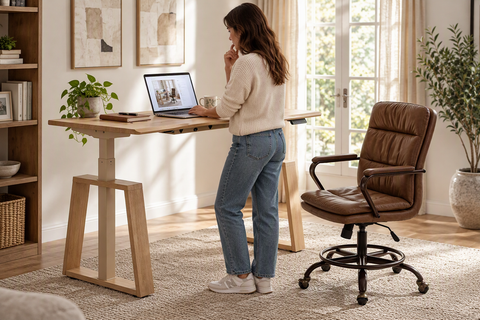
Modern reception desks are increasingly adopting sit-stand functionality. According to Cochrane's review on workplace interventions, sit-stand desks can reduce sitting time by over 80 minutes a day.
In a reception context, height adjustment isn't just for health—it's a way to shift between "Thinking" and "Execution" modes. Standing during high-traffic morning arrivals allows the receptionist to engage more eye-to-eye with guests, while sitting during quiet periods facilitates focused administrative tasks.
Safety and Compliance: The Trust Factor
When designing with light, safety cannot be an afterthought. This is where "Authoritativeness" is built.
1. Emergency Lighting Conflict
One non-obvious "gotcha" is the conflict between dynamic RGB and safety regulations. BS 5266-1 requires a minimum of 15 lux for emergency lighting. Most RGB systems are not rated for emergency use. Professional designers must ensure that if the building's power fails, the reception desk doesn't become a dark obstacle.
2. Ergonomic Standards
The desk itself should align with BIFMA G1-2013 Ergonomics Guidelines, ensuring the height range accommodates the 5th to 95th percentile of the population. This "fits most users" logic is critical for B2B clients who may have multiple staff members sharing a single workstation.
3. Material Safety
For desks using glass surfaces to enhance lighting effects, ensure the glass is tempered and shatter-resistant. Furthermore, look for UL GREENGUARD Certification to ensure the materials aren't off-gassing volatile organic compounds (VOCs) into the lobby air, maintaining a "Mindful" and healthy environment.
Sharing Personal Tips for Atmospheric Building
Creating a holistic lifestyle solution goes beyond the desk. Here are some "Expert Tips" for building a complete reception atmosphere:
- Layer the Light: Use the desk's integrated RGB as the "Accent Layer." Pair it with "Task Lighting" (a high-quality desk lamp) and "Ambient Lighting" (recessed ceiling lights).
- The Greenery Connection: Place plants near the light source. The glow of a soft green light against a Monstera leaf creates a "Biophilic" connection that reduces stress.
- The "Sunset" Preset: Program your lighting to shift from cool white at 9:00 AM to warm gold at 4:00 PM. This mimics the natural circadian rhythm, a technique supported by the World Health Organization (WHO) guidelines on healthy work environments.
- Cable Management as Art: Use "Snake" cable organizers or magnetic trays to keep every wire hidden. A single visible cable can "cheapen" a $5,000 installation.
Scenario Analysis: Choosing the Right Approach
To help you decide on the best implementation, let's look at two distinct corporate scenarios.
Scenario A: The High-Traffic Tech Startup
- Goal: Innovation signaling and high energy.
- Setup: Cool white (5000K) ambient light with dynamic brand-color RGB accents (e.g., subtle blue pulses).
- Material: Glass-top desk to maximize the "tech" aesthetic and light refraction.
- Priority: Durability and "Wow" factor.
Scenario B: The Boutique Legal or Financial Firm
- Goal: Stability, trust, and calm.
- Setup: Warm white (2700K) static lighting. No dynamic effects.
- Material: Sintered stone or wood-look finishes with "under-glow" lighting.
- Priority: Sophistication and glare reduction.
Logic Summary: These scenarios are modeled based on "Industry-Specific Applications" research which suggests that legal and healthcare environments benefit from traditional lighting that conveys stability, while tech firms leverage RGB for "Innovation Signaling."
Summary of Best Practices for Reception Lighting
| Feature | Recommended Practice | Benefit |
|---|---|---|
| Brightness | 20-30% of max output | Prevents glare and "cheap" aesthetic |
| Saturation | 10-15% for brand colors | Maintains professional subtlety |
| Light Source | Indirect (Hidden) | Creates an elegant, floating effect |
| Control | DMX or DALI Integrated | Allows for centralized, scheduled scenes |
| Safety | Separate Emergency Circuit | Ensures compliance with safety codes |
Lighting as a Catalyst for Mindfulness
Integrating RGB into a reception desk is not about making a "gaming desk" for the office. It is about using modern technology to craft a "Workspace Sanctuary." When we move away from over-saturated, distracting lights and toward a "Mindful" application of color and intensity, we create a space that respects the human experience.
By following ergonomic standards from OSHA and technical guidelines for commercial lighting, facility managers can ensure their reception area is both a functional workstation and a stunning piece of brand architecture. Lighting is the final layer of design—it’s what brings the furniture to life and turns a simple desk into an inspiring gateway for your business.
Disclaimer: This article is for informational purposes only and does not constitute professional architectural, electrical, or medical advice. Always consult with a certified lighting designer or electrical engineer before implementing complex lighting systems in a commercial space. For ergonomic concerns, please consult a qualified healthcare professional.
Sources
- CIBSE Recommended Lighting Levels
- BIFMA Ergonomics Guideline for Furniture
- Cochrane: Workplace interventions for reducing sitting at work
- OSHA eTools: Computer Workstations
- WHO Guidelines on Physical Activity & Sedentary Behaviour
- Luminate Lighting Group: Lifecycle Cost Analysis of LED
- Thorlux Lighting: Reception Area Standards




Leave a comment