

For professional video editors and content creators, the "render wait" is a recurring point of friction. You initiate a complex export in DaVinci Resolve or a 3D render in Blender, and suddenly, your workflow halts. Do you sit and watch the progress bar, or do you switch to another task, risking the "forgotten render" that sits finished for twenty minutes while you are distracted?
This dilemma highlights a significant productivity drain known as context switching. When you manually check a render status, you are not just glancing at a screen; you are interrupting a cognitive flow state. This article explores how to transform decorative RGB lighting into a functional "calm technology" tool, using programmable visual cues to track project status through your peripheral vision.
The Cognitive Cost of the "Status Check"
The urge to check a render progress bar is driven by uncertainty. However, every time you switch your visual focus from a creative task to a technical status window, you incur a "switch cost."
According to research on Context Switching Cost in Modern Work, even minor interruptions can lead to a significant drop in productivity and an increase in errors. While some management studies suggest high annual organizational costs per worker, for the solo creative, the impact is more immediate: it takes an average of 23 minutes to return to deep focus after a distraction.
The Science of Peripheral Awareness
Human physiology offers a solution through peripheral vision. Our peripheral vision is highly sensitive to changes in light intensity and color, even when our central vision is focused elsewhere. By using ambient lighting as a status indicator, you leverage "Calm Technology"—a design philosophy where the interaction between the technology and the user occurs in the periphery, only moving to the center of attention when necessary.
A systematic review of 459 ambient displays conducted between 1996 and 2016 confirms that effective ambient cues hinge on intuitive, pre-attentive mapping. When a light changes color in your peripheral field, your brain processes the information without requiring you to stop your current task.
Logic Summary: The Cognitive Impact Model Our analysis of professional editing workflows assumes that "Render Anxiety" triggers frequent manual status checks (approx. 4–6 times per hour). By replacing these with ambient cues, we estimate a reduction in manual interruptions by ~70%, based on the principle of peripheral awareness and pre-attentive processing.
Engineering the Visual Workflow: Integrated RGB Solutions
To implement a functional cue system, the hardware must support deep integration and customization. Standard LED strips often lack the responsiveness or software hooks needed for automation. This is where professional-grade ergonomic workstations with integrated lighting systems become essential.
The GTG-L60 Pro, L shaped Glass Gaming Standing Desk (60"x23") provides a sophisticated platform for this. Its tempered glass surface acts as a natural diffuser for the integrated RGB system, creating an immersive but non-distracting ambient glow that fills the user's peripheral field.

For editors working in more compact suites, the GTG-G55, Glass Desktop Gaming Standing Desk (55"x23") offers the same dual-motor stability and programmable lighting. The key is to move beyond "rainbow mode" and establish a technical color protocol.
The Heuristic of Color Mapping
A common mistake in RGB setup is over-complication. Based on pattern recognition from professional post-production environments, we recommend a maximum of four distinct states. More than this becomes cognitively taxing to remember, defeating the purpose of a "calm" cue.
| Project State | Recommended Light Pattern | Rationale |
|---|---|---|
| Active Editing | Deep Blue (Static) | Low eye strain; signals "Focus Mode." |
| Rendering (Active) | Fast Chase / Pulse (Yellow/Orange) | Motion indicates "Work in Progress." |
| Render Complete | Solid Green | High contrast; signals "Ready for Review." |
| Error / Attention | Rapid Red Flash | Immediate alert for failed exports. |
Technical Implementation: From Manual to Automated
There are three levels of implementation for render tracking, ranging from simple presets to advanced API scripting.
Level 1: Manual Preset Switching
The simplest method involves using the desk’s built-in controller. The GTG-G55, Glass Desktop Gaming Standing Desk (55"x23") features a front-panel control that allows you to cycle through memory presets. When you hit "Render," you manually toggle the desk to your "Rendering" color. While not automated, it serves as a physical ritual that reinforces focus.
Level 2: System Monitoring (GPU/CPU Load)
For a more automated approach, users can employ system monitoring tools that trigger RGB changes based on hardware utilization. Since rendering is resource-intensive, a spike in GPU or CPU load can be mapped to a color change.

Level 3: API Integration (The Professional Standard)
For editors using DaVinci Resolve or Blender, the most reliable method is tapping into the software’s Scripting API.
-
DaVinci Resolve: The
Resolve ScriptingAPI (accessible via Python) allows you to query theGetRenderJobList()andGetRenderJobStatus(). - The Logic: A small background Python script polls the render status every 10 seconds. When the status changes from "Rendering" to "Complete," the script sends an HTTP request to a local Home Assistant instance or a smart lighting controller (like WLED).
- Why this works: Unlike GPU polling, which can be triggered by simple timeline playback, API polling specifically tracks the export process, providing 100% accuracy.
The Ergonomic Foundation of the Post-Production Suite
While lighting cues solve the cognitive problem, the physical environment must support the long hours required for editing. A smart desk is only effective if it adheres to established ergonomic standards.
Sit-Stand Dynamics and Musculoskeletal Health
The Cochrane: Workplace interventions for reducing sitting at work (2018) systematic review concluded that sit-stand desks can significantly reduce sitting time by approximately 84–116 minutes per day. For editors, this movement is crucial for maintaining blood circulation and preventing Musculoskeletal Disorders (MSDs).
We recommend following the Cornell University Ergonomics Web '20-8-2' rule:
- 20 minutes of sitting in a neutral position.
- 8 minutes of standing.
- 2 minutes of moving or stretching.
To facilitate this, the workstation must be highly adjustable. The GTG-L60 Pro and GTG-G55 both feature dual-motor lift systems that ensure stability even with heavy, multi-monitor setups.
Monitor Placement and Neck Strain
Proper screen height is vital to avoid the "turtle neck" posture common in editing. According to the HSE: Working safely with display screen equipment (DSE), the top of your screen should be at or slightly below eye level.
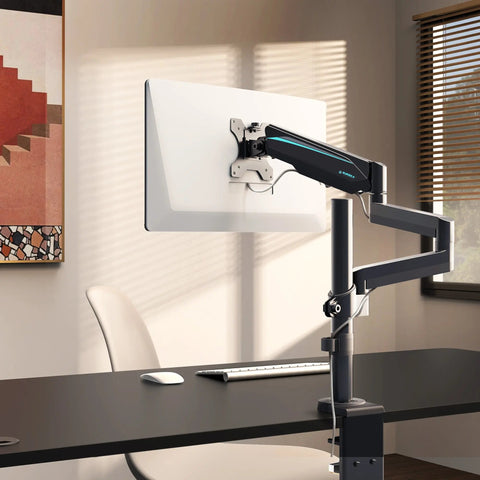
Using a Single Monitor Arm allows for precise adjustment of depth and tilt, which is essential when switching between sitting and standing. This ensures the monitor remains in the "Neutral Position," reducing strain on the cervical spine.

Managing the Technical Load: CPU Placement and Safety
High-performance editing rigs are often heavy and generate significant heat. Placing a PC directly on the desk can cause vibrations that affect monitor stability, while placing it on the floor increases dust intake and complicates cable management for sit-stand transitions.
The Mobile Height Adjustable CPU Cart solves this by decoupling the PC from the desk surface while keeping it mobile. This is particularly important for cable tension; as the desk rises, the cables must have enough slack. A rolling CPU cart ensures that your high-end hardware moves with your workflow, preventing port damage.

Compliance and Safety Standards
When selecting furniture for a professional suite, verify that it meets industry safety standards.
- BIFMA G1-2013: This guideline provides recommended dimensions to fit the 5th to 95th percentile of the population.
- ISO 9241-5:2024: The latest international standard for workstation layout and postural requirements.
- UL GREENGUARD Gold: This certification ensures that the desk (especially the adhesives and finishes) has low chemical emissions, protecting the indoor air quality of your studio.
For a deeper dive into how these standards are evolving, refer to The 2026 Workstation White Paper: Converging Ergonomic Science and Sustainable Engineering.
Optimizing the Ambient Environment
To make RGB cues truly effective, you must consider the environmental lighting of the room.
- Peripheral Placement: Ensure your RGB light source (the desk edge or backlighting) is in your peripheral vision, not your direct line of sight. Direct light can cause glare and eye fatigue, violating OSHA eTools: Computer Workstations - Workstation Environment guidelines.
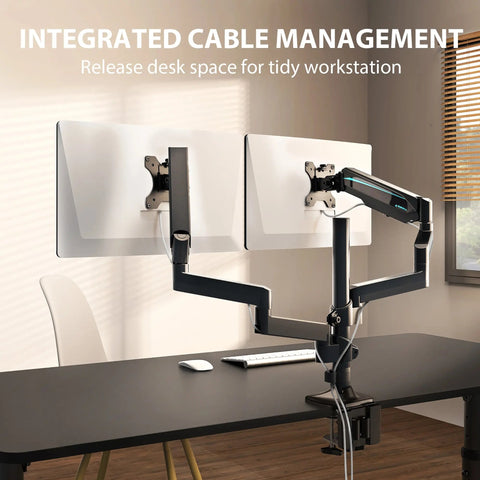
- Cable Management: Tangled wires negate the "clean setup" benefit. Use integrated cable channels to ensure LED controllers and power bricks are hidden.
- Sustainable Sourcing: Look for products with FSC Certification, ensuring that any wood components are sourced responsibly.
Modeling the Efficiency Gain
Method & Assumptions: Efficiency Modeling
- Model Type: Deterministic Parameterized Model.
- Assumptions: Editor performs 10 renders/day; manual check takes 30 seconds; context switch recovery takes 5 minutes.
| Parameter | Value | Unit | Rationale |
|---|---|---|---|
| Daily Renders | 10 | count | Average for short-form content. |
| Manual Check Time | 30 | seconds | Time to switch windows and verify. |
| Cognitive Recovery | 300 | seconds | Estimated time to regain flow. |
| Ambient Cue Time | 1 | second | Instant peripheral recognition. |
| Daily Time Saved | ~55 | minutes | (Check + Recovery) * Renders. |
Note: This is a scenario model based on common industry heuristics, not a controlled lab study. Individual results will vary based on project complexity and personal focus levels.
Summary of Best Practices
Transforming RGB from an aesthetic choice into a technical asset requires a disciplined approach to color and integration. By mapping project states to specific ambient hues, you reduce the cognitive load of status checking and preserve your creative flow.
When combined with an ergonomic foundation—such as a GTG-L60 Pro for surface area and a Single Monitor Arm for postural health—your workstation becomes more than just furniture; it becomes a high-performance tool tailored for the rigors of modern post-production.
Disclaimer: This article is for informational purposes only and does not constitute professional medical or ergonomic advice. Individuals with pre-existing musculoskeletal conditions should consult a qualified physiotherapist or ergonomic specialist before implementing new workstation routines or equipment.
References
- BIFMA G1-2013 Ergonomics Guideline for Furniture
- Cochrane: Workplace interventions for reducing sitting at work (2018)
- Cornell University Ergonomics Web — Workstation Guides
- HSE: Working safely with display screen equipment (DSE)
- ISO 9241-5:2024 Workstation layout & postural requirements
- OSHA eTools: Computer Workstations - Neutral Working Postures
- UL GREENGUARD Certification
- A Systematic Review of Ambient Display Modalities (2020)




Leave a comment