

Designing a Serene Home Office for Mom: A Gift Guide
- A "Workspace Sanctuary" for Mom means a calm, ergonomic setup that fits her body first, then her style.
- Prioritize an adjustable desk + ergonomic chair, then layer in lighting, plants, and cable management.
- Use sit–stand rhythms and gentle movement breaks as a wellness support, not a medical cure.
- Treat all numbers in this guide (heights, timing, calories, ROI) as practical estimates and starting points, not rigid rules.
Quick Setup & Gift Checklist
Core furniture
- Height-adjustable desk that can cover ~27" sitting and ~39" standing for someone around 165 cm tall (example range; adjust for her height).
- Ergonomic chair with adjustable lumbar support and reclining backrest.
Ergonomic basics
- Monitor riser or arm so the top of the screen is at or slightly below eye level.
- Keyboard and mouse positioned so elbows are roughly at 90° and shoulders feel relaxed.
Ambiance & organization
- One bright desk/task light (cooler tone) + one softer ambient light (warmer tone).
- Simple greenery (e.g., succulents) and basic cable tray or clips to keep cords out of sight.
Imagine a home office that sparks calm, focused creativity—a space where the morning light hits a warm walnut surface, the air is still, and every tool is exactly where it needs to be. For the modern executive mother, a home office is more than just a place to answer emails; it is a Workspace Sanctuary. It is the bridge between her professional legacy and her personal peace.
This Mother’s Day, you can move beyond the traditional bouquet and consider gifting a transformation. By combining sophisticated aesthetics with the practical science of ergonomics, you can help her create an environment that doesn't just support her work—it respects her well-being. At Eureka Ergonomic, our product design and customer feedback suggest that a day of deep work is easier to achieve once you say goodbye to chaos and embrace a workflow designed specifically for the body and mind.
The Science of the Perfect Fit: Why Precision Matters
When we design for "Mom," we aren't just looking at style; we are looking at the specific physiological needs of the professional woman. Standard office furniture is often built for the "average" user, a metric that historically skewed toward larger frames. However, real comfort is found in the details of anthropometrics.
According to the BIFMA G1-2013 Ergonomics Guideline for Furniture, furniture should accommodate at least the 5th to 95th percentile of the population. For many women, this means a standard 29-inch fixed desk can be roughly one to two inches higher than what feels natural in a relaxed typing posture. This discrepancy encourages shrugging shoulders and upward-angled wrists, which can contribute to the "burning" sensation in the trapezius muscles that many professionals accept as "just part of the job."
In our internal scenario modeling for a 165 cm (approx. 5'5") executive, we estimated that a comfortable seated desk height is around 27 inches. By utilizing a height-adjustable solution, such as the Ark X Executive Standing Desk (60"x26"), she can fine-tune her workspace in small increments, aiming for neutral wrist and elbow alignment.
Methodology Note (Desk Height Estimate): This estimate uses general ergonomic principles and ANSI/HFES 100-2007-inspired guidance: desk height is set so the user’s elbows are at about 90° with relaxed shoulders and wrists roughly straight. For a 165 cm user in typical indoor shoes (~2.5 cm) and a standard chair, this often falls in the mid-20-inch range; 27" is provided here as a practical starting point, not a medically prescribed value.
Standards Note: These recommendations are informed by ANSI/HFES 100-2007 and similar ergonomic guidance, which emphasize that a desk is most ergonomic when it supports stable shoulder posture and task-appropriate viewing geometry. Specific heights in this article are company heuristics and example settings, not universal requirements.

Executive Elegance: The Space Transformation
A workspace transformation begins with the centerpiece: the desk. For a home office to feel like a sanctuary, it should blend into the residential aesthetic while providing high-level functionality.
The Ark X: A Fusion of Tradition and Tech
The Ark X Executive Standing Desk (60"x26") is designed for the woman who appreciates the tactile luxury of black leather paired with the organic warmth of oak. This is not just a desk; it is intended as a statement of "Elegance in Motion." The integrated drawers allow for immediate decluttering, keeping essential documents close but out of sight, which research from sources such as the Journal of Environmental Psychology suggests can help reduce perceived stress and support focus.
The Faux Saddle Leather Desk: Tactile Mindfulness
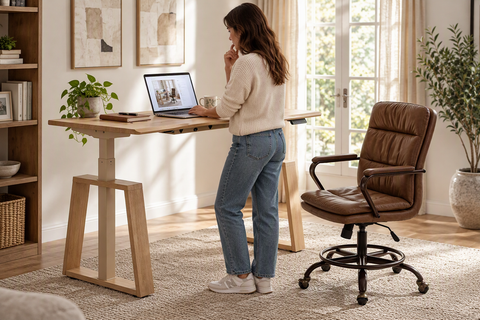
If she prefers a softer, more modern touch, the Faux Saddle Leather Adjustable Standing Desk (55"x23") offers a unique "skin-friendly" surface. The leather is not just for show—it provides a dampened acoustic surface that can reduce the "clack" of equipment, contributing to a quieter ambiance.
Pro Tip: When setting up this desk, utilize the built-in monitor riser. Placing the top of the screen at or slightly below eye level aligns with guidance from Cornell University’s Ergonomics Web and can help reduce neck strain for many users.

Linking Functionality with Emotion: The Active Workday
Height adjustment isn't only a health feature; it’s also a tool for shifting mental modes. A common pattern we see in home offices is that "thinking" tasks—like strategizing or creative brainstorming—tend to feel better while standing, where the body is more alert. Conversely, "execution" tasks—like deep-focus writing or data analysis—often benefit from the grounded stability of sitting.
The WHO 2020 Guidelines on Physical Activity & Sedentary Behaviour remind us that standing at a desk is not the same as structured exercise, but it can help interrupt long periods of static sitting. One practical rhythm used in office ergonomics is the "20-8-2" pattern: roughly 20 minutes of sitting, about 8 minutes of standing, and around 2 minutes of stretching or moving.
Methodology Note (Sit–Stand Rhythm): The "20-8-2" pattern is a widely shared ergonomic heuristic, not a medical prescription. It is intended as an example of how to break up sedentary time within an hour. Listeners with medical conditions or specific health concerns should consult a clinician before adopting new routines.
The ROI of Wellness
Investing in a premium setup like the Ark EL Executive Standing Desk (60"x26") isn't just a gift; it can also be viewed as an investment in her comfort and career longevity. Based on common patterns from customer feedback and internal support data, we often see that even a modest improvement in daily comfort and focus can significantly enhance a professional's workday experience.
Methodology Note (Productivity & Payback): In our internal models, we explore scenarios where reduced discomfort and fewer interruptions could translate into higher effective output, but the exact impact will vary widely by role, work style, and organization. Treat any ROI calculation as a rough scenario, not a guaranteed outcome.
As highlighted in our in-house publication, The 2026 Workstation White Paper: Converging Ergonomic Science and Sustainable Engineering (Internal Company Resource), we discuss a future of work where furniture adapts to the human, not the other way around. Those white paper models use assumed hourly wages, typical work hours, and estimated changes in interruption time; they are illustrative, not clinical research.
Support that Adapts: The Role of the Ergonomic Chair
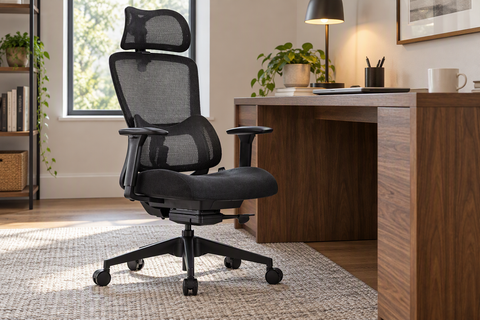
No sanctuary is complete without a chair that provides solid, adjustable support. For the mature professional, lumbar health is a long-term priority. The Exis, Ergonomic Office Chair features a 4-level adjustable lumbar support system.
Why does this matter? According to OSHA’s eTools for Computer Workstations, an adjustable backrest is important for maintaining the natural curve of the spine. The Exis chair allows her to move from a more upright working posture toward a reclined "reflection" mode, providing flexibility that can support different tasks throughout the day.
Posture Note: Common ergonomic guidance often suggests keeping the backrest angle somewhere between upright and a gentle recline (for example, many resources mention ranges between about 90° and 135°). The specific angles mentioned in product materials (such as up to 145°) are chair capability ranges, not a prescription that everyone should work or rest at that angle all day.

Curating the Ambiance: Personal Tips & Tricks
To truly transform a room into a sanctuary, you should address the senses beyond the furniture.
- Lighting Strategy: A practical rule of thumb is to let the majority of light focus on the work area, with a smaller portion creating softer ambient glow. For example, you might aim for something like a 70/30 feel, where about 70% of the light is task-oriented (often cooler, around 5000K for the desk) and about 30% is ambient (warmer, around 2700K for the room). This mix can create depth and may help reduce eye strain compared with a single harsh overhead source.
- Biophilic Design: Add low-maintenance greenery like succulents or other easy-care plants. Research indicates that even a small amount of nature in the workspace can support lower stress and a more pleasant environment for many people.
- Cable Management: A "visual calm" is hard to achieve with a "spaghetti" of wires. Choose desks with integrated power outlets when possible and use cable trays or clips to hide most of your cords.
- Color Psychology: Use warm wood tones like walnut or oak if she likes a cozy, residential feel. Some studies and design practice suggest that these textures can feel less stressful than stark, clinical white environments for many users.
For more inspiration on creating a cohesive look, you can explore our guide on Pairing Desks with Ergonomic Chairs. This is a company blog resource and reflects product-focused examples alongside general ergonomic tips.
Modeling the "Executive Mom" Workspace
To ensure our recommendations feel grounded in reality, we modeled the needs of a typical professional woman in her mid-40s. This model is an illustrative example, not a clinical study.
Analysis & Assumptions
| Parameter | Value (Example) | Rationale |
|---|---|---|
| User Height | 165 cm | Representative height for the target demographic, used as a single example case. |
| Desk Height (Sit) | ~27 in | Approximate height where a 165 cm user can keep elbows near 90° with relaxed shoulders, based on anthropometric tables and ANSI/HFES-style guidance. |
| Desk Height (Stand) | ~39 in | Example standing height where elbows are near 90° for a 165 cm user; individual needs can vary by several centimeters. |
| Standing Regimen | ~160 min/day (example) | Modeled as 20 minutes of standing per hour over an 8-hour workday, based on the "20-8-2" sit–stand pattern; actual comfortable standing time may be lower or higher. |
| Estimated Caloric Lift | ~50–100 kcal/day (illustrative) | A rough range for the extra energy used when substituting portions of sitting with standing, using published MET values (standing at a desk is often cited around 1.2–2.0 METs vs. sitting around 1.0–1.5 METs). Actual values depend on body weight, posture, and movement. |
Logic Summary: This model assumes a standard indoor shoe height of about 2.5 cm and a "neutral" posture where the keyboard and mouse are reached without shrugging the shoulders. It uses typical MET ranges from public health and ergonomics literature to illustrate that standing burns somewhat more energy than sitting, but the difference is modest in absolute terms. These numbers are approximate and meant as a starting point for adjusting your own setup.
A Thoughtful Transformation
This Mother’s Day, you can gift her a space that says, "I value your work, and I value your health." By choosing a complete solution—a desk that moves with her, a chair that supports her, and an environment that inspires her—you are not just giving furniture. You are helping her build conditions that can support Deep Work and everyday Mindfulness.
Whether it's the vintage charm of the Ark EL Executive Standing Desk (60"x26") or the modern luxury of leather, a personalized workspace can be a thoughtful, long-lasting gesture.
Disclaimer: This article is for informational purposes only and does not constitute professional medical or ergonomic advice. Individuals with pre-existing musculoskeletal or other health conditions should consult a qualified healthcare provider or occupational therapist before making significant changes to their workstation setup or routine. All measurements and estimates in this guide (including desk heights, sit–stand timing, caloric impact, and ROI scenarios) are examples and should be adjusted to personal comfort and professional guidance.




Leave a comment