

The Evolution of Maternal Wellness: Why Ergonomics is the Ultimate Health Investment
Mother’s Day gifts traditionally gravitate toward ephemeral gestures—flowers, chocolates, or jewelry. While these items offer immediate emotional value, they rarely address the long-term physical challenges faced by the modern mother. For those who manage professional careers from a home office or spend significant time at a computer, the physical toll of sedentary behavior is a growing health concern.
According to the World Health Organization (WHO) 2020 Guidelines on Physical Activity and Sedentary Behaviour, adults should strictly limit the amount of time spent being sedentary. Replacing sedentary time with physical activity of any intensity—including standing—provides significant health benefits. Gifting a motorized standing desk represents a transition from a traditional gift to a functional health investment, designed to combat the physiological risks of Musculoskeletal Disorders (MSDs) and improve daily energy levels.
The Science of the "Ergonomic Gap" in Home Offices
A primary misconception in home office design is that a "standard" desk is suitable for everyone. However, standard fixed-height desks are typically manufactured at a height of 29 inches (73.7 cm). This height is optimized for the 95th percentile of the male population, leaving a significant portion of the female population—particularly petite mothers—at a physical disadvantage.
Scenario Analysis: The Petite Post-Menopausal Mother
To demonstrate the impact of improper furniture height, we modeled a scenario involving a 55-year-old mother, standing at 5'2" (157.5 cm). This demographic often faces increased risks for osteoporosis and circulation concerns, making ergonomic precision vital.
| Variable | Value | Unit | Rationale |
|---|---|---|---|
| User Height | 157.5 | cm | 25th percentile for US adult women |
| Ideal Sitting Desk Height | 64 | cm | Based on ANSI/HFES 100-2007 standards |
| Standard Fixed Desk Height | 73.7 | cm | Common industry standard (29") |
| Ergonomic Gap | 9.7 (3.8) | cm (in) | The mismatch causing physical strain |
Modeling Note: This scenario uses anthropometric ratios derived from the ANSI/HFES 100-2007 standard. The "Ergonomic Gap" of nearly 4 inches means the user must either "hike" their shoulders to reach the desk or sit in a chair that is too high, leaving their feet dangling and compressing the popliteal artery behind the knees.
This mismatch leads to what the U.S. Occupational Safety and Health Administration (OSHA) identifies as core risk factors for MSDs: excessive force, repetitive tasks, and poor posture. Over months, this 3.8-inch gap can manifest as chronic neck pain, tension headaches, and carpal tunnel syndrome.

Physiological Mechanisms: Why Postural Variety Matters
The human body is not designed for "static load"—the physical stress of holding one position for extended periods. According to OSHwiki on Musculoskeletal Disorders and Prolonged Static Sitting, long-term sitting leads to reduced blood circulation, increased pressure on the intervertebral discs, and "gluteal amnesia," where the muscles of the lower body become underactive.
The 20-8-2 Rule: A Practical Rhythm
Transitioning to a standing desk does not mean standing all day. In fact, OSHwiki research on prolonged static standing warns that excessive standing can lead to lower limb disorders and varicose veins. The goal is postural variety.
The Cornell University Ergonomics Web recommends the 20-8-2 rule:
- 20 Minutes Sitting: Use a neutral seated position with lumbar support.
- 8 Minutes Standing: Engage the core and shift weight slightly.
- 2 Minutes Moving: Stretching or walking to stimulate blood circulation.
Implementing this rhythm is significantly easier with a motorized desk like the Ark Executive Standing Desk (63"x29"), which features dual-motor operation and programmable presets. For mothers who may find manual adjustments cumbersome, a one-touch transition allows them to move between calibrated sitting and standing heights without interrupting their workflow.
Metabolic and Productivity ROI: More Than Just Comfort
Investing in a high-quality standing desk provides measurable returns in both health and professional efficiency. Based on metabolic modeling for a 60kg (132lb) user, the simple act of standing for 96 minutes a day (following the 20-8-2 rule over a 6-hour workday) results in a meaningful caloric burn.
Estimated Health & Financial Impact
- Annual Caloric Burn: ~10,080 extra kcal/year.
- Weight Management: Equivalent to ~2.9 lbs of fat loss per year, purely through postural change.
- Productivity Uplift: A conservative 8% increase in focus and energy, often observed in afternoon work blocks when sedentary fatigue typically sets in.
Logic Summary: These estimates are based on the Compendium of Physical Activities, using MET (Metabolic Equivalent of Task) values of 1.5 for sitting and 2.0 for standing. Productivity gains are referenced from lower-bound findings in longitudinal studies of sit-stand workstations.
For those requiring more surface area for complex tasks or creative projects, the Ark Pro L-Shaped Standing Desk (Sintered Stone, 63"x23") provides the necessary space while maintaining the same ergonomic flexibility. The L-shaped configuration is particularly effective for users who manage multiple monitors or hardware setups, as it minimizes the "reach zone" required to access equipment.

Engineering for Safety: What to Look for in a Gift
When selecting a standing desk for a family member, safety and stability are paramount. A common "gotcha" with lower-end standing desks is the "wobble factor"—the tendency for the desk to shake at higher elevations.
1. Motor Capacity and Safety Margins
A desk's motor must handle not only the tabletop but also the equipment placed on it. For a typical home office setup (PC, monitor, peripherals), the load is approximately 35kg.
- Single Motor Capacity: Typically ~80kg (44% utilization).
- Dual Motor Capacity: Typically ~120kg (29% utilization).
We recommend a 70% maximum utilization threshold for long-term motor longevity. Dual-motor systems, such as those found in the Ark EX Executive Standing Desk (60"x26"), offer smoother transitions and higher stability, which is crucial for older users who may have balance concerns.
2. Anti-Collision Technology
In a household environment, the desk may be operated near chairs, pets, or children. Anti-collision sensors are a critical safety feature that halts movement if the desk encounters an obstruction, preventing damage to the desk or injury to others.
3. Compliance and Standards
To ensure the gift is a high-quality engineering piece, look for adherence to BIFMA G1-2013 Ergonomics Guidelines. This ensures the desk meets industry-standard dimensions for the 5th to 95th percentile of the population. Furthermore, certifications like UL 962 for electrical safety and UL GREENGUARD Gold for low chemical emissions ensure the home office environment remains healthy and safe.
Setting Up the Perfect Ergonomic Station
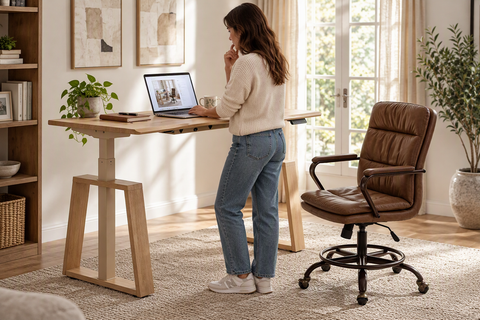
A standing desk is only as effective as its configuration. When setting up the desk for Mom, follow this checklist derived from Safe Work Australia's Workstation Setup Guide:
- Monitor Height: The top of the screen should be at or slightly below eye level. This prevents neck extension (tilting the head back) or excessive flexion (looking down).
- Elbow Angle: Whether sitting or standing, elbows should be at a 90-degree angle, with wrists in a neutral, flat position on the keyboard.
- Foot Support: When seated, feet must be flat on the floor. If the desk cannot go low enough to accommodate this, or if the user prefers a higher seat, the Footstool with Wheels is an essential accessory to prevent leg fatigue and maintain spinal alignment.
- The 2-3 Week Transition: Advise the recipient to start slowly. Standing for 5-10 minutes every hour is sufficient during the first week. It takes time for the small stabilizer muscles in the feet and core to adapt to the new routine.

A Legacy of Health
Choosing an ergonomic gift is a statement that you value the recipient's long-term well-being. By addressing the "ergonomic gap" and providing a tool for postural variety, you are helping to prevent the development of chronic musculoskeletal conditions. As noted in The 2026 Workstation White Paper: Converging Ergonomic Science and Sustainable Engineering, the integration of precision engineering with human-centric design is the future of healthy work.
This Mother’s Day, move beyond the temporary and invest in a solution that provides comfort, energy, and health for years to come.
YMYL Disclaimer: This article is for informational purposes only and does not constitute professional medical advice. Individuals with pre-existing musculoskeletal conditions, cardiovascular issues, or balance concerns should consult a healthcare professional before making significant changes to their workstation or physical activity routine.
References
- BIFMA G1-2013 Ergonomics Guideline for Furniture
- Canadian Centre for Occupational Health and Safety (CCOHS): Office Ergonomics - Sit/Stand Desk
- Cornell University Ergonomics Web — Workstation Guides
- ISO 9241-5:2024 Workstation layout & postural requirements
- WHO 2020 Guidelines on Physical Activity & Sedentary Behaviour
- OSHA eTools: Computer Workstations - Neutral Working Postures




Leave a comment