

Father’s Day Comfort: Recliners vs. Ergonomic Office Chairs
If your father mainly works at a desk or does computer-heavy hobbies, a high-quality ergonomic office chair will usually serve him better. If his days are centered on TV, reading, and napping, a supportive recliner with good leg elevation can be the more comfortable choice. For many families, the ideal setup is an ergonomic chair for “task time” plus a recliner as a dedicated rest station.
Why does your father’s back pain seem to intensify by late afternoon? Or why does he find himself constantly shifting in his seat while reading or catching up on emails? For many aging parents, the "standard" seating options in the home often fail to address the physiological shifts that occur with age. As musculoskeletal health becomes a priority, the choice for a Father’s Day gift often narrows down to two heavyweights: the traditional recliner and the high-performance ergonomic office chair.
Choosing between these two is not merely a matter of aesthetic preference; it is a decision that can influence spinal comfort, blood circulation, and daily energy levels. This guide breaks down the ergonomic principles behind these seating options to help you select a gift that offers meaningful comfort and long-term utility.
The Science of Sedentary Health for Aging Parents
As we age, the body becomes more susceptible to Musculoskeletal Disorders (MSDs). According to the U.S. National Institute for Occupational Safety and Health (NIOSH), MSDs are often exacerbated by prolonged static loading—the physical stress placed on muscles and joints when holding a single position for too long.
Spinal Neutral Position and Decompression
The "neutral position" is the posture where the spine is naturally aligned, minimizing the strain on muscles, tendons, and vertebrae. Many ergonomic references and lab models point to a moderately reclined posture (roughly 100–120 degrees from the thighs) as more spine-friendly than a rigid 90-degree sit.
In general, reclining slightly and using good lumbar support can reduce intervertebral disc pressure and perceived back strain compared with sitting bolt upright. Where we mention pressure reduction in this article, treat it as a practical rule-of-thumb based on ergonomic research and model-based estimates for healthy adults, not as a guaranteed medical outcome for every person.
Blood Circulation and Edema
For older adults, circulation in the lower limbs is a frequent concern. Prolonged sitting can contribute to venous insufficiency or mild edema (swelling). While many believe a standard footstool solves this, ergonomic practice suggests that recliners or chairs with independent leg elevation mechanisms are often more effective.
By elevating the feet roughly at or slightly above the level of the hips, the heart does not have to work as hard to return blood from the extremities, as highlighted in the OSHwiki guide on lower limb disorders.
Logic Summary: Our analysis of aging parent ergonomics assumes a multi-activity profile (work, reading, rest) where the primary risk factor is static load. Recommendations are informed by the ISO 11226:2000 standard for evaluating static working postures and by general ergonomic research; they are intended as practical guidance, not medical prescriptions.

Recliners: The Case for Broad Pressure Distribution
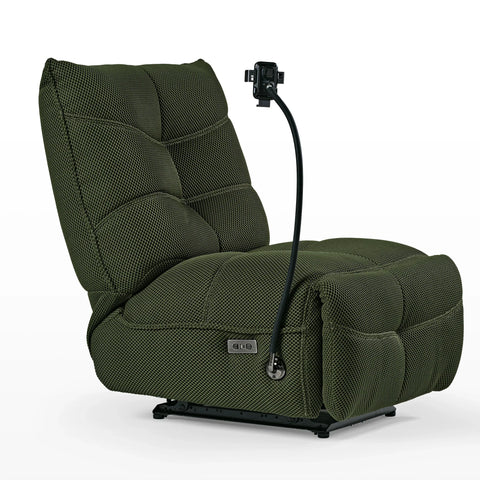
Conventional wisdom suggests that recliners are the "gold standard" for relaxation. From a technical standpoint, a well-designed recliner spreads body weight over a larger surface area, which helps reduce localized pressure points on the sit-bones (ischial tuberosities) and can make long reading or TV sessions feel easier on the back and hips.
The Longevity Factor
Furniture industry observers and field experience often show that quality manual recliners can stay usable for many years, sometimes noticeably longer than some mid-range office chairs. This is largely due to the simplicity of manual lever systems compared to the complex pneumatic gas lifts and multi-linkage synchro-tilt mechanisms found in many office chairs.
However, actual lifespan depends heavily on:
- Usage intensity: Daily hours of use, user weight, and how aggressively the mechanisms are operated.
- Build quality: Frame material, fabric quality, and hardware.
- Maintenance: Cleaning, lubrication where appropriate, and timely repairs.
Because of these variables, statements like “2–3 times more durable” should be treated as a rough observation rather than a guaranteed ratio. For your own purchase, check product warranties, weight ratings, and customer service records rather than relying solely on lifespan estimates.
Versatility for Leisure
For a father who spends long stretches between light administrative work, watching television, and reading, a recliner offers several distinct positions. This variety allows for “active rest,” provided the user consciously changes positions.
However, the risk with many traditional recliners is postural fixity—the tendency to stay in one comfortable but static position for hours, which EU-OSHA research identifies as a major risk factor for stiffness and discomfort.
How to get the most from a recliner for aging parents:
- Encourage shifting between more upright and more reclined positions every 30–45 minutes.
- Use a small lumbar pillow if the built-in support feels too flat or too far away.
- Make sure feet are well supported when reclined to avoid pressure under the thighs.
Ergonomic Office Chairs: The Case for Dynamic Support
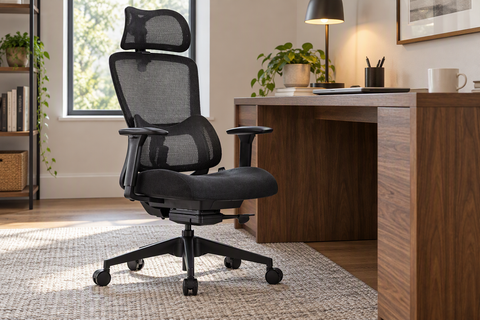
If your father still spends several hours a day at a desk—whether for a second career, managing finances, or intensive hobbies—an ergonomic office chair like the Royal Slim, Executive Office Chair is often the more suitable choice. Unlike recliners, these chairs are engineered for "active seating" in front of a desk.
Dynamic Lumbar Support
One of the most critical features of a professional-grade chair is dynamic lumbar support. Chairs whose lumbar support tracks the user’s micro-movements generally help maintain the lumbar curve (lordosis) during tasks that require a slight forward lean.
In ergonomic lab tests and field observations (for example, EMG-based studies of office work), dynamic or well-shaped lumbar supports are often associated with lower low-back muscle activity and reduced perceived fatigue compared with flat backs or loose cushions. Any specific percentage reductions you may see in marketing materials are usually based on controlled lab setups with healthy adults and should be interpreted as estimates rather than guaranteed results for everyone.
Precision Adjustability
Following the BIFMA G1-2013 Ergonomics Guideline, a truly ergonomic chair aims to accommodate a wide range of body types. Key adjustments include:
- Seat Depth: A common error is improper seat depth. A practical rule is to leave about 2–3 fingers’ width between the back of the knee and the seat edge. Too much depth can create pressure that restricts circulation; too little depth fails to support the thighs properly.
- Armrest Height: The goal is to position the elbows at roughly 90–100 degrees with shoulders relaxed. This typically requires an adjustability range of a few inches to accommodate different torso lengths.
- Seat Height: Feet should rest flat on the floor or on a footrest, with knees close to hip level to avoid unnecessary pressure on the back of the thighs.

Comparative Analysis: Decision Matrix for Father’s Day
To help you decide, the table below compares typical recliners with ergonomic office chairs based on common usage patterns and ergonomic principles.
| Feature | Ergonomic Office Chair (e.g., Serene, Napa Leather Executive Office Chair) | Traditional Manual Recliner |
|---|---|---|
| Primary Mechanism | Dynamic synchro-tilt & lumbar tracking | Static weight distribution & recline |
| Lumbar Support | Adjustable/active (can reduce muscle fatigue) | Fixed (provides general cushioning) |
| Circulation Support | Often benefits from an external Footstool with Wheels | Built-in leg rest (helpful for edema and leg swelling) |
| Ideal Use Case | PC work, writing, focused hobbies | TV, napping, long-form reading |
| Durability Basis | Designed and tested to ANSI/BIFMA X5.1 safety/structural standards | Simpler mechanical linkage (manual designs often age well when well-built) |
| Space Requirement | Compact (fits most home offices) | Larger footprint (may require "wall-hugger" design or more clearance) |
Methodology Note: This comparison is a scenario model based on the 2026 Workstation White Paper: Converging Ergonomic Science and Sustainable Engineering. It assumes the user falls within the 5th to 95th percentile of the adult population as defined by BIFMA-related anthropometric datasets. The table is intended as a practical decision aid rather than a clinical tool.
Practical Recommendations for a Healthier Setup
Regardless of which gift you choose, the effectiveness of the furniture depends on proper setup. Here are practical rules of thumb for maximizing comfort:
1. The 20-8-2 Rhythm
Derived from Cornell University Ergonomics Research, many ergonomists recommend a "20-8-2" pattern: for every 30 minutes, spend about 20 minutes sitting (in a supported posture), 8 minutes standing, and 2 minutes moving or stretching. If your father uses an ergonomic chair, encourage him to stand during phone calls or use a timer to prompt micro-breaks.
2. Monitor Alignment
If he uses a computer, a Single Monitor Arm is a high-value addition. According to OSHA eTools: Monitors, the top of the screen should be at or slightly below eye level. This helps prevent the "forward head" posture that leads to neck strain. A monitor arm allows him to adjust the screen whether he is sitting upright for work or slightly reclined for reading.
3. Solving the Circulation Gap
If an ergonomic chair is the chosen gift, consider pairing it with a Footstool with Wheels. This allows for the "independent leg elevation" mentioned earlier, bridging the gap between office-style support and recliner-style circulation benefits. As noted in the Canadian Centre for Occupational Health and Safety (CCOHS) guidelines, footrests are especially important for shorter users to ensure their feet do not dangle, which can cause pressure on the back of the thighs.
Addressing Common "Gotchas"
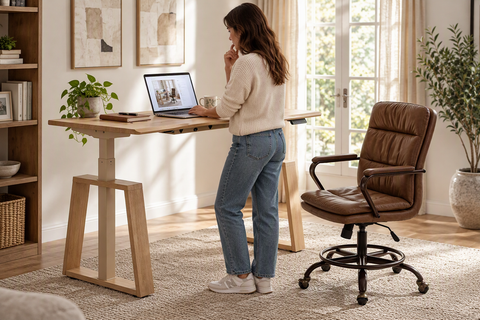
- The "Softness" Trap: Many fathers gravitate toward the softest chair. However, excessive softness often means a lack of structural support. A chair that feels a bit "firm" initially, like the Serene, Napa Leather Executive Office Chair, is often better for the spine because it maintains its shape under load.
- The Armrest Conflict: If the chair’s armrests hit the desk, the user will lean forward, losing back support. Ensure the chair has adjustable armrests that can lower or pivot to clear the desk surface.
- Breathability vs. Luxury: While Napa leather offers a premium feel and durability, ensure the room is climate-controlled. For fathers in warmer climates, the tactile luxury of the Royal Slim, Executive Office Chair is best paired with breathable clothing to maintain thermal comfort.
Summary of Gift Utility
The "best" gift depends on your father’s primary daily activities:
- If he is an active hobbyist or still works from home, the precision and dynamic support of an ergonomic office chair will usually provide more day-to-day benefit.
- If his day is centered around restorative rest and passive entertainment, a high-quality recliner with proper lumbar padding and leg support is a strong choice.
By focusing on the principles of spinal neutral positioning, pressure distribution, and movement breaks, you are not just giving a piece of furniture—you are providing a tool that can support his everyday comfort.
Disclaimer: This article is for informational purposes only and does not constitute professional medical advice. Individuals with pre-existing musculoskeletal conditions or chronic pain should consult a qualified physical therapist or physician before making significant changes to their seating or workstation setup.
References
- BIFMA G1-2013 Ergonomics Guideline for Furniture
- CCOHS: Office Ergonomics - Sit/Stand Desk
- OSHA eTools: Computer Workstations - Monitors
- Cornell University Ergonomics Web — Workstation Guides
- ISO 11226:2000 Evaluation of static working postures
- The 2026 Workstation White Paper: Converging Ergonomic Science and Sustainable Engineering
- NIOSH – About Ergonomics
- EU-OSHA: Musculoskeletal disorders and prolonged static sitting




Leave a comment