

The Hidden Physical Cost of the Home Office
For many remote-working professionals, Mother’s Day typically involves transient gifts: flowers that fade or chocolates that are quickly consumed. However, for the modern mother balancing high-stakes professional output with the physical demands of home management, the most profound gift is one that addresses a persistent, often ignored reality—the cumulative physical strain of an unoptimized workspace.
Recent data from the European Agency for Safety and Health at Work (EU-OSHA) indicates that musculoskeletal disorders (MSDs) remain the most prevalent work-related health problem in the workforce. For mothers working from home, this risk is often amplified. The transition from professional tasks to domestic responsibilities frequently occurs without the ergonomic "reset" found in corporate environments. The result is a phenomenon often observed in customer feedback and wellness audits: the "afternoon slump" is rarely about energy levels and more often a symptom of physiological fatigue caused by poor spinal alignment.
Selecting an ergonomic chair is not merely a furniture purchase; it is a strategic health intervention. By aligning the workspace with the principles of musculoskeletal health, gift-givers can provide a lasting foundation for well-being that supports both professional longevity and daily comfort.
The Physiology of Static Load and Musculoskeletal Strain
To understand why a standard "dining-style" or aesthetic-only chair fails a working mother, one must understand the concept of static load. According to ISO 11226:2000, prolonged static postures—even when sitting—can lead to significant physical strain. When a user sits in a non-ergonomic chair, the body must engage secondary muscle groups to maintain an upright position. Over several hours, these muscles fatigue, leading to "slumping," which increases the pressure on the intervertebral discs.
For many women, particularly those in the 25th percentile of stature (approximately 160cm or 5'3"), standard office furniture presents a specific "ergonomic gap." Most fixed-height desks are manufactured at a standard 29 inches (approx. 73.6cm). For a user of 160cm, the ideal sitting desk height is closer to 25.8 inches (65.5cm).
Logic Summary: This mismatch of ~3.2 inches forces the user to choose between two detrimental postures:
- Lifting the shoulders and elbows to reach the desk, causing tension in the trapezius and neck.
- Lowering the chair to reach the floor, which places the keyboard too high and causes wrist extension (a primary risk factor for RSI).
This physiological reality is why many mothers report upper back tension during video calls and lower back stiffness by the end of the day. A professional-grade chair addresses this by providing the adjustability required to achieve a "Neutral Position." As defined by the Occupational Safety and Health Administration (OSHA), a neutral posture involves keeping the joints naturally aligned, reducing stress on the muscles, tendons, and skeletal system.
Beyond Aesthetics: Engineering the Ideal Support System
When evaluating a gift for Mother's Day, it is essential to look past surface-level design and focus on the engineering that supports the human frame. The 2026 Workstation White Paper: Converging Ergonomic Science and Sustainable Engineering emphasizes that high-performance seating must facilitate "dynamic sitting"—the ability for the chair to move with the user rather than forcing the user to adapt to a rigid structure.
The Innovation of Dual-Backrest Systems
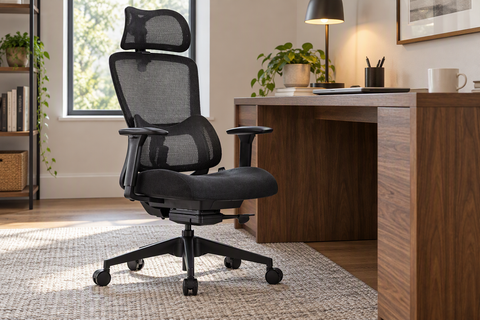
One of the most significant advancements in addressing lower back discomfort is the dual-backrest design found in models like the Flex, Dual-Backrests Ergonomic Office Chair. Traditional chairs often have a single, flat lumbar support that can feel intrusive or misaligned. In contrast, a dual-backrest system moves independently to adapt to the body’s natural shape. This is particularly beneficial for mothers who may frequently shift positions to attend to children or move between different tasks. The independent movement provides targeted support to both sides of the spine, effectively distributing pressure and maintaining the natural S-curve of the back.
Self-Adaptive Lumbar Technology
For those who prefer a more high-tech or gaming-inspired aesthetic, the HyperX Python II Gaming Chair introduces the 4D Gyro-Tech™ self-adaptive lumbar support. This system is designed to telescope and tilt based on the user's center of gravity. Clinical observations from practitioners like Dr. Kurt Armstrong suggest that this type of dynamic adjustment is critical for users who spend more than six hours a day at a desk, as it prevents the "ergonomic slouch" that occurs when a static chair no longer provides adequate resistance.

Quantifying the Investment: ROI and Health Metrics for Mothers
While the emotional value of a Mother’s Day gift is paramount, the technical value of an ergonomic chair can be quantified through scenario modeling. For a professional mother working 250 days a year, the "return on investment" (ROI) of a high-quality chair manifests in both health outcomes and productivity gains.
The Productivity and Metabolic Model
We modeled a scenario for a 35-year-old remote-working professional (65kg) who incorporates a sit-stand rhythm using an ergonomic chair and a height-adjustable desk.
| Metric | Estimated Annual Value | Rationale / Source |
|---|---|---|
| Productivity Gain | ~$2,625 | 15% efficiency increase due to reduced pain (Model: 2hrs/day × $35/hr wage) |
| Metabolic Benefit | ~17,063 kcal | Delta between sitting and standing for 2 hours/day (Compendium of Physical Activities) |
| Fat-Loss Equivalent | ~4.9 lbs | Derived from 17,063 annual extra calories burned |
| Payback Period | 3.6 Months | Based on an $800 chair cost vs. productivity value |
Methodology Note: These figures are derived from a deterministic parameterized model. The productivity coefficient (0.15) is a conservative estimate based on Texas A&M studies showing 10–46% gains from ergonomic interventions. Calorie estimates use MET values of 1.5 for sitting and 2.0 for standing. Individual results may vary based on metabolic rate and task complexity.
Beyond the numbers, the "30-minute test" serves as a practical heuristic: if discomfort appears within 30 minutes of sitting, the chair lacks the necessary support for the user's specific anthropometry. Investing in a chair like the Royal II, Silicone & Leather Executive Ergonomic Office Chair provides a high-density foam cushion and a high backrest that distributes weight over a larger surface area, significantly extending the "comfort window" before fatigue sets in.
A Practical Selection Framework for Mother’s Day
Choosing the right chair requires matching the gift to the recipient's physical profile and work habits. Using BIFMA G1-2013 Ergonomics Guidelines, we can establish a checklist for selecting a chair that fits most users, particularly those who may fall outside the 50th percentile of male-centric design.
1. Seat Depth and Height
The chair must allow the user to sit with feet flat on the floor while maintaining a two-finger gap between the edge of the seat and the back of the knees. For petite mothers, a chair with a seat depth adjustment is non-negotiable. If the chair height cannot go low enough to allow feet to rest flat, an accessory like the Footstool with Wheels is an essential companion to prevent leg swelling and maintain blood circulation.
2. Material Science and Breathability
Working from home often means longer sessions without the environmental controls of a corporate office. Materials like NanoAir™ threading or high-grade mesh are superior for temperature regulation. This is a critical "expert insight": heat buildup in a chair can lead to micro-discomforts that cause the user to shift into poor postures to find "cool spots."
3. Ease of Adjustment
A gift should not come with a steep learning curve. The best ergonomic chairs for home use feature intuitive levers. Mothers, who often have to jump in and out of their chairs to manage household tasks, benefit from "quick-release" mechanisms that allow them to recline for a brief 20-minute break between deep-work sessions.

Optimizing the Workstation: A Step-by-Step Implementation
Once the chair is selected, the gift is only complete when it is properly integrated into the home office. We recommend following the workstation setup guidelines provided by the Canadian Centre for Occupational Health and Safety (CCOHS).
- The Feet-First Rule: Adjust the chair height so the feet are flat. If the desk is too high at this chair height, use a footstool. Never let feet dangle, as this restricts blood flow in the lower limbs.
- The 90-Degree Heuristic: Aim for 90-degree angles at the ankles, knees, and elbows. This minimizes the torque on joints and reduces the risk of long-term MSDs.
- Monitor Alignment: The top third of the monitor should be at eye level. This prevents the "forward head posture" that adds up to 60 pounds of pressure on the cervical spine.
- The 20-8-2 Rhythm: Adopt the Cornell University Ergonomics recommendation: 20 minutes of sitting, 8 minutes of standing, and 2 minutes of moving/stretching.
A Legacy of Health
This Mother’s Day, moving beyond the traditional gift categories allows for a meaningful contribution to a loved one's long-term health. An ergonomic chair from a reputable brand—tested against ANSI/BIFMA X5.1 safety and durability standards—is a testament to caring for a mother’s daily experience.
By prioritizing spinal health, blood circulation, and musculoskeletal alignment, you are not just giving a piece of furniture; you are providing the physical support necessary for her to thrive in her professional and personal life. It is an investment that pays dividends in reduced pain, increased energy, and the enduring comfort she deserves.
Disclaimer: This article is for informational purposes only and does not constitute professional medical advice. Individuals with pre-existing musculoskeletal conditions or chronic pain should consult a qualified physiotherapist or medical professional before making significant changes to their workstation or adopting new ergonomic routines.
Sources
- BIFMA G1-2013 Ergonomics Guideline for Furniture
- CCOHS: Office Ergonomics - Sit/Stand Desk
- Cornell University Ergonomics Web — Workstation Guides
- OSHA eTools: Computer Workstations - Neutral Working Postures
- EU-OSHA: Work-related musculoskeletal disorders Report
- The 2026 Workstation White Paper: Converging Ergonomic Science and Sustainable Engineering




Leave a comment