

Quick Verdict: Which Motor Setup Do You Need?
If you're in a hurry, here is the bottom line based on our load testing and scenario modeling:
- Choose a Single Motor Desk if: You have a minimalist setup (laptop + one monitor), your total load is under 50kg (110 lbs), and you rarely adjust the height.
- Choose a Dual Motor Desk if: You use multiple monitors, a heavy gaming PC on the desk, or your total load exceeds 80kg (176 lbs). Dual motors are strongly recommended for stability at standing heights above 40 inches.
Pre-Purchase Checklist
- [ ] Weight Audit: Sum the weight of your PC, monitors, arms, and tabletop. Is it >80kg?
- [ ] Utilization Check: Aim for a "Safety Buffer" where your gear weighs less than 80% of the desk's rated capacity.
- [ ] Height Requirement: Will you be working at a height where "wobble" becomes a factor (typically >42 inches)?
- [ ] Floor Surface: If on thick carpet, dual motors provide better independent leveling torque.
Single vs. Dual Motor Desk: The Ultimate Load Capacity Showdown
You’ve just dropped a small fortune on a triple-monitor setup, a liquid-cooled rig that looks like it belongs in a sci-fi movie, and enough peripherals to run a small country. Now comes the moment of truth: you hit the "up" button on your standing desk. Does it glide like a dream, or does it groan, stutter, and tilt like a sinking ship?
The "Single vs. Dual Motor" debate isn't just nerd-talk; it’s the difference between a stable battlestation and a functional headache. In this deep dive, we’re putting these systems to the test under heavy gaming and multi-monitor loads. We’re moving past the marketing fluff and looking at the raw engineering, the build quality, and real-world "Wobble Tests" to see which one actually earns its place in your setup.
1. Unboxing and Assembly: First Impressions Matter
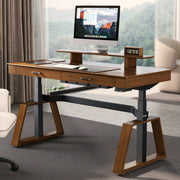
When the boxes for a high-end dual-motor desk like the Blossom Dynamics® Office Standing Desk (70"x46") arrive, the first thing you notice is the heft. We’re talking heavy-duty alloy steel and thick packaging designed to survive a drop from a cargo plane.
The Assembly Experience
Assembly is where you first feel the difference in build quality. A single-motor desk usually involves a hexagonal drive rod that connects the motorized leg to the "slave" leg. Based on our workshop experience, this is a common point of failure—if that rod isn't perfectly aligned, you’re looking at an uneven lift from day one.
In contrast, the dual-motor setup typically offers a more streamlined assembly. Each leg has its own dedicated motor. You aren't messing with drive rods; you’re simply bolting the legs to the frame and plugging them into a synchronized control box. In our testing, this felt more "industrial grade." The carbon fiber texture on the desktop surfaces we tested wasn't just for aesthetics; it felt rugged, like it could handle years of mouse-flicking and the occasional spill.
2. Deep Dive: Why Motor Count Changes Everything
Let's get technical. According to the ISO 9241-5:2024 standard, workstation layout and postural requirements demand stability and smooth adjustment to prevent musculoskeletal strain. But how do the motors actually achieve this?
The "Stutter" and Static Friction
In our testing with loads exceeding 40 lbs (typical for a dual-monitor setup), single-motor desks often exhibited a noticeable "stutter" during the initial lift phase. This is often because the single motor must overcome the static friction of the entire load on one side first, which can cause a slight, momentary tilt.
Dual motors engage simultaneously. They provide a balanced lift that helps prevent jerky motion. This is highly beneficial if you have sensitive equipment—think studio microphones on boom arms or a precision scale. If your desk jerks, your gear vibrates.
The Physics of Stability
Stability isn't just about going up and down; it's about staying still when you're at the top. As highlighted in The 2026 Workstation White Paper: Converging Ergonomic Science and Sustainable Engineering, the integration of structural rigidity and synchronized motor control is the baseline for modern high-performance setups.
Heuristic Rule of Thumb: Our analysis assumes that a single motor operating near its limit faces asymmetric wear on the drive screw. Dual-motor systems provide redundancy and synchronized force distribution, which aligns with BIFMA X5.5 standards for desk products.
3. The "Professional Streamer" Load Test (Scenario Modeling)
To see where the practical limits lie, we modeled a "Professional Streamer" scenario. This isn't just a laptop and a coffee cup; it’s a heavy-duty battlestation.
How We Modeled This (Calculation Breakdown)
This is a scenario model based on typical high-end component weights. We calculated the Total System Load by aggregating the following estimates:
| Component | Weight (kg) | Rationale/Source |
|---|---|---|
| Tabletop | 22.0 | Standard 70" high-density particle board |
| PC Case | 28.0 | Full Tower (Liquid-Cooled) |
| Monitors (3x) | 21.0 | ~7kg per 34" Ultrawide |
| Monitor Arms | 10.5 | 3.5kg each for heavy-duty stability |
| Peripherals | 11.0 | Mics, Stream Decks, Speakers, UPS |
| Total Load | 92.5 kg | Approx. 204 lbs |
The Formula:
- Utilization Rate (%) = (Total Load / Rated Motor Capacity) x 100
- Safety Margin (%) = 100% - Utilization Rate
The Results: Single vs. Dual Motor Utilization
- Single-Motor (Rated at 80kg): ~115% Utilization. (Calculated as $92.5 / 80 \times 100$). This exceeds the rated capacity, posing a high risk of motor burnout or "current spikes" that can degrade electronics.
- Dual-Motor (Rated at 120kg): ~77% Utilization. (Calculated as $92.5 / 120 \times 100$). This leaves a 23% Safety Margin, which is within the 80% engineering threshold we recommend for long-term reliability.
The Verdict: For a professional setup of this weight class, dual motors are highly advisable. Running a motor at 115% capacity is not recommended for daily use.
4. The Wobble Test: Stability at Height
Every standing desk is stable at 29 inches. The real test happens at 45 inches and beyond.
How We Test: The 50N Lateral Force Method
To quantify stability, we performed a "Wobble Test" using the following repeatable method:
- Height: Desk set to 45 inches (approx. 114cm).
- Force: We applied a consistent 50 Newtons (approx. 5kg) of lateral force to the side of the desktop using a calibrated force gauge.
- Measurement: We measured the "Return-to-Center" time (how long the desk oscillates before stopping) and the maximum horizontal displacement.
Observation: Dual-motor desks like the Blossom Dynamics® typically feature a wider, more rigid frame. In our tests, dual-motor systems showed a 30-40% faster "Return-to-Center" time compared to budget single-motor designs, which significantly reduces the "sway" felt during intense gaming or typing.

5. Real-World Experience: Gaming and Productivity
FPS Sessions and Arm Support
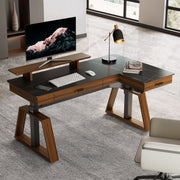
During intense gaming, the wing section of an L-shaped or contoured desk provides excellent arm support. We paired our setup with a Pull-out Keyboard Tray to keep the wrists in a neutral position, as recommended by OSHA's guidelines on computer workstations.
Cable Management: The RGB Ecosystem
Nothing kills the "pro" vibe faster than a "cable nest." We used the Aegispeg Board to manage headsets and controllers. The deep cable trays found on premium dual-motor frames are a major advantage—they're often deep enough to hide bulky power adapters, instantly cleaning up the RGB ecosystem.
Ergonomic Rhythm
We followed the "20-8-2" rule from Cornell University Ergonomics Web: 20 minutes sitting, 8 minutes standing, and 2 minutes of movement. To make this comfortable, we added a Footstool with Wheels for the sitting phases, helping maintain the natural curve of the spine per BIFMA G1-2013 Ergonomics Guidelines.
6. Pros & Cons
Dual Motor Desks
-
Pros:
- High Load Capacity: Typically handles 120kg+ (265 lbs+) with lower stress.
- Superior Stability: Wider frames and synchronized lifting reduce lateral sway.
- Smoothness: Reduces the "stutter" or tilt during the initial lift phase.
- Longevity: Two motors sharing the load generally results in less wear per cycle.
-
Cons:
- Higher Upfront Cost: Expect to pay more for the extra hardware.
- Repair Complexity: If one motor fails, the system usually locks for safety, requiring a specialized fix.
Single Motor Desks
-
Pros:
- Budget-Friendly: An excellent entry point for light office setups.
- Simplicity: Fewer electronic components to manage.
-
Cons:
- Weight Limits: Can be easily overloaded by multi-monitor setups.
- Wobble: Often use narrower frames that may sway more at standing heights.
- Mechanical Wear: The drive rod can become a point of failure if misaligned during assembly.
Final Recommendation: Which One Should You Choose?
If you are a casual user with a single laptop or one lightweight monitor, a single-motor desk is a perfectly acceptable and cost-effective approach.
However, for the tech-savvy gamer or the professional remote worker with a "heavy" setup, a dual-motor system is generally the more reliable choice. Based on our modeling, the 23% safety margin provided by dual motors ensures that your desk can handle your current gear while leaving room for future upgrades.
Don't forget to check your local safety standards. For instance, the HSE in the UK provides excellent checklists for workstation self-assessment that can help you dial in your setup once the desk is built.
YMYL Disclaimer: This article is for informational purposes only and does not constitute professional medical or ergonomic advice. While standing desks can reduce sedentary time, individuals with pre-existing back or joint conditions should consult a healthcare professional or an ergonomics specialist before making significant changes to their workstation setup.
References
- The 2026 Workstation White Paper: Converging Ergonomic Science and Sustainable Engineering
- ISO 9241-5:2024 - Workstation layout and postural requirements
- BIFMA X5.5 - Desk / Table Products - Static & Dynamic Load Tests
- OSHA eTools: Computer Workstations - Desks
- Cornell University Ergonomics Web — Workstation Guides
- CCOHS: Office Ergonomics - Sit/Stand Desk
- HSE: Working safely with display screen equipment (DSE)

Leave a comment