

2026 New Year Guide: Keyboard Tray for Sit-Stand Efficiency
As we transition into 2026, the resolution to increase professional output often centers on software tools, time-management frameworks, or high-end hardware. However, a significant yet frequently overlooked bottleneck to sustained productivity lies in the physical interface of the workspace. For remote professionals and office-bound experts alike, the start of the year is an opportune moment to address the physiological toll of the modern workday.
The "New Year productivity push" often results in longer hours at the desk, which, without proper ergonomic intervention, translates to an increased risk of Repetitive Strain Injury (RSI) and general Musculoskeletal Disorders (MSDs). While sit-stand desks have become a staple of the healthy office, they only solve half of the equation—the sedentary behavior. They do not inherently solve the problem of "static load" or improper joint alignment. This guide explores why the humble keyboard tray is the critical engineering control required to bridge the gap between a standing desk and true ergonomic efficiency, aligned with the principles detailed in The 2026 Workstation White Paper: Converging Ergonomic Science and Sustainable Engineering.
The Physiology of the "Neutral Reach Zone"
To understand why keyboard placement is vital, one must first understand the concept of the "Neutral Position." According to the U.S. Occupational Safety and Health Administration (OSHA) eTools, a neutral posture is a comfortable working position where your joints are naturally aligned, reducing stress and strain on the muscles, tendons, and skeletal system.
When a keyboard is placed directly on a standard 29-inch high desktop, most users—especially those in the 5th to 50th height percentiles—are forced to "reach up." This elevation causes the shoulders to shrug (trapezius activation) and the wrists to extend upward. Over time, this creates a "static load," a condition where muscles remain contracted without movement, impeding blood circulation and leading to the buildup of metabolic waste products.
The pathophysiological mechanism of MSDs often begins with this restricted blood flow and localized inflammation. According to OSHwiki on Pathophysiological Mechanisms, prolonged static postures can lead to tissue adaptation that increases the risk of chronic pain. By utilizing an under-desk tray, such as the Adjustable Keyboard Tray, users can bring the input devices down to a level that allows the elbows to maintain an open angle of 90 to 120 degrees, effectively dropping the shoulders into a relaxed, neutral state.

The Sit-Stand Paradox: Why a Desk Alone Isn't Enough
A common misconception is that simply switching to a height-adjustable desk eliminates ergonomic risk. While the Cochrane Library’s systematic review confirms that sit-stand desks significantly reduce total sitting time (by approximately 84–116 minutes per day), the transition between sitting and standing often introduces "parallax error" in equipment height.
When you stand, your abdominal muscles engage differently, and your center of gravity shifts. Often, a desk height that feels comfortable for the eyes (monitor level) is too high for the hands. This creates a conflict: do you prioritize neck health by keeping the monitor high, or shoulder health by keeping the desk low?
An ergonomic keyboard tray resolves this conflict by decoupling the height of the keyboard from the height of the monitor. This allows for independent adjustability, a feature identified as a "critical requirement" for 2026 workspace standards. By using a Pull-out Keyboard Tray, you can maintain the monitor at eye level to prevent cervical strain while keeping the keyboard at the "elbow-neutral" height recommended by the BIFMA G1-2013 Ergonomics Guideline.

Technical Calibration: Modeling the Perfect Height
To achieve peak efficiency, one must move beyond "feeling" and utilize a data-driven approach to setup. We have developed a practical model to calculate the ideal keyboard tray position based on common industry heuristics and anthropometric data.
Methodology Note (Logic Summary): This model assumes a standard seated posture with feet flat on the floor. It is designed to minimize ulnar deviation and wrist extension. The values are hypothetical estimates based on the Duke Ergonomics Program standards and are intended for self-check purposes.
Parameter Description Typical Range (in) Rationale $H_{seat}$ Seat height from floor 16 – 21 BIFMA/ISO standard range $H_{elbow}$ Seat to elbow distance 7 – 11 Average adult torso/arm length $H_{kbd}$ Tray height from floor 22 – 29 Target neutral zone $\Delta_{wrist}$ Wrist offset 0 – 0.8 Accounts for keyboard thickness $T_{tilt}$ Negative tilt angle 0° – 15° Reduces carpal tunnel pressure
The Formula for Seated Success: $Target Tray Height = (H_{seat} + H_{elbow}) - \Delta_{wrist}$
In practice, the most common mistake we observe—based on patterns from customer support and warranty inquiries—is setting the keyboard tray too high. This forces the elbows above 90 degrees, leading to persistent shoulder fatigue. A useful heuristic is to first set your chair height so your feet are flat, then adjust the tray so your forearms are parallel to the floor with wrists straight. This often means the tray sits 1–2 inches below the actual desktop surface.
The 2026 Hierarchy of Workspace Optimization
To reach your 2026 productivity goals, your workspace should be viewed through the "Hierarchy of Controls," a framework provided by OSHA for controlling hazards.
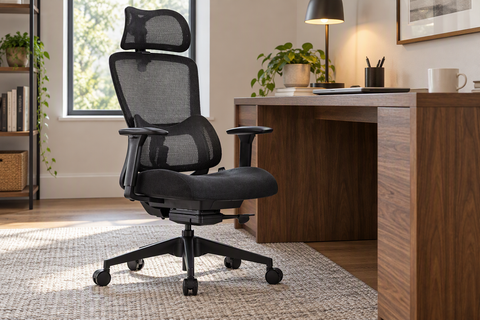
- Engineering Controls (Most Effective): These are physical changes to the workspace. A sit-stand desk combined with an adjustable keyboard tray and a high-performance chair like the Flex, Dual-Backrests Ergonomic Office Chair falls into this category. The Flex chair’s dual backrest design provides targeted lumbar support that adapts to movement, complementing the posture changes enabled by the tray.
- Administrative Controls: These involve changing how you work. This includes the "20-8-2" rule popularized by Cornell University Ergonomics: 20 minutes of sitting, 8 minutes of standing, and 2 minutes of moving/stretching.
- Personal Protective Equipment (PPE): In an office context, this might include wrist rests or blue-light glasses, though these are considered the least effective as they do not remove the underlying postural hazard.
For a comprehensive setup, consider the Lira, Ergonomic Office Chair, which features a mesh design for airflow and 3D armrests. The ability to adjust armrest height is crucial when using a keyboard tray, as the armrests should ideally be level with the tray surface to provide continuous support from the shoulder to the wrist.

Scenario-Based Analysis: Tall vs. Petite Users
Ergonomics is not a "one size fits all" science. The ISO 9241-5:2024 standard emphasizes that workstations must accommodate a wide range of body types.
Scenario A: The 95th Percentile Tall User (~6'2"+) For taller individuals, the primary challenge is legroom. When installing an under-desk tray on a sit-stand desk, ensure the mounting hardware has enough vertical clearance. A common "gotcha" is the tray hitting the user's thighs when seated at the desk's lowest setting. Tall users should look for trays with slim-profile tracks and ensure their chair, such as the Lira, Ergonomic Office Chair, has sufficient seat depth adjustment.
Scenario B: The 5th Percentile Petite User (~5'0") Petite users often find that even at its lowest setting, a standard desk (29 inches) is too high. This leads to "perching" on the edge of the chair or dangling feet, both of which restrict blood circulation. For these users, a keyboard tray is not just an accessory; it is a necessity to bring the working surface down to a reachable 22–24 inches while allowing the feet to remain firmly planted on the floor (or a footrest).
Practical Installation and Usage Heuristics
When optimizing your workspace for the new year, keep these expert-derived heuristics in mind:
- The Negative Tilt Advantage: While most users default to a flat tray, a slight negative tilt (where the front edge is higher than the back) can significantly reduce wrist extension. This is particularly effective for those using mechanical keyboards with a higher profile. However, this adjustment is highly individual and should be tested over 3–5 days.
- Cable Management: Integrated cable channels on the underside of the tray are non-negotiable. For sit-stand efficiency, cables must have enough slack to move with the desk but be secured enough to prevent snags during height transitions.
- Mouse Placement: Ensure the tray is wide enough to accommodate both the keyboard and the mouse on the same level. Reaching up to the desktop for the mouse while the keyboard is on a tray creates "asymmetrical shoulder loading," a leading cause of mid-back pain.
- Stability Check: A tray that wobbles or bounces during typing will increase muscle tension as the body subconsciously tries to stabilize the surface. Look for heavy-duty steel tracks and locking mechanisms that meet ANSI/BIFMA X5.5 standards.
Building a Sustainable 2026 Workflow
The goal of ergonomic intervention is to create a "frictionless" environment where the physical setup supports, rather than hinders, cognitive performance. By integrating an Adjustable Keyboard Tray into your sit-stand routine, you are applying a high-level engineering control that addresses the root cause of many office-related MSDs.
As you set your productivity goals, remember that the most sophisticated software cannot compensate for a pained body. Investing in foundational pieces—a highly adjustable chair like the Flex and a precision-calibrated keyboard surface—is the most effective way to ensure that your 2026 ambitions are met with the physical resilience they require.
For more detailed insights on building a professional-grade home office, refer to our guide on Setting Up Your Standing Desk for Peak Productivity and explore the benefits of Standing vs. Traditional Desks.
YMYL Disclaimer: This article is for informational purposes only and does not constitute professional medical advice, diagnosis, or treatment. The ergonomic recommendations provided are based on general industry standards and may not be suitable for individuals with pre-existing musculoskeletal conditions or chronic pain. Always seek the advice of a qualified healthcare professional or a certified professional ergonomist before making significant changes to your workstation or work habits, especially if you are experiencing persistent discomfort.
References
- BIFMA G1-2013 Ergonomics Guideline for Furniture
- OSHA eTools: Computer Workstations - Neutral Working Postures
- Cochrane: Workplace interventions for reducing sitting at work
- Cornell University Ergonomics Web — Workstation Guides
- ISO 9241-5:2024 Workstation layout & postural requirements
- Duke Ergonomics Program: Standards and Guidelines for Computer Workstations
- OSHwiki: Pathophysiological mechanisms of musculoskeletal disorders




Leave a comment