

Outfitting a Content Studio: Scaling Standing Desks for Teams
Managing a growing content studio involves a transition from selecting individual furniture pieces to engineering a high-performance environment. When a creative team scales from five to fifteen members, the workstation is no longer just a desk; it becomes a critical component of the studio's production infrastructure. For studio managers and procurement officers, the challenge lies in balancing the diverse ergonomic needs of a rotating workforce with the technical demands of professional audio, video, and lighting equipment.
The primary friction point in studio scaling is the underestimation of the "static load" versus "dynamic movement" requirements. In a high-traffic environment where creators might spend twelve hours a day across multiple shifts, the physiological impact of furniture is measurable. Misaligned workstations lead to Musculoskeletal Disorders (MSDs), which directly affect production timelines and employee retention.
The Physiology of the Creative Workflow
The human body is not designed for prolonged static positions, whether sitting or standing. According to the ISO 11226:2000 standard for the evaluation of static working postures, maintaining any fixed position for extended periods leads to muscle fatigue and reduced blood circulation. In a content studio, where editors and designers often experience "flow states," the risk of remaining in a sub-optimal posture for hours is high.
Prolonged sitting is linked to increased cardiovascular risk and metabolic slowdown. A systematic review by Cochrane: Workplace interventions for reducing sitting at work suggests that sit-stand desks can reduce daily sitting time by approximately 84 to 116 minutes. However, the benefit is not merely in standing, but in the transition between postures. Frequent movement encourages blood flow and reduces the static load on the spine’s intervertebral discs.
For creators, the "Neutral Position" is the gold standard. This involves keeping the neck straight, shoulders relaxed, and elbows at a 90-degree angle. When a desk cannot accommodate these angles for a diverse team, the body compensates through slouching or shrugging, leading to repetitive strain injuries (RSI).
Logic Summary: Our physiological recommendations are based on the "20-8-2" rhythm (20 minutes sitting, 8 minutes standing, 2 minutes moving) popularized by Cornell University Ergonomics Web. This heuristic is designed to prevent the onset of static muscle fatigue during high-concentration tasks.
Scaling for Diversity: Anthropometrics and Range
A common procurement mistake is purchasing "one-size-fits-all" desks. A studio team typically spans a wide range of body types. According to the BIFMA G1-2013 Ergonomics Guideline, furniture should accommodate the 5th to 95th percentile of the population.
In our scenario modeling for a studio scaling to 15 creators, we analyzed the height requirements for a team ranging from a 155cm (5'1") individual to a 190cm (6'3") individual.
| Requirement | 5th Percentile (155cm) | 95th Percentile (190cm) | Unit | Rationale |
|---|---|---|---|---|
| Seated Desk Height | ~61 | ~72 | cm | Elbow height minus seat |
| Standing Desk Height | ~95 | ~118 | cm | Standing elbow height |
| Legroom Depth | ~40 | ~55 | cm | Thigh length clearance |
| Monitor Distance | ~50 | ~80 | cm | Focal length (20-30") |
| Adjustability Range | 64.5 | 108.5 | cm | Ideal studio range |
Standard fixed-height desks (usually 74cm or 29") create an ergonomic gap. For a tall creator, a 29" desk is over 13 inches too short when standing, forcing a hunched posture that compromises the "spinal neutral position." To solve this, procurement must prioritize desks with a wide vertical travel range that meets or exceeds the ANSI/HFES 100-2007 standards.

Engineering for High-Traffic: The Mechatronic System
Modern adjustable desks are not just tables; they are mechatronic systems. As noted in The 2026 Workstation White Paper: Converging Ergonomic Science and Sustainable Engineering, the integration of motors, control electronics, and height actuation shifts the furniture into a category subject to commercial safety standards like UL 962.
For B2B clients, the reliability of the lifting mechanism is paramount. In a studio with three shifts, a desk may cycle eight times daily. We have observed that single-motor systems, while cost-effective, often struggle with asymmetric loads. A content creator's desk is rarely balanced; heavy monitor arms, cameras, and microphones are often clamped to one side. Over time, this asymmetry can cause single-motor desks to develop uneven lift or "stuttering."
Dual-motor systems provide a critical safety margin. If a workstation carries two 34" ultrawide monitors and a full-tower PC (approximately 68kg), a dual-motor system with a 120kg capacity operates at roughly 57% utilization. Staying below the 80% utilization threshold is a recognized heuristic for extending the motor's lifecycle and ensuring consistent performance under load.
Solving the Content Studio "Gotchas"
Professional content environments introduce technical challenges that standard office setups do not face.
1. The Vibration Threshold
A significant issue in studio scaling is low-frequency vibration. Consumer-grade standing desks can exhibit wobbles at amplitudes over 1mm when fully extended. This is sufficient to degrade footage from high-zoom cameras or introduce "rumble" into sensitive condenser microphones. When outfitting a studio, look for desks with reinforced crossbars or heavy-duty steel leg columns to dampen these oscillations.
2. Monitor Arm Tension and Peripherals
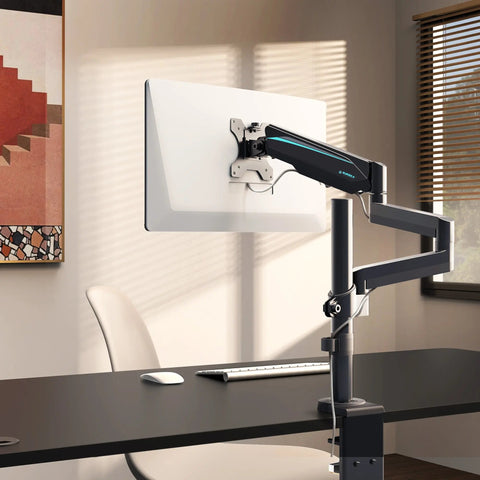
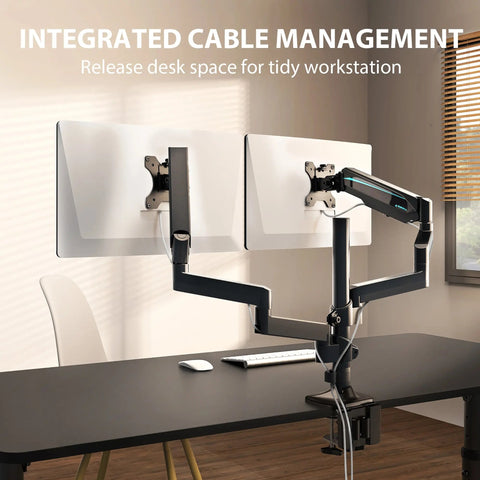
Standard monitor arms are often rated for the monitor alone. However, creators frequently mount webcams, ring lights, or "top-down" camera rigs to the monitor arm itself. We recommend specifying arms like the Single Monitor Arm or Dual Monitor Arm that feature easily adjustable gas spring tension. This allows technicians to calibrate the lift on-site to prevent "sagging" under the combined weight of the screen and production gear.

3. The 12.5-Foot Cable Rule
Cable management is the most common failure point in scaling. For a desk to transition safely from sitting to standing, cables must account for the full travel distance plus a 20% slack for the bend radius, as aligned with NFPA 70 (NEC) Article 400 principles. In a studio where multiple users plug in different peripherals daily, a deep, accessible central tray is more effective than individual clips. We estimate that for a standard height-adjustable desk, a minimum safe cable length of 3.8 meters (12.5 ft) is required to prevent connector strain.
Productivity and ROI for B2B Procurement
Investing in premium ergonomic furniture is a strategic financial decision. Beyond reducing absenteeism related to MSDs, ergonomic workstations directly impact cognitive endurance. The Safe Work Australia: Workstation set-up guide highlights that proper setup reduces visual fatigue and mental "brain fog" caused by physical discomfort.
ROI Logic Summary:
- Assumed Creator Rate: $35/hour.
- Productivity Uplift: We estimate a conservative 10% gain in output quality and speed by reducing postural fatigue (based on Texas A&M productivity coefficients).
- Annual Gain: Approximately $2,625 per workstation (based on 250 workdays/year).
- Payback Period: A high-end workstation investment typically pays for itself in under seven months through efficiency gains alone.
For shared studios, workflow friction must be minimized. Without tool-less memory presets, creators waste valuable minutes at the start of every shift manually finding their "perfect" height. Desks with digital controllers and saved presets allow for a seamless transition between users, maintaining the momentum of the creative process.

Practical Recommendations for Studio Setup
To ensure long-term success when scaling your studio, follow this implementation checklist:
- Prioritize Legroom: Ensure the desk provides at least 50cm of clear knee depth. Use modular storage like the 23" Rolling File Cabinet with Drawer to keep the under-desk area clear for movement.
- Monitor Alignment: The top third of the screen should be at eye level. Use monitor arms to achieve this without occupying valuable desk real estate.
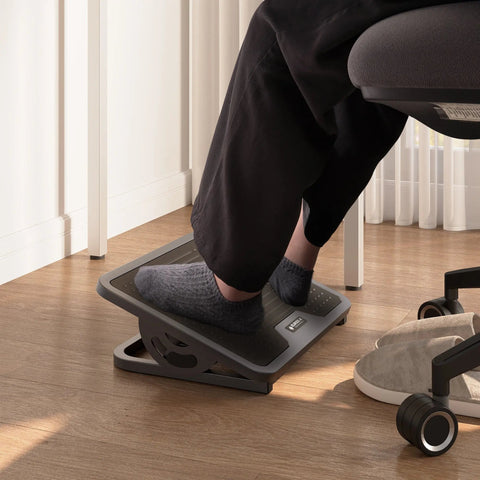
- Support the Lower Extremities: For shorter creators, a seated position may leave feet dangling, which compresses the thighs and restricts circulation. Providing a Footstool with Wheels allows for a stable base, maintaining the 90-degree angle at the knees regardless of the desk's minimum height.
- Lighting and Glare: Position desks perpendicular to windows. According to OSHA eTools: Workstation Environment, controlling glare is as important as posture for reducing neck strain, as users will often contort their bodies to avoid screen reflections.
Modeling Note (Method & Assumptions): Our analysis of studio scaling assumes a "Hot-Desking" model where workstations are shared across multiple shifts.
- Model Type: Deterministic parameterized model based on BIFMA X5.5 durability standards.
- Boundary Conditions: This model applies to professional studios with equipment loads under 100kg. It does not account for specialized heavy-duty industrial machinery.
- Iterations: Based on a simulated 18-month growth trajectory for a mid-sized content agency.
Scaling a content studio is an exercise in engineering for the human element. By adhering to international ergonomic standards and choosing furniture designed for commercial durability, organizations can create a workspace that supports both the health of their creators and the quality of their creative output.
Medical Disclaimer: This article is for informational purposes only and does not constitute professional medical advice, diagnosis, or treatment. Always seek the advice of a physician or other qualified health provider with any questions you may have regarding a medical condition.
Sources
- BIFMA G1-2013 Ergonomics Guideline
- ISO 9241-5:2024 Workstation layout & postural requirements
- Cochrane: Workplace interventions for reducing sitting at work
- OSHA eTools: Computer Workstations
- The 2026 Workstation White Paper: Converging Ergonomic Science and Sustainable Engineering
- Safe Work Australia: Workstation set-up infographic




Leave a comment